Nashville Predators – Predator Smash

Throughout the year, the Sip Advisor will alphabetically travel the National Hockey League (NHL), discovering the best and worst each team has to offer in a variety of subjects. We will also feature a drink based off the franchise. Today, we travel to Nashville, or as the local hockey fans know it, Smashville, for an in-depth look at the Predators:

Establishment Story: The Predators joined the NHL as an expansion team in 1998. Previously, Nashville had almost become the home of a relocated New Jersey Devils, but that deal fell through. After the team’s logo was revealed, a naming competition commenced, with options being Ice Tigers, Fury and Attack. One final alternative was submitted by owner Craig Leipold, that being the eventual winner Predators.

Stanley Cups: The Predators have never won the Stanley Cup, but did appear in the 2017 Stanley Cup Finals versus the Pittsburgh Penguins, losing in six games. Aside from 2017, Nashville has only advanced as far as the second round, which they have achieved four times. The Predators have qualified for the playoffs 15 times over their 24 seasons in existence.

Celebrity Fan: Due to Nashville’s music scene, many artists of the area have become supporters of the Predators. This includes Keith Urban and wife Nicole Kidman, Carrie Underwood (who is married to former Predator Mike Fisher), Vince Gill, Dierks Bentley, and Shania Twain. This has made life very easy on whoever has to book musical acts for between periods or national anthem duties.
Smashville

Super Fan: Section 303 of Bridgestone Arena, affectionately known as The Cellblock or Cellblock 303, has been called “the loudest section of the loudest arena in the NHL”. The fan club dates back to the days of the Nashville Knights (1989-96) minor league team. Some popular members included Eudora Hunter, an 82-year-old woman who held up funny signs to the delight of other fans, and Ben ‘Big Ben’ Butzbach, who painted various images on his stomach. Sadly, both fans have passed away.

Mascot: Gnash is a sabre-toothed tiger, the animal being selected because the partial skeleton of one was found during excavation of the First American Cave in Nashville in 1971. Based on this story, it’s said that Gnash was discovered frozen in ice, while crews were building the Nashville Arena, today’s Bridgestone Arena. The frozen cat thawed and disappeared, re-emerging to debut with the Predators in 1998.

Tradition: Adapting the Detroit Red Wings tradition of throwing octopi onto the ice, Predators fans have been known to toss catfish from the stands, first occurring on October 30, 2003. Fans are also known to display their Fang Fingers, either foam gloves or curled index and middle fingers, which they use in a biting motion to sounds from the movie Psycho, prior to Predators power plays.

Appearances in Media: The Predators were the 2022 feature team in the NHL Network’s Behind the Glass series, which documents the chosen franchise’s training camp. This was the third installment of the all access series, with other teams followed being the New Jersey Devils in 2018 and Philadelphia Flyers in 2019. No team was highlighted in 2020 or 2021, due to the pandemic. Four episodes aired in fall 2022, with footage including Nashville starting their season with games in Prague, Czechia.
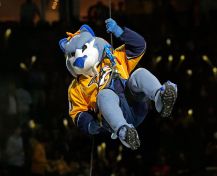
Gnash

Events/Scandals: On June 16, 2018, Predators forward Austin Watson was arrested following a domestic incident. He would plead no contest to a charge of domestic assault and be sentenced to one year probation and attending a batterer intervention course. The NHL suspended Watson for the 2018 pre-season and 27 regular season games (reduced to 18 by an arbiter) for unacceptable off-ice conduct. Watson didn’t rejoin Nashville until March 25, 2019, following time in the league’s substance abuse program.

Rivalry: The Predators greatest feuds have occurred against fellow long-time Central Division opponents, such as the Chicago Blackhawks, Minnesota Wild and St. Louis Blues. Nashville also had decent rivalries with the Detroit Red Wings and Columbus Blue Jackets, but those have dissipated to some degree, as both teams were moved into the Eastern Conference during the 2013 divisional realignment.

Tragedy: Wade Belak played the final three seasons of his NHL career with the Predators. When he retired in 2011, he remained with the franchise in an organizational role. Sadly, on August 31, 2011, Belak was found dead in his Toronto hotel room, where he was to take part in the hockey/figure skating crossover reality TV series Battle of the Blades. Belak’s cause of death was never officially released, but it was treated as a suicide by hanging.

Player Nicknames: Two of Nashville’s top goalies of all-time have memorable handles, including Pekka Rinne being known by teammates as Chief, while his incumbent Juuse Saros has been dubbed Juice. Also, 6’6” fourth-liner Michael McCarron has been the recipient of two wrestling-themed monikers while a member of the Predators organization. First, he was known as Big Show with the minor league Milwaukee Admirals, followed by Big Sexy with the big league club.
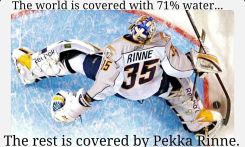
Pekka Rinne

Line: The Vowel Line consisted of Martin Erat, Denis Arkhipov and Vladimir Orszagh, for obvious reasons. Some other former top units include Viktor Arvidsson, Ryan Johansen and Filip Forsberg, as well as J.P. Dumont, Jason Arnott and Alexander Radulov. The franchise has always been known for the quality of its defense, with one of their most dominant pairs being Shea Weber and Ryan Suter.

Captain: Speaking of Shea Weber, he was named captain of the Predators on July 8, 2010. He served in the role for six seasons, before his shocking trade to the Montreal Canadiens in the 2016 off-season. Fellow blueliner Roman Josi is the team’s current leader and going into the next season, will surpass Weber as the franchise’s longest-serving captain. With Josi under contract until 2027-28, he should set a new standard of leadership within the organization.

Enforcer: Jordin Tootoo was a fan favourite for Predators supporters during his eight seasons with the team. The first Inuit person to play a regular season NHL game, Tootoo holds the all-time franchise record for penalty minutes with 725. Nicknamed the Tootoo Train for his devastating hits, Tootoo could also be relied upon to help on the scoresheet, putting up 30 points in his final campaign in Nashville. After retiring in 2018, Tootoo was invited to return to Nashville for Jordin Tootoo Night on February 2, 2019.

Family Values: Brothers Andrei and Sergei Kostitsyn played a portion of one season together with the Predators. They had previously also suited up together with the Montreal Canadiens. Andrei returned to play in Europe in 2012, following a curfew issue during the previous playoffs. Sergei lasted one more season, before his contract was mutually terminated and he too was Europe bound. The brothers were the first Belarussian siblings to play in the NHL.

Shea Weber

Returning Players: Two back-to-back first round Nashville draft picks started and ended their careers there, with gaps in between. Forward Scott Hartnell was drafted 6th overall in 2000, playing six seasons with the Predators. Hartnell closed his career with a final season in Smashville in 2017-18. Defenseman Dan Hamhuis, drafted 12th overall in 2001, played eight seasons with the organization, returning for two campaigns from 2018 to 2020.

Short Stint: Peter Forsberg’s tenure with the Predators lasted all of 22 games. He was brought in prior to the 2007 trade deadline, in exchange for the hefty price of Scottie Upshall, Ryan Parent and first- and third-round draft picks. While he was productive, scoring 19 points in those games, the Predators were eliminated in the first round of the playoffs. Forsberg then contemplated retirement, returning to the Colorado Avalanche for nine games the next season.

Undrafted: Vernon Fiddler was signed by the Predators on May 6, 2002, after playing with their American Hockey League affiliate, the Norfolk Admirals, as a free agent. He would debut with the big club in November 2002 and become a fixture of the roster from 2006 to 2009. Fiddler played the final 20 games of his career with Nashville, finishing with 877 games played, 104 goals and 157 assists.

Trade: One of the most lopsided deals in NHL history saw the Predators trade Martin Erat (along with Michael Latta) to the Washington Capitals for top prospect Filip Forsberg at the 2013 trade deadline. Erat was practically useless for the Capitals, while Forsberg became a star with Nashville. Forsberg is already the Predators all-time leading goal scorer and entered the 2022-23 season with an eight-year contract extension.

Filip Forsberg

Signing: Among the better deals the Predators have signed, include Paul Kariya (two-year, $9 million in 2005) and Jason Arnott (five-year, $22.5 million in 2006). As for one that didn’t turn out so well, was Matt Duchene’s seven-year, $56 million pact in 2019. Duchene, an avid country music fan, was bought out of the last three years of his deal in the 2023 off-season, leaving the Predators with a payout of $9.33 million over six years.

Draft Pick: The highest the Predators have ever picked was second overall, using their first ever selection on David Legwand in 1998. The team has made some amazing second round choices, stealing future captains Shea Weber in 2003 and Roman Josi in 2008. Nashville has also done well drafting goalies in later rounds, taking current netminder Juuse Saros 99th overall in 2013 and all-time backstop stat leader Pekka Rinne 258th overall in 2004.

Holdouts: While the Predators have had no contract impasses over their history, it should be noted that Nashville prospect Jimmy Vesey (drafted 66th overall in 2012) refused to sign with the team. This meant he would become a free agent in the 2016 off-season, as teams have four years to sign a college draft pick. To settle the dispute, the Predators traded Vesey’s rights to the Buffalo Sabres, but he still elected to become a free agent and eventually signed with the New York Rangers.

Buyouts: Center Kyle Turris was a key component of a 2017 three-way trade between the Predators, Colorado Avalanche and Ottawa Senators, signing a contract extension with Nashville immediately following the swap. However, on October 7, 2020, the Predators bought out the remaining four seasons of that six-year, $36 million contract. Nashville would have to pay Turris $16 million over the next eight years, while Turris would play 50 more NHL games over two seasons with the Edmonton Oilers.
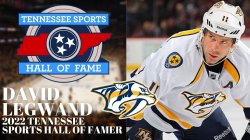
David Legwand

Unique Game: In 2000, the Predators faced the Pittsburgh Penguins for a pair of regular season games in Saitama, Japan. In more recent years, they’ve participated in other high-profile league spectacles, such as the 2020 Winter Classic versus the Dallas Stars, a 2022 Stadium Series game against the Tampa Bay Lightning and were part of the 2022 Global Series, opening their campaign with two matches versus the San Jose Sharks in Prague, Czechia.

Goal: One of the greatest feats in hockey is for a goalie to score a goal. Predators legend Pekka Rinne did just that on January 9, 2020, firing a puck into the empty net of the Chicago Blackhawks, en route to a 5-2 victory. The win was also the first for coach John Hynes behind the Nashville bench. Fellow Predators netminder Chris Mason was also credited with a goalie goal in 2006, but that was the result of an own goal by the Phoenix Coyotes.

Fight/Brawl: Although not a traditional rival, the Predators and Winnipeg Jets have shared the same division since 2013. In the 2017 playoffs, the Predators defeated the Jets in seven games and for the teams first meeting since the elimination, in October 2018, tempers boiled over quickly, resulting in a line brawl. 76 penalty minutes were handed out in the contest, with a lopsided 60 going to Winnipeg. Nashville won the game 3-0.

Injury: In an unfortunate incident of friendly fire, when Jason Arnott scored the winning goal of Game 3 of the first round of 2008 playoffs against the Detroit Red Wings, teammate Alexander Radulov jumped on him in celebration. The resulting fall led to Arnott receiving a concussion and missing much of the rest of the playoffs. Nashville lost the series in six games, playing the final two contests without their captain and regular season scoring leader.

Pekka Rinne Goal

Penalty: Jordin Tootoo was suspended a couple times during his Nashville tenure, including five games in 2007 for a sucker punch to Stephane Robidas (which resulted in a concussion) of the Dallas Stars and two games in 2011 for charging Buffalo Sabres goalie Ryan Miller. It was Miller’s first game back after being hit by Boston Bruins power forward Milan Lucic three weeks earlier, which caused many around the NHL to call for changes to that part of the game, including Predators GM David Poile.

Wildest Story: During the 2012 playoffs, Predators forwards Alexander Radulov and Andrei Kostitsyn were spotted in a Scottsdale, Arizona bar at 5:00 am, the morning of Game 2 of Nashville’s series against the Arizona Coyotes. This violated team curfew and both players were suspended for that night’s contest. Radulov had just returned to the organization after four seasons in Russia. When his contract expired following the team’s elimination by the Coyotes, Radulov returned to Russia for another four years.

Blooper: During a November 2011 game against the Toronto Maple Leafs, winger Craig Smith looked to seal the win for the Predators with an empty net goal. He was alone on a breakaway and nobody had any chance of stopping him. The horn inside Bridgestone Arena went off and everyone assumed Smith had scored… except he had tried to shoot the puck into the top of the net and had completely put it over the net and into the stands instead. Thankfully, Nashville still emerged with a 4-1 victory.

Miscellaneous: When NHL jobs seem to have short shelf lives, it’s amazing that Predators GM David Poile guided the franchise from its earliest days until retiring after the 2023 NHL draft. Poile owns the record for most wins as a GM, finishing his executive career with 1,533 victories. He won the NHL General Manager of the Year award in 2017 and outside of the NHL, Poile also oversaw the 1998 and 1999 USA World Championship teams, as well as the American 2014 Olympics squad.

Nashville Predators: Predator Smash
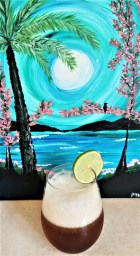
Predator Smash

  • 2 oz Bourbon
  • Top with Iced Tea
  • Blend with Ice
  • Splash of Lemon-Lime Soda
  • Garnish with a Lime Slice

This frozen drink was served for a time at Bridgestone Arena. While it didn’t come with a name when I found it, I’ve dubbed the beverage myself. I vowed to use my Margaritaville blender more this summer, so this was a good recipe to start with.

Colorado Avalanche – Avalanche Shot

Throughout the year, the Sip Advisor will alphabetically travel the National Hockey League (NHL), discovering the best and worst each team has to offer in a variety of subjects. We will also feature a drink based off the franchise. Today, we may need some oxygen, as we visit the high altitudes of Colorado and try to survive the Avalanche:

Establishment Story: What is now the Colorado Avalanche began as the Quebec Nordiques, one of the original franchises of the World Hockey Association (WHA) in 1972. The Nordiques joined the NHL in 1979, as part of the NHL-WHA merger. The franchise was sold and relocated to Denver, Colorado in 1995 and renamed the Avalanche. Other possible names for the team included Extreme, Blizzards and Black Bears.

Stanley Cups: The Avalanche won the Stanley Cup in their first year in Colorado, helped along by the Avalanche picking up Patrick Roy from the Montreal Canadiens, a double shot at the province of Quebec. The team reached the league pinnacle again in 2001 and 2022, totalling three Stanley Cups. They have won each of their Stanley Cup Finals appearances. As the Nordiques, the franchise also won one WHA Avco Cup in 1977.

Celebrity Fan: South Park creators Trey Parker and Matt Stone are Avalanche supporters, as both grew up in Colorado. Another famous fan of the team is baseball Hall of Fame member Larry Walker, who played for the Colorado Rockies for 10 seasons. Walker, a Canadian who grew up also playing hockey, was honoured by the Avalanche for his 2020 Hall of Fame election by being named the team’s honourary emergency back-up goalie for a game.

Nordiques

Super Fan: During the Avalanche’s Stanley Cup-winning 2022 season, one fan was banned from the team’s home games, but it was for a somewhat noble reason. Ryan Clark was caught throwing a small bag of his friend’s ashes onto the ice during a January 8, 2022 contest. The friend was Kyle Stark, a die-hard Avalanche supporter, who died unexpectedly the previous December. Clark admitted the tribute may not have been the best idea, but had no regrets.

Mascot: Bernie the St. Bernard debuted on October 3, 2009, replacing Howler the Yeti, who was retired in 1999 after an issue with an opposing team fan. Bernie wears jersey #1, with a bone used to make the number. The Nordiques mascot was Badaboum, who first appeared for the Rendez-vous ’87 series between NHL All-Stars and the Soviet National Team in Quebec City. Badaboum was a furry blue creature, similar to a seal.

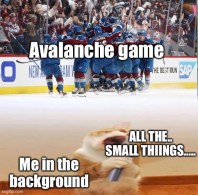
Tradition: For the past few seasons, the Avalanche have used the Blink-182 song All the Small Things as a theme song. For a portion of the track, the audio is cut off, so fans can sing the parts themselves. As the Avalanche made their run to the 2022 Stanley Cup, the tradition was often highlighted by the media. Blink-182 lead singer Mark Hoppus joined the team as they raised the Stanley Cup banner, leading the crowd in a rendition of the tune.

Appearances in Media: In the South Park episode Stanley’s Cup, Stan Marsh is forced to coach a kid’s hockey team, parodying The Mighty Ducks movie. When Marsh’s team is invited to play during the intermission of a Colorado Avalanche-Detroit Red Wings game, the other peewee team no-shows. As consolation, the Avalanche let Marsh’s team play the third period against Detroit, where they get absolutely annihilated, losing 32-2.

All the Small Things

Events/Scandals: Avalanche goalies have a history of being arrested for domestic violence. First, in October 2000, Patrick Roy was detained after an argument with his wife. His case was later dismissed for not meeting the standard of criminal mischief. 13 years later, Semyon Varlamov was arrested and charged with the misdemeanor assault of his girlfriend. The charges were dropped when prosecutors couldn’t prove their case.

Rivalry: As the Quebec Nordiques, the team had a long-standing feud with provincial rivals the Montreal Canadiens, known as the Battle of Quebec. The teams met in the playoffs five times and even battled over TV rights. As for the Colorado Avalanche, their greatest battles occurred with the Detroit Red Wings, as the two teams battled for Western Conference and league supremacy in the late 1990s.

Tragedy: Peter McNab was the color analyst for the Avalanche from their debut in 1995 up until his death from cancer on November 6, 2022. He was 70 years old. McNab played in the NHL for 14 seasons, before moving into the broadcast booth, first with the New Jersey Devils. For all of his contributions to the game, McNab was inducted into the U.S. Hockey Hall of Fame in 2021.

Player Nicknames: Two of the Avalanche’s most legendary players also have the most memorable nicknames in team history. Joe Sakic was known as Mr. Clutch throughout his long tenure with the franchise, always coming up big when it mattered most. Sakic’s former teammate, Peter Forsberg, was dubbed Peter the Great, a nod to the Tsar of Russia from 1682 to 1721.

Joe Sakic

Line: Colorado’s dominant top line over the last few seasons has consisted of Gabriel Landeskog, Nathan MacKinnon and Mikko Rantanen. The trio has piled up points since being combined and were integral members to the Avalanche winning the 2022 Stanley Cup. Two other notable lines were comprised of Alex Tanguay and Milan Hejduk on the wings, with Joe Sakic or Peter Forsberg at center, for the JAM Line and AMP Line, respectively.

Captain: After serving as the Nordiques co-captain for the 1990-91 season, Joe Sakic was named the permanent captain for the 1992-93 campaign and held the mantle through to his retirement in 2009. Another enduring captaincy is that of Gabriel Landeskog, who was the youngest NHL captain ever, when he began his term in 2012. Landeskog is still the team’s captain to this day.

Enforcer: Nicknamed ‘The Sheriff’, Scott Parker patrolled the ice for the Avalanche for 237 games, over two separate stints. During his time with the franchise, Parker tallied 538 penalty minutes, to go along with five goals and 11 assists. Parker was a member of the Avalanche’s 2001 Stanley Cup championship team, suiting up for four games of the team’s playoff run.

Family Values: The Stastny brothers (Peter, Marian and Anton) starred for Quebec through the early 1980s, piling up points as the team’s top line. The Nordiques even helped the brothers defect from Czechoslovakia to play hockey in Canada, a move which opened the door for other Iron Curtain players to follow. Later, Paul Stastny, son of Peter, was drafted by Colorado, playing eight seasons with the Avalanche.

Stastny

Returning Players: Peter Forsberg played 10 seasons for the Nordiques/Avalanche franchise, before moving on to the Philadelphia Flyers and later Nashville Predators. He then sat out most of the 2007-08 season, recovering from foot surgery, before rejoining the Avalanche for nine games. After two seasons in Sweden, Forsberg attempted an NHL comeback with Colorado, but only lasted two games, citing his chronic foot issues as a reason for his retirement.

Short Stint: When Paul Kariya and Teemu Selanne came to the Avalanche for the 2003-04 season, the reunion of the two star players was supposed to bolster an already strong team. Kariya and Selanne both underperformed, though, and Colorado was eliminated from the playoffs in the second round. Following the 2004-05 NHL lockout, Kariya would sign with the Nashville Predators, while Selanne returned to the Mighty Ducks of Anaheim.

Undrafted: Peter Stastny’s Hall of Fame career began by fleeing Czechoslovakia with his pregnant wife, assisted by Nordiques President and CEO, Marcel Aubut. Stastny dominated the NHL upon arrival, breaking the record for most points in a season by a rookie, including a two consecutive game effort of seven goals and seven assists. Stastny would also play with the New Jersey Devils and St. Louis Blues over 15 seasons.

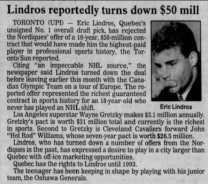
Trade: The greatest move the franchise ever executed was sending Eric Lindros to the Philadelphia Flyers for a massive package of assets. This included Peter Forsberg, Ron Hextall, Steve Duchesne, Mike Ricci, Kerry Huffman, Chris Simon, two first round draft picks and $15 million. While Lindros was a dominant player in the league for a time, the Avalanche would go onto win two Stanley Cups during Lindros’ career.

Forsberg

Signing: In 2019, the Avalanche took an $850,000 chance on forward Valeri Nichushkin, who was coming off being bought out by the Dallas Stars, following a season where he failed to score over 57 games. Nichushkin rebounded with Colorado, finding the form that made him the 10th overall pick of the 2013 draft. In 2021-22, Nichushkin recorded 25 goals and 27 assists, as well as contributing 15 points in the team’s Stanley Cup victory. This resulted in an eight-year, $49 million contract extension.

Draft Pick: The Nordiques/Avalanche have done very well with the first overall selection, including three consecutive top choices from 1989 to 1991 (Mats Sundin, Owen Nolan and Eric Lindros). The franchise also selected Nathan MacKinnon first overall in 2013. Additionally, choosing defenseman Cale Makar at fourth overall in 2017 may go down as one of the greatest draft steals of all-time.

Holdouts: Going into the 1991 NHL Entry Draft, Eric Lindros and his camp made it clear he would not play for the Nordiques, despite them owning the first overall selection and Lindros being the clear cut favourite to be picked. The Nordiques took Lindros anyway, resulting in the player refusing to put on the team’s jersey. At the 1992 NHL Entry Draft, the Nordiques traded Lindros to the Philadelphia Flyers, ending the impasse.

Buyouts: Three years in a row, from 2016 to 2018, the Avalanche used buyouts on aging defensemen, ending the Colorado tenures of Brad Stuart, Francois Beauchemin and Brooks Orpik in subsequent seasons. The Stuart buyout cost the team $2.4 million, while the Beauchemin and Orpik releases cost $3 million each. Orpik’s buyout came just weeks after he was traded to the Avalanche, allowing him to return to the Washington Capitals on a cheaper deal.

Lindros

Unique Game: From 1997 to 2016, the Avalanche played a pre-season game almost each year, dubbed Frozen Fury, against the Los Angeles Kings in Las Vegas. Colorado also returned to Quebec City for an exhibition game in 2002 against the Montreal Canadiens. The franchise has played a few outdoor games, including the 2016 Stadium Series vs. Detroit Red Wings, 2020 Stadium Series vs. Los Angeles Kings and NHL Outdoors at Lake Tahoe Saturday vs. Vegas Golden Knights.

Goal: Defenseman Uwe Krupp was injured for much of the Avalanche’s inaugural 1995-96 season, returning just in time for the end of the campaign. Good thing, as Krupp would score the winning goal in the third overtime period of Game 4 of the Stanley Cup Finals versus the Florida Panthers, clinching Colorado’s first championship. In doing so, Krupp became the first German-trained player to win the Stanley Cup.

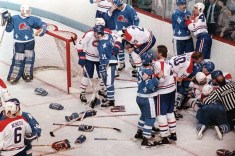
Fight/Brawl: Two of the NHL’s most memorable brawls involved the Nordiques/Avalanche franchise. First, the Good Friday Massacre between the Nordiques and Montreal Canadiens occurred during the 1984 playoffs, resulting in 11 ejections and 252 penalty minutes. Second, the 1997 Brawl in Hockeytown between the Avalanche and Detroit Red Wings was the outcome of tempers boiling over from the previous year’s playoff meeting.

Injury: When the Avalanche played the Vancouver Canucks on March 8, 2004, Colorado’s Steve Moore was a marked man for his previous elbow on Canucks captain Markus Naslund. With the Avalanche up 8-2, Canucks players began targeting Moore, with Todd Bertuzzi punching him from behind. As a result of the punch, the players falling to the ice and a pile up that ensued, Moore suffered three fractured neck vertebrae, a concussion and cuts to his face. This ended Moore’s career and led to a lawsuit settlement.

Good_Friday_Massacre

Penalty: Speaking of the Brawl in Hockeytown, it was all precipitated by Claude Lemieux’s hit-from-behind on Detroit’s Kris Draper in Game 6 of the 1996 Western Conference Finals. Draper ended up with a concussion, broken jaw and shattered cheek and orbital bones. Lemieux was ejected from the contest and subsequently suspended by the NHL for two games.

Wildest Story: Further complicating the Eric Lindros trade saga, the Nordiques had actually arranged two different deals for the coveted player. The other transaction was negotiated with the New York Rangers and an independent arbiter was needed to settle the matter. The Flyers deal was enforced, while the Rangers offer of Tony Amonte, Alexei Kovalev, Sergei Nemchinov, James Patrick, either Mike Richter or John Vanbiesbrouck, multiple first-round draft picks, and $20 million was voided.

Blooper: Patrick Roy was one of the greatest goalies in NHL history, but he is also remembered for this major error, made during the 2002 Western Conference Finals, against the Detroit Red Wings. Roy made a sprawling glove save, but when he went to show off the stop, he dropped the puck, allowing the Red Wings to score. The Avalanche, who were leading the series 3-2, went on to lose this game and the next, with the Red Wings advancing to the Stanley Cup Finals.

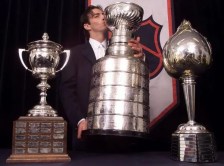
Miscellaneous: Another great trade for the Avalanche, was bringing in defenseman Ray Bourque from the Boston Bruins in 2000. Bourque waited 23 long seasons to finally win the Stanley Cup. When the Avalanche finally did so in 2001, captain Joe Sakic didn’t hesitate to immediately pass the trophy to Bourque, once it was presented to him. The joy and relief on Bourque’s face, as he skated the championship around the ice was evident. This would mark the end of Bourque’s NHL career, going out on top.

Colorado Avalanche: Avalanche Shot

Avalanche Shot

  • 0.75 oz Raspberry Vodka
  • 0.75 oz Blue Curacao

This is the first shooter of the NHL project, as I could find no suitable cocktails. You’re supposed to drop the shot into a glass of Red Bull, but I don’t like working with that ingredient. The colours of the shot replicate Avalanche jerseys hues.

Anaheim Ducks – Triple Deke

Throughout the year, the Sip Advisor will alphabetically travel the National Hockey League (NHL), discovering the best and worst each team has to offer in a variety of subjects. We will also feature a drink based off the franchise. Today, we begin this trek with a look at the Anaheim Ducks. Let’s just see how mighty they are:

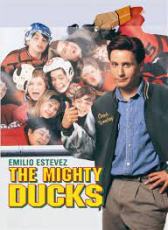
Establishment Story: The Ducks joined the NHL in 1993 as the Mighty Ducks of Anaheim. The expansion team was born from the 1992 Walt Disney Company movie The Mighty Ducks, as Disney looked to expand into the sports ownership world. As of 2005, Disney is no longer behind the franchise and the team has dropped the ‘Mighty’ portion of their moniker, simply going as the Anaheim Ducks.

Stanley Cups: The Ducks lone Stanley Cup came in 2007, when they defeated the Ottawa Senators in five games. They reached the Stanley Cup Finals one other time, losing to the New Jersey Devils in seven games, ending their 2003 Cinderella post-season run. Despite being the Stanley Cup runner up, Ducks goalie Jean-Sébastien Giguère was awarded the Conn Smythe Trophy as the playoffs MVP.

Celebrity Fan: Emilio Estevez, star of The Mighty Ducks movie franchise as coach Gordon Bombay, is a fan of the team his movies are responsible for. Estevez often makes appearances in the Anaheim crowd when the team is in important situations, such as the Stanley Cup Finals. From time to time, Estevez also supports the team on his social media accounts.

Emilio Estevez

Super Fan: Given the Ducks beginnings as a popular movie franchise and its Disney connection, fans of the team stretch far and wide. Season ticket members of the club are known as the Orange Alliance. Among the diehards is Ned Marr, who can be easily recognized for his face and head paint (he’s bald after all), which he first donned during the 2013 playoffs. His popularity even led to appearing in a Papa John’s commercial.

Mascot: Wild Wing made his debut with the rest of the team in 1993. His name was picked through a fan vote and he wears the number 93, referencing the franchise’s founding year. In a case of fiction-inspiring-reality-inspiring-fiction, the character of Wildwing Flashblade from the Mighty Ducks cartoon series is based on Wild Wing the mascot. The Ducks very first game featured a secondary mascot, nicknamed The Iceman, but the electric guitar-playing hype man disappeared soon after.

Tradition: Through all incarnations of the Anaheim franchise, Fowl Towels have been a popular fan item, with folks at games waving the towels to cheer on the squad. The towels were originally white, but are now orange, matching the team’s home jerseys throughout the years. Some Ducks supporters also use duck call devices to root on the club.

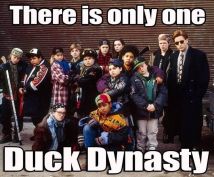
Appearances in Media: The team’s logo and jerseys appeared in the aforementioned Mighty Ducks movie franchise, as well as its spinoff cartoon series. The reboot TV series Mighty Ducks: Game Changers has included cameos from current Ducks players, such as Trevor Zegras, Troy Terry and Max Jones. Lastly, in the first season of TV show Boy Meets World (a Disney production coinciding with the Ducks inaugural season), main character Cory Matthews wears a Mighty Ducks jersey.

Mighty Ducks

Events/Scandals: Bob Murray’s run as the Ducks GM both began and ended abruptly. He took over the role in November 2008, when previous GM Brian Burke suddenly joined the Toronto Maple Leafs. Murray’s term ended almost exactly 13 years later, when he resigned while under investigation by the team for an alleged history of verbal abuse to players and other staff members.

Rivalry: Fellow California-based teams, the Los Angeles Kings and San Jose Sharks, are natural rivals to the Ducks. Anaheim’s feud with Los Angeles is dubbed the Freeway Face-Off. Despite the animosity between the teams and fan bases, the two squads have only met in the playoffs once, with the Kings winning the 2014 series in seven games. The teams have also faced each other for the 2007 NHL Premiere from London and the 2014 Stadium Series at Dodger Stadium.

Tragedy: There are no direct tragedies associated with the Ducks, but fan favourite Ruslan Salei, who played in Anaheim for nine seasons, was among the 44 killed in the September 2011 Lokomotiv Yaroslavl hockey team plane crash. The Belarussian was drafted by the Ducks ninth overall in 1996 and once held the franchise record for games played by a defenceman. Salei’s popularity led to the Honda Center, Anaheim’s home arena, being nicknamed ‘The House that Rusty Built’.

Player Nicknames: Corey Perry’s style of play has earned him two nicknames, one on each end of the spectrum. The first, Scorey Perry, was earned for his scoring prowess, including the career-high 50 he potted in 2010-11, earning him the Rocket Richard and Hart Memorial Trophies. The second, The Worm, comes from Perry’s knack of irritating his opponents.

Corey Perry

Line: Speaking of Corey Perry, his long-time partnership with Ryan Getzlaf led to a lot of success for the Ducks. The duo played together with Dustin Penner as the Kid Line/PPG Line and with Bobby Ryan as the RPG Line. Another very successful pair for the team was Paul Kariya and Teemu Selanne. Their most notable third linemate was Steve Rucchin, a rare player to come to the NHL from the Canadian Interuniversity Sport route.

Captain: Ryan Getzlaf played his entire 17-season career with the Ducks, serving as captain from 2010 until his retirement in 2022. He holds the franchise record for most games played (1,157), points (1,019) and assists (737). Getzlaf was twice nominated for the Mark Messier Leadership Award, but failed to win the trophy. In retirement, Getzlaf is still an active member in the Anaheim community.

Enforcer: While I’d love to put the Bash Brothers (Fulton Reed and Dean Portman) here, from D2: The Mighty Ducks, the honour has to go to Todd Ewen, who holds the franchise records for penalty minutes in a season (285) and in a period (37). Sadly, Ewen commited suicide in 2015, aged 49. He had been suffering from depression for years, with chronic traumatic encephalopathy from his years as a fighter perhaps contributing to his death.

Family Values: Brothers Scott and Rob Niedermayer not only got to play together on the Ducks for four seasons, they got to share winning a Stanley Cup together. It was Scott’s fourth championship – following three with the New Jersey Devils – and Rob’s first. Scott was the team’s captain, while Rob was an alternate. After Scott finished his lap around the ice with the trophy, he passed it to Rob, which Scott described as a highlight of his career.

Ryan Getzlaf

Returning Players: Defenseman Francois Beauchemin had three stints with the Ducks. He was first traded to Anaheim in 2005, being part of the 2007 championship squad. Beauchemin joined the Toronto Maple Leafs as a free agent in 2009, but was traded back to Anaheim in 2011. His final tenure with the team was for the 2017-18 season, which he announced would be his final campaign, retiring as a Duck.

Short Stint: Dany Heatley’s NHL career wrapped up with six games as a member of the Ducks during the 2014-15 season. While playing for the Ducks minor league affiliate, the Norfolk Admirals, Heatley was traded to the Florida Panthers organization, but didn’t get into any games with them, instead playing for their minor league team, the San Antonio Rampage. Heatley then retired from hockey after a season in Germany.

Undrafted: Chris Kunitz was signed by Anaheim as an undrafted free agent in 2003, following being named a finalist for the Hobey Baker Award, given to the top NCAA men’s hockey player. He was actually lost to the Atlanta Thrashers on waivers in 2005, but reclaimed weeks later by the Ducks. Kunitz would go on to be a member of the 2007 Stanley Cup championship team.

Trade: Acquiring superstar Teemu Selanne and pairing him with Paul Kariya was one of the greatest moves in Ducks history. To nab Selanne, the team had to part with two former first round picks in Oleg Tverdovsky and Chad Kilger, but it was certainly worth it. Selanne would return to the club later in his career and be part of the franchise’s only Stanley Cup victory. Selanne holds many of the Ducks offensive records, including regular season goals, power-play goals and game-winning goals.

Teemu Selanne

Signing: The signings of Scott Neidermayer and Teemu Selanne (returning to the club) following the 2004-05 NHL lockout, would eventually lead to winning the 2007 Stanley Cup. On the flip side, the signing of Todd Bertuzzi in 2007 to a two-year, $8 million deal was eventually bought out after one season, as the Ducks had players like Corey Perry they needed to resign and were tight against the salary cap.

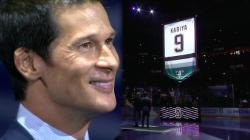
Draft Pick: The Ducks first ever player selection, Paul Kariya at 4th overall in 1993, was a very good one. Kariya became the face of the franchise for its first decade of existence, with his jersey number retired by the team in 2018. The 2003 draft also yielded great results, with Ryan Getzlaf (19th overall) and Corey Perry (28th overall) being chosen. The pair were integral to the Ducks 2007 Stanley Cup win.

Holdouts: When Paul Kariya’s first NHL contract expired in 1997, he and the Ducks failed to agree on a new pact. This led to Kariya missing the first 32 games of the 1997-98 campaign, prior to inking a two-year, $14 million deal. The holdout meant Kariya, a Japanese Canadian, was absent from the lineup as the Ducks and Vancouver Canucks played a pair of games in Tokyo to open the season.

Buyouts: It came as a bit of a shock when Corey Perry was bought out by the Ducks in 2019. Sure, his production had dropped in recent times, but he’d been with the franchise for 14 years. Another interesting case was that of defenseman Simon Després, who was let loose in 2017, with four years remaining on his contract, due to concerns over his concussion history.

Paul Kariya

Unique Game: Aside from the above-mentioned games against Los Angeles (2007 NHL Premiere from London and 2014 Stadium Series) and the Ducks travelling to Japan to open the 1997-98 season against Vancouver, the team has also played in destinations such as and Finland and Sweden (versus the Buffalo Sabres and New York Rangers, respectively), for the 2011 NHL Premiere. Their contests in Tokyo were the first NHL games outside of North America that counted in the league standings.

Goal: Trevor Zegras is known for his high skill level and many highlight real goals. These include his lacrosse-style tally and batting out of the air a Sonny Milano alley-oop pass made over the net from behind it. Zegras’ flair for goal scoring led to him being invited to the 2022 NHL All-Star Game as a special guest to compete in the Breakaway Challenge. He was also made the cover athlete for the NHL 23 video game.

Fight/Brawl: A rather ordinary December 2001 game between the Ducks and the Calgary Flames took a turn late in the third period, when the teams took turns taking runs at each other’s goalies. The result was the last minute and a half featured constant fights off of each faceoff. By the end of the game, only one substitute player remained on each bench, with 309 penalty minutes recorded. A number of players were suspended or fined in the aftermath.

Injury: During the 2003 Stanley Cup Finals, Devils defenceman Scott Stevens caught Paul Kariya with a crushing open ice hit that knocked the Ducks superstar out cold. In the days before concussion protocols, Kariya would return to the game just minutes later and even score a goal. Sadly, in 2011, Kariya would be forced to retire due to post-concussion syndrome and many point to this hit as one that contributed to Kariya’s issues.

Trevor Zegras

Penalty: During a March 2008 game against the Vancouver Canucks, Ducks defenseman Chris Pronger stomped on Ryan Kesler’s leg after the two had become tangled up. While the NHL originally let the incident pass unpunished, further video evidence resulted in an eight-game suspension for Pronger. Although Kesler wasn’t injured on the play, many thought the punishment was light, compared to Chris Simon’s 30-game suspension for a similar incident earlier that season.

Wildest Story: In the summer following Anaheim’s Stanley Cup triumph, Edmonton Oilers GM Kevin Lowe signed emerging forward Dustin Penner to a five-year, $21.25 million offer sheet. Ducks GM Brian Burke responded in the only way a responsible GM should, publically criticizing and name calling his counterpart. This led to the challenge of a barn fight, where a Lake Placid venue was even chosen, before NHL commissioner Gary Bettman stepped in and made sure the bout didn’t happen.

Blooper: Mascots can sometimes be put in dangerous situations, all in the name of getting fans riled up. For the Ducks 1995 home opener pre-game show, Wild Wing was to leap over a wall of fire. While rehearsal apparently went smoothly, when it came time to perform the act live, the mascot fell directly onto the flames. Thankfully, Wild Wing wasn’t harmed in any way and was back to interacting with fans quickly.

Miscellaneous: In the early years of the franchise, Mighty Ducks merchandise sold more than all other NHL teams combined. This was assisted by items being sold at Disney theme parks and in Disney Stores. With Disney World being located in Florida, it’s likely Mighty Ducks items sold better there than their expansion cousin Florida Panthers could ever have imagined for themselves.

Anaheim Ducks: Triple Deke

Triple Deke

  • Muddled Cuccumber
  • 1.5 oz Gin
  • 1 oz Watermelon Liqueur
  • Garnish with Cucumber Slices

This cocktail is an homage to The Mighty Ducks movies, particularly the first film, when the triple deke move is used throughout. The recipe called for Watermelon Syrup to be used, but I elected to add some Watermelon Liqueur to the mix.

October 1 – Slapshot

Hockey Tough

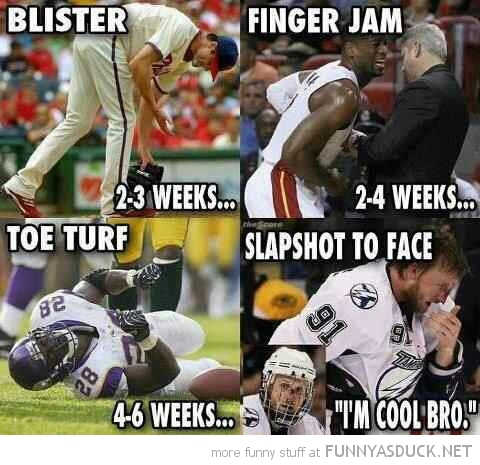
It’s not even debatable… hockey players are the toughest athletes in the world. While baseball players miss time with blisters and soccer stars writhe on the pitch and clutch their legs on phantom touches, NHL’ers play through devastating injuries on a regular basis. As the league returns to action tonight for their 2013-14 season, these hombres must be saluted as the toughest of the sporting bunch!

players-hockey

Steve Yzerman (2002)

Steve Yzerman is known as one of the greatest leaders in sports history. In 2002, Yzerman suffered a serious knee injury, but refused to let it keep him down. Yzerman had good reason to continue playing, though. His Detroit Red Wings lifted the 2002 Stanley Cup, mere months after he was an integral member Canada’s 2002 gold medal triumph at the Winter Olympics. Following that glorious year of events, Yzerman had to have his knee completely realigned, but still returned to hockey that season.

Patrice Bergeron (2013)

Continuing to play at a professional level with broken ribs is one thing, but imagine that same injury resulted in a punctured lung. Most normal people can’t even laugh with broken ribs, let alone play a highly physical and demanding sport. Patrice Bergeron played through Stanley Cup Final games with a punctured lung, among other injuries. It’s not like Bergeron didn’t already have a Stanley Cup on his resume, as the Bruins had won the grand prize just two years earlier, but Bergeron continued to play so as not to let down his team.

Jacques Plante (1959)

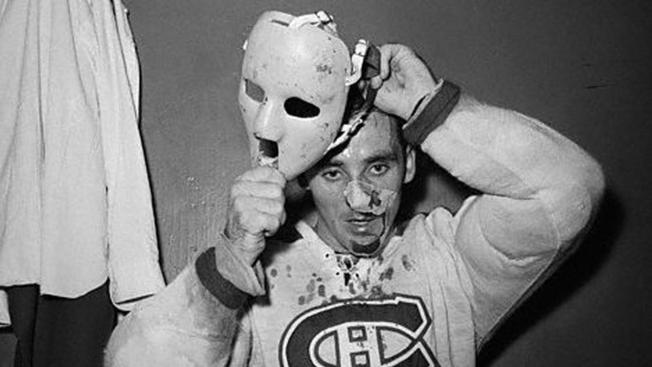
You’re already pretty tough in my books if you’re willing to stand in front of the net and have shots fired at you, as well as players crashing your crease… you’re even tougher if you did it back in the days of limited padding and no face masks. In a 1959 game, Jacques Plante took a slapshot to face, breaking his nose and cutting him open. Plante simply got stitched up, put on a mask and returned to ice. The occurrence ushered in the goalie mask as a regular protective device in the NHL.

Jacques Plante Putting on Mask

Mario Lemieux (1993)

In January 1993, following repeat Stanley Cup championships and amid another wildly successful season, Mario Lemieux announced that he would be taking some time away from hockey to treat his Hodgkin’s lymphoma cancer diagnosis. Not ever cancer could stop Super Mario, though. He returned to hockey two months later and on the same day as radiation treatment to score a goal and add an assist. He was even given a standing ovation from the opponent Philadelphia Flyers fans, some of the toughest supporters in all of sports.

Gregory Campbell (2013)

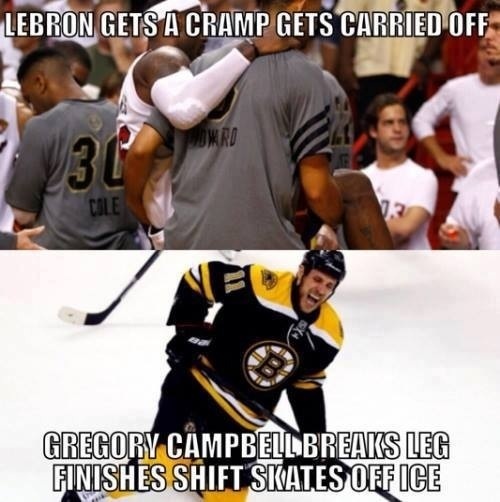
There’s something about the current crop of Boston Bruins that is admirable. On top of Patrice Bergeron’s struggles from the Stanley Cup Finals, there is also the case of Gregory Campbell, who stayed on the ice to kill the rest of a penalty after blocking a shot which broke his leg. Campbell struggled to stay in the play and break up whatever he could before hobbling to the bench and leaving the game.

Gregory Campbell Leg Break

Bobby Baun (1964)

During the Toronto Maple Leafs 1964 Stanley Cup finals series with the Detroit Red Wings, defenseman Bobby Baun broke his leg blocking a Gordie Howe shot. He was taken from the ice on a stretcher, but reemerged on the bench for the overtime period. Although he wasn’t known for his offensive abilities, the hockey gods looked down kindly upon Baun that night and he notched the overtime winner, forcing a game seven. The Leafs would hoist the cup days later with Baun still in the lineup.

Paul Kariya (2003)

Before concussions were such a hot button topic, a player could “get his bell rung” and be back on the ice in no time. But imagine taking one of the hardest open ice body checks in hockey history, from one of hockey’s all-time thunderous hitters and returning to the ice minutes later to score a huge goal, extending your team’s playoff life and championship bid. That’s exactly what Paul Kariya did when Scott Stevens flattened him in game six of their Stanley Cup Final Series.

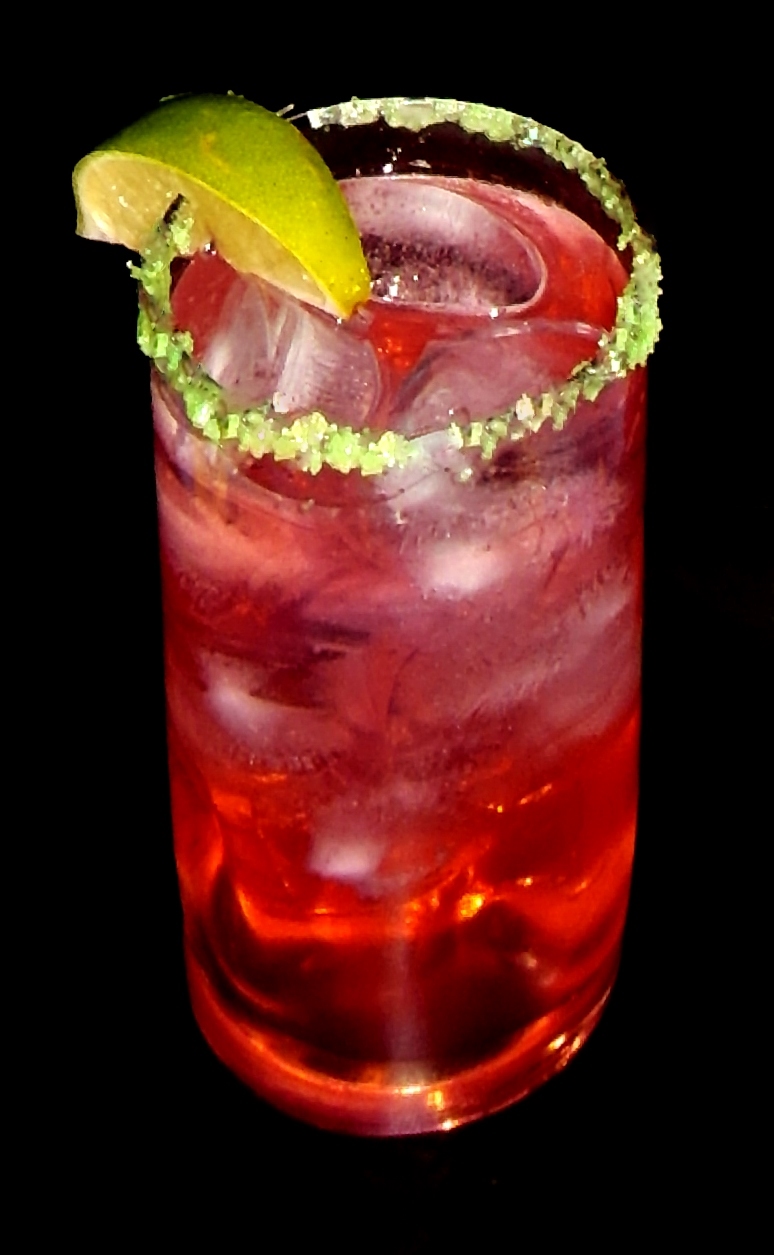
Drink #274: Slapshot

Slapshot Drink Recipe

  • Rim glass with Pop Rocks
  • 2 oz Tequila (I used Sauza Gold)
  • Top with half Brisk Strawberry-Melon and half Club Soda
  • Garnish with Lime Wedge

There are people out there who don’t go to work when they twist their ankle or have a cold… not the noble hockey player, however. Much respect to the brotherhood of hockey players out there. Let the games begin!

Sip Advisor Bar Notes (4 Sips out of 5):
This was an impressive drink. The Brisk Strawberry-Melon, which had found itself tucked away in the fridge for far too long, came out and had a career-making appearance. No more riding the pine for this mixer… it earned itself a brand spanking new contract with this gutsy performance!