Colorado Avalanche – Avalanche Shot

Throughout the year, the Sip Advisor will alphabetically travel the National Hockey League (NHL), discovering the best and worst each team has to offer in a variety of subjects. We will also feature a drink based off the franchise. Today, we may need some oxygen, as we visit the high altitudes of Colorado and try to survive the Avalanche:

Establishment Story: What is now the Colorado Avalanche began as the Quebec Nordiques, one of the original franchises of the World Hockey Association (WHA) in 1972. The Nordiques joined the NHL in 1979, as part of the NHL-WHA merger. The franchise was sold and relocated to Denver, Colorado in 1995 and renamed the Avalanche. Other possible names for the team included Extreme, Blizzards and Black Bears.

Stanley Cups: The Avalanche won the Stanley Cup in their first year in Colorado, helped along by the Avalanche picking up Patrick Roy from the Montreal Canadiens, a double shot at the province of Quebec. The team reached the league pinnacle again in 2001 and 2022, totalling three Stanley Cups. They have won each of their Stanley Cup Finals appearances. As the Nordiques, the franchise also won one WHA Avco Cup in 1977.

Celebrity Fan: South Park creators Trey Parker and Matt Stone are Avalanche supporters, as both grew up in Colorado. Another famous fan of the team is baseball Hall of Fame member Larry Walker, who played for the Colorado Rockies for 10 seasons. Walker, a Canadian who grew up also playing hockey, was honoured by the Avalanche for his 2020 Hall of Fame election by being named the team’s honourary emergency back-up goalie for a game.

Nordiques

Super Fan: During the Avalanche’s Stanley Cup-winning 2022 season, one fan was banned from the team’s home games, but it was for a somewhat noble reason. Ryan Clark was caught throwing a small bag of his friend’s ashes onto the ice during a January 8, 2022 contest. The friend was Kyle Stark, a die-hard Avalanche supporter, who died unexpectedly the previous December. Clark admitted the tribute may not have been the best idea, but had no regrets.

Mascot: Bernie the St. Bernard debuted on October 3, 2009, replacing Howler the Yeti, who was retired in 1999 after an issue with an opposing team fan. Bernie wears jersey #1, with a bone used to make the number. The Nordiques mascot was Badaboum, who first appeared for the Rendez-vous ’87 series between NHL All-Stars and the Soviet National Team in Quebec City. Badaboum was a furry blue creature, similar to a seal.

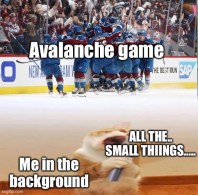
Tradition: For the past few seasons, the Avalanche have used the Blink-182 song All the Small Things as a theme song. For a portion of the track, the audio is cut off, so fans can sing the parts themselves. As the Avalanche made their run to the 2022 Stanley Cup, the tradition was often highlighted by the media. Blink-182 lead singer Mark Hoppus joined the team as they raised the Stanley Cup banner, leading the crowd in a rendition of the tune.

Appearances in Media: In the South Park episode Stanley’s Cup, Stan Marsh is forced to coach a kid’s hockey team, parodying The Mighty Ducks movie. When Marsh’s team is invited to play during the intermission of a Colorado Avalanche-Detroit Red Wings game, the other peewee team no-shows. As consolation, the Avalanche let Marsh’s team play the third period against Detroit, where they get absolutely annihilated, losing 32-2.
All the Small Things

Events/Scandals: Avalanche goalies have a history of being arrested for domestic violence. First, in October 2000, Patrick Roy was detained after an argument with his wife. His case was later dismissed for not meeting the standard of criminal mischief. 13 years later, Semyon Varlamov was arrested and charged with the misdemeanor assault of his girlfriend. The charges were dropped when prosecutors couldn’t prove their case.

Rivalry: As the Quebec Nordiques, the team had a long-standing feud with provincial rivals the Montreal Canadiens, known as the Battle of Quebec. The teams met in the playoffs five times and even battled over TV rights. As for the Colorado Avalanche, their greatest battles occurred with the Detroit Red Wings, as the two teams battled for Western Conference and league supremacy in the late 1990s.

Tragedy: Peter McNab was the color analyst for the Avalanche from their debut in 1995 up until his death from cancer on November 6, 2022. He was 70 years old. McNab played in the NHL for 14 seasons, before moving into the broadcast booth, first with the New Jersey Devils. For all of his contributions to the game, McNab was inducted into the U.S. Hockey Hall of Fame in 2021.

Player Nicknames: Two of the Avalanche’s most legendary players also have the most memorable nicknames in team history. Joe Sakic was known as Mr. Clutch throughout his long tenure with the franchise, always coming up big when it mattered most. Sakic’s former teammate, Peter Forsberg, was dubbed Peter the Great, a nod to the Tsar of Russia from 1682 to 1721.
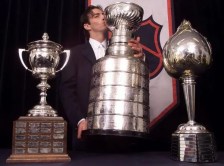
Joe Sakic

Line: Colorado’s dominant top line over the last few seasons has consisted of Gabriel Landeskog, Nathan MacKinnon and Mikko Rantanen. The trio has piled up points since being combined and were integral members to the Avalanche winning the 2022 Stanley Cup. Two other notable lines were comprised of Alex Tanguay and Milan Hejduk on the wings, with Joe Sakic or Peter Forsberg at center, for the JAM Line and AMP Line, respectively.

Captain: After serving as the Nordiques co-captain for the 1990-91 season, Joe Sakic was named the permanent captain for the 1992-93 campaign and held the mantle through to his retirement in 2009. Another enduring captaincy is that of Gabriel Landeskog, who was the youngest NHL captain ever, when he began his term in 2012. Landeskog is still the team’s captain to this day.

Enforcer: Nicknamed ‘The Sheriff’, Scott Parker patrolled the ice for the Avalanche for 237 games, over two separate stints. During his time with the franchise, Parker tallied 538 penalty minutes, to go along with five goals and 11 assists. Parker was a member of the Avalanche’s 2001 Stanley Cup championship team, suiting up for four games of the team’s playoff run.

Family Values: The Stastny brothers (Peter, Marian and Anton) starred for Quebec through the early 1980s, piling up points as the team’s top line. The Nordiques even helped the brothers defect from Czechoslovakia to play hockey in Canada, a move which opened the door for other Iron Curtain players to follow. Later, Paul Stastny, son of Peter, was drafted by Colorado, playing eight seasons with the Avalanche.

Stastny

Returning Players: Peter Forsberg played 10 seasons for the Nordiques/Avalanche franchise, before moving on to the Philadelphia Flyers and later Nashville Predators. He then sat out most of the 2007-08 season, recovering from foot surgery, before rejoining the Avalanche for nine games. After two seasons in Sweden, Forsberg attempted an NHL comeback with Colorado, but only lasted two games, citing his chronic foot issues as a reason for his retirement.

Short Stint: When Paul Kariya and Teemu Selanne came to the Avalanche for the 2003-04 season, the reunion of the two star players was supposed to bolster an already strong team. Kariya and Selanne both underperformed, though, and Colorado was eliminated from the playoffs in the second round. Following the 2004-05 NHL lockout, Kariya would sign with the Nashville Predators, while Selanne returned to the Mighty Ducks of Anaheim.

Undrafted: Peter Stastny’s Hall of Fame career began by fleeing Czechoslovakia with his pregnant wife, assisted by Nordiques President and CEO, Marcel Aubut. Stastny dominated the NHL upon arrival, breaking the record for most points in a season by a rookie, including a two consecutive game effort of seven goals and seven assists. Stastny would also play with the New Jersey Devils and St. Louis Blues over 15 seasons.

Trade: The greatest move the franchise ever executed was sending Eric Lindros to the Philadelphia Flyers for a massive package of assets. This included Peter Forsberg, Ron Hextall, Steve Duchesne, Mike Ricci, Kerry Huffman, Chris Simon, two first round draft picks and $15 million. While Lindros was a dominant player in the league for a time, the Avalanche would go onto win two Stanley Cups during Lindros’ career.

Forsberg

Signing: In 2019, the Avalanche took an $850,000 chance on forward Valeri Nichushkin, who was coming off being bought out by the Dallas Stars, following a season where he failed to score over 57 games. Nichushkin rebounded with Colorado, finding the form that made him the 10th overall pick of the 2013 draft. In 2021-22, Nichushkin recorded 25 goals and 27 assists, as well as contributing 15 points in the team’s Stanley Cup victory. This resulted in an eight-year, $49 million contract extension.

Draft Pick: The Nordiques/Avalanche have done very well with the first overall selection, including three consecutive top choices from 1989 to 1991 (Mats Sundin, Owen Nolan and Eric Lindros). The franchise also selected Nathan MacKinnon first overall in 2013. Additionally, choosing defenseman Cale Makar at fourth overall in 2017 may go down as one of the greatest draft steals of all-time.

Holdouts: Going into the 1991 NHL Entry Draft, Eric Lindros and his camp made it clear he would not play for the Nordiques, despite them owning the first overall selection and Lindros being the clear cut favourite to be picked. The Nordiques took Lindros anyway, resulting in the player refusing to put on the team’s jersey. At the 1992 NHL Entry Draft, the Nordiques traded Lindros to the Philadelphia Flyers, ending the impasse.

Buyouts: Three years in a row, from 2016 to 2018, the Avalanche used buyouts on aging defensemen, ending the Colorado tenures of Brad Stuart, Francois Beauchemin and Brooks Orpik in subsequent seasons. The Stuart buyout cost the team $2.4 million, while the Beauchemin and Orpik releases cost $3 million each. Orpik’s buyout came just weeks after he was traded to the Avalanche, allowing him to return to the Washington Capitals on a cheaper deal.
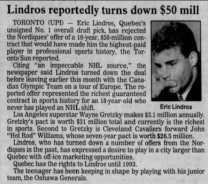
Lindros

Unique Game: From 1997 to 2016, the Avalanche played a pre-season game almost each year, dubbed Frozen Fury, against the Los Angeles Kings in Las Vegas. Colorado also returned to Quebec City for an exhibition game in 2002 against the Montreal Canadiens. The franchise has played a few outdoor games, including the 2016 Stadium Series vs. Detroit Red Wings, 2020 Stadium Series vs. Los Angeles Kings and NHL Outdoors at Lake Tahoe Saturday vs. Vegas Golden Knights.

Goal: Defenseman Uwe Krupp was injured for much of the Avalanche’s inaugural 1995-96 season, returning just in time for the end of the campaign. Good thing, as Krupp would score the winning goal in the third overtime period of Game 4 of the Stanley Cup Finals versus the Florida Panthers, clinching Colorado’s first championship. In doing so, Krupp became the first German-trained player to win the Stanley Cup.

Fight/Brawl: Two of the NHL’s most memorable brawls involved the Nordiques/Avalanche franchise. First, the Good Friday Massacre between the Nordiques and Montreal Canadiens occurred during the 1984 playoffs, resulting in 11 ejections and 252 penalty minutes. Second, the 1997 Brawl in Hockeytown between the Avalanche and Detroit Red Wings was the outcome of tempers boiling over from the previous year’s playoff meeting.

Injury: When the Avalanche played the Vancouver Canucks on March 8, 2004, Colorado’s Steve Moore was a marked man for his previous elbow on Canucks captain Markus Naslund. With the Avalanche up 8-2, Canucks players began targeting Moore, with Todd Bertuzzi punching him from behind. As a result of the punch, the players falling to the ice and a pile up that ensued, Moore suffered three fractured neck vertebrae, a concussion and cuts to his face. This ended Moore’s career and led to a lawsuit settlement.
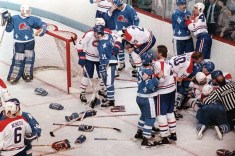
Good_Friday_Massacre

Penalty: Speaking of the Brawl in Hockeytown, it was all precipitated by Claude Lemieux’s hit-from-behind on Detroit’s Kris Draper in Game 6 of the 1996 Western Conference Finals. Draper ended up with a concussion, broken jaw and shattered cheek and orbital bones. Lemieux was ejected from the contest and subsequently suspended by the NHL for two games.

Wildest Story: Further complicating the Eric Lindros trade saga, the Nordiques had actually arranged two different deals for the coveted player. The other transaction was negotiated with the New York Rangers and an independent arbiter was needed to settle the matter. The Flyers deal was enforced, while the Rangers offer of Tony Amonte, Alexei Kovalev, Sergei Nemchinov, James Patrick, either Mike Richter or John Vanbiesbrouck, multiple first-round draft picks, and $20 million was voided.

Blooper: Patrick Roy was one of the greatest goalies in NHL history, but he is also remembered for this major error, made during the 2002 Western Conference Finals, against the Detroit Red Wings. Roy made a sprawling glove save, but when he went to show off the stop, he dropped the puck, allowing the Red Wings to score. The Avalanche, who were leading the series 3-2, went on to lose this game and the next, with the Red Wings advancing to the Stanley Cup Finals.

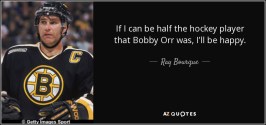
Miscellaneous: Another great trade for the Avalanche, was bringing in defenseman Ray Bourque from the Boston Bruins in 2000. Bourque waited 23 long seasons to finally win the Stanley Cup. When the Avalanche finally did so in 2001, captain Joe Sakic didn’t hesitate to immediately pass the trophy to Bourque, once it was presented to him. The joy and relief on Bourque’s face, as he skated the championship around the ice was evident. This would mark the end of Bourque’s NHL career, going out on top.

Colorado Avalanche: Avalanche Shot

Avalanche Shot

  • 0.75 oz Raspberry Vodka
  • 0.75 oz Blue Curacao

This is the first shooter of the NHL project, as I could find no suitable cocktails. You’re supposed to drop the shot into a glass of Red Bull, but I don’t like working with that ingredient. The colours of the shot replicate Avalanche jerseys hues.
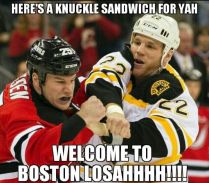
Boston Bruins – Black and Gold

Throughout the year, the Sip Advisor will alphabetically travel the National Hockey League (NHL), discovering the best and worst each team has to offer in a variety of subjects. We will also feature a drink based off the franchise. Today, we’re shipping up to Boston to learn about the Bruins and what makes them so big and bad:

Establishment Story: The Bruins were founded in 1924, making them the oldest active U.S.-based team in the NHL. They are an Original Six franchise, created after American businessman Charles Adams convinced the NHL to expand into the U.S. The team’s first GM, Art Ross, chose the team’s name of Bruins, a nickname for brown bears, which matched the team’s original colours of brown and yellow, similar to Adams’ grocery store chain.

Stanley Cups: The Bruins have won six Stanley Cups, most recently sipping from Lord Stanley’s chalice in 2011. Boston has also come up short in the Stanley Cup Finals 14 times, the most runner-up ribbons in NHL history. Their victories came over the New York Rangers (1929 and 1972), Toronto Maple Leafs (1939), Detroit Red Wings (1941), St. Louis Blues (1970), and Vancouver Canucks (2011).

Celebrity Fan: The Bruins have a long list of celebrity supporters. Among them, are the likes of Denis Leary, John Krasinski, Bill Burr, Conor McGregor, and the band Dropkick Murphys.  In a great trolling move, Burr made “Boston” the promo code to some of his comedy shows in Montreal, taking a jab at the long-time Bruins rival. The Dropkick Murphys have a number of songs either used by the Bruins or composed in homage to the team.

Boston Bruins

Super Fan: Liam Fitzgerald, aka Fist-Bump Kid, first became famous for a viral video showing the youngster fist-bumping Bruins players, as they left the ice following their pre-game warmup on November 4, 2014. Fitzgerald, who was born with Down syndrome and diagnosed with leukemia when he was three, was made an honourary member of the team and even has his own hockey card. Now 16, Fist-Bump Kid appeared at the 2023 Winter Classic, fist-bumping Boston players as they were introduced.

Mascot: Blades the Bruin made his debut in 1999. His backstory says Blades was first introduced to hockey by watching long-time Bruins organization member Johnny Bucyk play pond hockey with some kids. Blades hopped into Bucyk’s truck after one of these sessions, arriving later at Boston Garden. There, Bucyk fed Blades pizza, hotdogs, popcorn and soda, and the bear never returned to the wild.

Tradition: Prior to puck drop each night, the Fan Banner, a giant Bruins flag, is passed around the lower bowl as Cochise by the band Audioslave blasts over the speaker system. An honourary Fan Banner captain is often used to lead the pre-game ceremony, which has included other Boston-area sports stars, such as Pedro Martinez and Julian Edelman, as well as inspirational honourees, like the Boston Marathon bombing survivors.

Appearances in Media: The Bruins have been featured in a number of movies and TV shows. First, on Cheers, fictional Bruins goalie Eddie LeBec marries bartender Carla Tortelli. Also, on Rescue Me, firefighter Tommy Gavin (played by Denis Leary) plays on the FDNY hockey team, which faces off against former Bruins Cam Neely and Phil Esposito. Lastly, in Happy Gilmore, the titular character is clad in Bruins home and away jerseys during the film.

Happy Gilmore

Events/Scandals: Mitchell Miller was a renounced draft pick by Arizona Coyotes in 2020, when it was revealed he had repeatedly bullied a developmentally challenged classmate. For some reason, the Bruins thought signing Miller in 2022 was a good idea, kicking another hornet’s nest of troubles for the NHL. Two days after announcing the signing, the Bruins parted ways with Miller, but the damage to the team brand was already done.

Rivalry: The Bruins have had a number of storied rivalries throughout their history. Their arch nemesis would have to be the Montreal Canadiens, whom they have battled in the playoffs 34 times, with Montreal winning 18 straight post-season meetings from 1946 to 1987. Other rivals of the Bruins include the Buffalo Sabres, Toronto Maple Leafs and Philadelphia Flyers (Big Bad Bruins vs. Broad Street Bullies), as well as the defunct Hartford Whalers.

Tragedy: Normand Leveille was Boston’s top pick of the 1981 draft and showed promise in his rookie season, tallying 33 points in 60 games. Sadly, the Bruins never got to see what Leveille would become, as early in his sophomore campaign, he suffered a brain aneurysm, putting him into a three-week coma. Leveille survived, but lost the ability to walk, ending his NHL career at only 19 years old.

Player Nicknames: In 1938, when goalie Frank Brimsek recorded six shutouts in his first seven games with the Bruins, media and fans began calling him Mr. Zero and the ill will showed towards him for being brought in to replace fan favourite Tiny Thompson quickly faded. Later that season, Brimsek’s teammate Mel Hill earned the moniker Sudden Death, thanks to scoring three overtime game-winning goals, helping Boston win the Stanley Cup.

Bruins vs. Canadiens

Line: A number of Bruins lines have gained notoriety, including the Kraut Line (Milt Schmidt, Woody Dumart, and Bobby Bauer), the Nitro Line (Wayne Cashman, Phil Esposito and Ken Hodge) and the Perfection Line (Patrice Bergeron, Brad Marchand and David Pastrnak). The Kraut Line were the first unit to finish a season first, second and third in NHL scoring, while the Nitro Line led the team to two Stanley Cups.

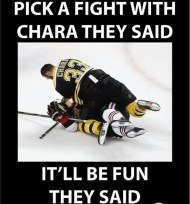
Captain: Zdeno Chara was one of the Bruins best acquisitions ever, when they signed the towering defenseman in 2006. Chara would immediately become captain and lead the 2011 squad to the Stanley Cup. He remained with the team and served in the role of captain for 14 seasons, which included two other unsuccessful trips to the Stanley Cup Finals. Chara signed a one-day contract with Boston in September 2022, in order to retire as a member of the Bruins.

Enforcer: Terry O’Reilly was a great protector of his teammates, who affectionately nicknamed him Taz. Another moniker he was given, this time by the press, was Bloody O’Reilly. O’Reilly holds the Bruins franchise record for penalty minutes with 2,095. He was even referenced as Happy Gilmore’s favourite hockey play. O’Reilly’s #24 jersey was retired by the team in 2002.

Family Values: A few father and son duos enjoyed separate stints with the Bruins, including franchise legend Ray Bourque and son Chris; Ted Donato and son Ryan (each drafted by the Bruins 27 years apart); Ken Hodge and son Ken Jr. (first father and son to score a hat trick for the same team); and Ron Grahame and son John (first father and son to play goalie for the same team).

Chara

Returning Players: Goalie Gerry Cheevers was claimed by the Bruins in 1965 Intra-League Draft and would go on to backstop the team to their 1970 and 1972 Stanley Cups. He also went on a NHL record 32-game undefeated streak in 1972, before leaving to play in the World Hockey Association. Following a contract dispute in 1975, Cheevers returned to Boston, finishing his career with five more seasons. Cheevers may be best remembered for his mask, which he marked with stitches in places it had been hit.

Short Stint: A pair of Hall of Fame defensemen finished their careers with the Bruins. First, Paul Coffey was signed to a two-year, $4 million contract in the 2000 off-season, but after 18 games and only providing four assists, he was waived and went unclaimed by another team. Next, Brian Leetch joined Boston for the 2005-06 season, recording his 1,000 career point, over 61 contests with the team.

Undrafted: Defenseman Torey Krug was signed out of the NCAA in 2012, following a season where he led the league in scoring and was named a Hobey Baker Award (Player of the Year) finalist. Krug remained with the Bruins until 2020. Another notable college signing for Boston was Mike Milbury, who would spend his entire 12-season NHL career with the Bruins and also coach the team from 1989 to 1991.

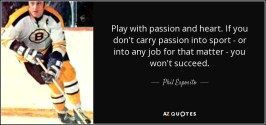
Trade: Among the Bruins greatest trades, was acquiring star Phil Esposito from the Chicago Blackhawks in 1967. Esposito came to Boston along with Ken Hodge and Fred Stanfield, developing into one of the best players of his generation. Esposito would win two Stanley Cups as a member of the Bruins, before being dealt in another blockbuster to the New York Rangers in 1975.

Phil Esposito

Signing: The rules of the NHL were much different in 1962, when the Bruins signed future superstar Bobby Orr, at the time only 14 years old. The terms of the deal saw the Bruins give Orr and his family a $10,000 signing bonus, a new car and add stucco to their home. Orr would finally join the Bruins on the ice as an 18-year-old, staying with the team for 10 seasons, winning eight straight (1968-75) Norris Trophies, as the NHL’s top defenseman.

Draft Pick: The Bruins greatest selection ever was taking Ray Bourque 8th overall in 1979. Perhaps the teams greatest draft class was their 2006 haul, when they collected Phil Kessel (5th overall), Milan Lucic (50th overall) and Brad Marchand (71st overall) in subsequent rounds. Boston also did very well landing Patrice Bergeron at 45th overall in 2003. Bergeron has gone on to win five Selke Trophies, as the league’s best defensive forward.

Holdouts: Phil Kessel’s 2009 holdout wasn’t allowed to extend too long, as he was dealt to the Toronto Maple Leafs after both sides failed to reach any agreement on a new contract over the off-season. The haul for dealing Kessel was very good, made even better when the Maple Leafs performed poorly the next two seasons, resulting in Boston drafting Tyler Seguin (2nd overall in 2010), Jared Knight (32nd overall in 2010) and Dougie Hamilton (9th overall in 2011).

Buyouts: Boston’s most costly buyout was Dennis Seidenberg, who they were forced to pay $4,666,667, while Seidenberg plied his trade with the New York Islanders for a couple campaigns. Seidenberg was a prominent member of the 2011 Stanley Cup-winning team and had been with the Bruins for seven seasons before being released in 2016. He retired in 2019.

Ray Bourque

Unique Game: The Bruins profile and success has resulted in the team playing many outdoor games, including the 2010, 2016, 2019 and 2023 Winter Classics versus the Philadelphia Flyers, Montreal Canadiens, Chicago Blackhawks and Pittsburgh Penguins, respectively. They also battled the Flyers  for one of the 2021 Outdoors at Lake Tahoe games. In 1956, Boston played exhibition games against local teams in New Brunswick and Newfoundland.

Goal: Bobby Orr scored many spectacular goals over his career, but none compare to his Stanley Cup-clinching tally in 1970. It’s perhaps best remembered for Orr soaring through the air after scoring the overtime marker, arms raised in triumph, while being tripped by St. Louis Blues defenseman Noel Picard. I mean, the play is actually known as The Goal in hockey lore. What else could go here?

Fight/Brawl: It was a wild night in 1979, when members of the Bruins ended up in the stands of Madison Square Garden, fighting with fans of the New York Rangers. The chaos started at the end of the game, when Stan Jonathan was assaulted by a fan. Jonathan’s Boston teammates came to his aid, with the highlight of the melee being Mike Milbury beating a fan with their own shoe. The NHL installed higher glass in arenas, as a result of the incident.

Injury: Cam Neely’s knee-on-knee collision with Pittsburgh Penguins defenseman Ulf Samuelsson in the 1991 playoffs, was the first of many knee issues, resulting in Neely only playing 22 games over the next couple seasons and being forced into retirement at the age of 31. Neely’s attempts to return to the game were recognized with him being awarded the Bill Masterton Memorial Trophy for perseverance and dedication in 1994.

The Goal

Penalty: Billy Coutu, nicknamed Wild Beaver, was banned from the NHL for life in 1927, after assaulting referee Jerry Laflamme. The incident occurred after the Bruins lost the Stanley Cup Finals to the Ottawa Senators. Coutu’s ban would be lifted in 1929, allowing him to play minor league hockey. He would also be reinstated into the NHL for the 1932-33 season, but never played in the league again.

Wildest Story: In 1948, the NHL banned Bruins forward Don Gallinger and former teammate Billy Taylor (traded to the New York Rangers that season, when management questioned his poor play) for life, after it was discovered the pair had gambled on their own teams. Gallinger and Taylor were reinstated in 1970, marking the longest ever suspensions in league history.

Blooper: The most famous Too Many Men on the Ice penalty in NHL history occurred in Game 7 of the 1979 Stanley Cup Semi-Finals. With Boston up 4-3 over the Montreal Canadiens and a berth in the Finals looming, the Bruins were penalized late in the game. Montreal scored on the power play and won the game in overtime. Boston coach Don Cherry (who played his only NHL game with the Bruins) was later fired for the gaffe.

Miscellaneous: When Willie O’Ree suited up for the Bruins on January 18, 1958, he broke hockey’s black colour barrier, becoming the “Jackie Robinson of ice hockey”. All this, despite suffering an eye injury years earlier, that should have ended his career had he not kept it hidden. O’Ree was named the NHL’s Diversity Ambassador in 1998 and inducted into the Hockey Hall of Fame in 2018. His #22 jersey was retired by the Bruins in 2022.

Boston Bruins: Black and Gold

Black and Gold

  • 1.5 oz Jack Daniel’s Honey Whiskey
  • 0.5 oz Triple Sec
  • 0.5 oz Cinnamon Schnapps
  • Top with Iced Tea
  • Garnish with Lemon Slices

There are numerous recipes with this name. I went with the one that interested me the most and was used by a Boston pizzeria in support of the Bruins. I couldn’t find exact measurements for the drink, so built it as I wanted to. Some ingredients could be altered for a different mix.