
Throughout the year, the Sip Advisor will alphabetically travel the National Hockey League (NHL), discovering the best and worst each team has to offer in a variety of subjects. We will also feature a drink based off the franchise. Today, we look at the Vancouver Canucks, the Sip Advisor’s hometown and favourite squad. I’ll try my best to not show any bias!:
Establishment Story: The Canucks joined the NHL as an expansion team in 1970. Previously, minor league versions of the Canucks played in the Pacific Coast Hockey League and Western Hockey League from 1945-70. Canucks owners had bid to join the NHL for its 1967 expansion, but were denied. They also tried to have the Oakland Seals moved to Vancouver, but that was vetoed by the NHL.
Stanley Cups: The Canucks have not won the big one, despite appearing in three Stanley Cup Finals (1982 vs. New York Islanders, 1994 vs. New York Rangers and 2011 vs. Boston Bruins). In two of those championship series, they played to a seventh and deciding game, coming up short both times. Vancouver did win back-to-back President’s Trophies in 2011 and 2012, but the ultimate prize has always eluded the franchise.
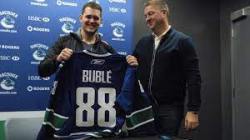
Celebrity Fan: Singer Michael Bublé is a passionate supporter of the Canucks, as the Burnaby native has been for most of his life. Bublé even has an ownership stake in the Western Hockey League Vancouver Giants junior team. Bublé is such a hockey fan, part of his concert contract rider asks each promoter to include the puck of a local team in his dressing room.
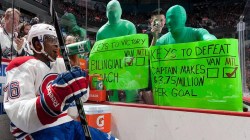
Super Fan: First appearing on December 22, 2009, the infamous Green Men – wearing full-body spandex outfits – quickly became recognizable fixtures at Canucks games. Taking their seats next to the visitor’s penalty box, the Green Men (Adam ‘Force’ Forsyth and Ryan ‘Sully’ Sullivan) would mercilessly mock those sent to the sin bin with signs and other antics. The duo was inducted into ESPN’s Hall of Fans, before retiring after the 2014-15 season.
Mascot: Fin the Whale was introduced on June 4, 2001. Among the orca/killer whale’s favourite things are B.C. salmon, the book Moby Dick and the movie Free Willy… not to mention arena popcorn! His least favourite team, of course, would be the defunct Hartford Whalers. While Fin is perhaps best known for his charity appearances, he also has a habit of chomping unsuspecting fan’s heads.
Tradition: Towel Power was born during the 1982 Campbell Conference Finals. When coach Roger Nielson grew frustrated over what he viewed to be lopsided officiating, he waived a white towel attached to a raised stick as his sign of surrender. Upon the team’s return to home ice, fans began waving towels in support of the coach and team. The Canucks won three straight, advancing to their first Stanley Cup Finals.
Appearances in Media: Thanks to actress Cobie Smulders hailing from Vancouver, like her How I Met Your Mother character Robin Scherbatsky, a number of references to the Canucks occurred over the course of the sitcom’s nine seasons. These included multiple occasions where Scherbatsky is clad in a Canucks jersey, mentions players from the team and attends a Canucks-New York Rangers game.
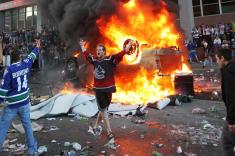
Events/Scandal: Following their defeats in both the 1994 and 2011 Stanley Cup Finals, Downtown Vancouver became engulfed in riots that destroyed property and caused numerous injuries. Thankfully, in both incidents, no deaths were reported. In the aftermath of the 2011 riot, 887 criminal charges were laid against 301 suspects, hopefully deterring future similar behaviour.
Rivalry: The Canucks lacked a true geographic rival until the Seattle Kraken entered the NHL in 2021. Up to that point, rivalries with fellow western Canada clubs the Calgary Flames and Edmonton Oilers have always existed, as well as incident- and playoff-born rivalries with teams such as the New York Rangers, Colorado Avalanche, Chicago Blackhawks and Boston Bruins.
Tragedy: The Canucks franchise has been struck with tragedy on a few occasions. One of the team’s first stars, Wayne Maki, was diagnosed with brain cancer in 1972, succumbing to the disease in 1974, aged 29. Then, in 2008, defenseman Luc Bourdon was killed in a motorcycle accident at the young age of 21. Finally, forward Rick Rypien committed suicide in the 2011 off-season, after his tenure with Vancouver, but before debuting with the Winnipeg Jets.
Player Nicknames: Canucks history is loaded with great nicknames. Among them: Russian Rocket (Pavel Bure), Steamer (Stan Smyl), Captain Kirk (Kirk McLean), Brockstar (Brock Boeser), King Richard (Richard Brodeur), and JovoCop (Ed Jovanovski). An underrated entry would be Cowan the Brabarian, given to Jeff Cowan after a bra was thrown on the ice following a goal from the enforcer.
Line: Two Canucks lines had very successful runs as a unit. First, the West Coast Express (Markus Naslund, Todd Bertuzzi and Brendan Morrison) terrorized opponents from 2002-06. The line was named after Vancouver’s commuter train line. Second, the Lotto Line (Brock Boeser, Elias Petterson and J.T. Miller) had a shorter but memorable stint together. The trio received its moniker when a Twitter user realized their numbers 6, 40 and 9, matched the local 649 lottery.
Captain: While the Canucks have had a number of memorable leaders, including Stan Smyl, Trevor Linden and Henrik Sedin, in 2008, the organization abandoned all convention, naming goalie Roberto Luongo as the team’s captain. He was the first netminder to hold such an honour since 1947-48. Luongo’s reign as team leader lasted only two seasons, before it was mutually agreed he should relinquish the role.
Enforcer: Canucks history is littered with teams that couldn’t beat opponents on the scoreboard, so they just tried to beat them up. Among the franchise’s many fighters, perhaps the most beloved was – and still is – the ‘Algonquin Assassin’ Gino Odjick. Odjick holds the team record for total penalty minutes at 2,127, over eight seasons with the club. Odjick also holds five of the top 10 slots for penalty minutes in a season.
Family Values: The Canucks have a long history of family relations within the organization. This is best highlighted with the Sedin twins, who were able to come to Vancouver together thanks to the incredible draft day dealings of GM Brian Burke. The Canucks also united the Courtnall brothers – Geoff and Russ, from nearby Vancouver Island – for 13 games in the 1994-95 season.
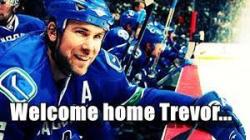
Returning Players: The trading of Trevor Linden during the 1998 Olympic break never seemed right for both the player and the organization. That was all remedied in 2001, when Linden was reacquired by the Canucks. Linden played out the rest of his career with the team, reaching 1,000 games played and points scored with the club it was meant to happen with.
Short Stint: A free agent in 2008, Toronto Maple Leafs icon Mats Sundin weighed contract offers from a number of teams, while also considering retirement. The Canucks two-year, $20 million offer would have made Sundin the highest paid player in the NHL. After sitting out the start of the season, Sundin finally put pen to paper with Vancouver on December 18, 2008, being paid a prorated $5 million for the season. Sundin played 49 games combined (regular season and playoffs) with the Canucks, before retiring.
Undrafted: Alex Burrows story of perseverance from undrafted to star player is inspiring. He quickly rose through the ranks of the minor leagues, joining the big league squad in January 2006 and never looked back. Originally a checker, Burrows eventually found himself on the top line, where he and the Sedins became a popular trio. Burrows was added to the Canucks Ring of Honour in 2019.
Trade: Among the best moves the Canucks have made are acquiring Roberto Luongo from the Florida Panthers and stealing Markus Naslund from the Pittsburgh Penguins. Both trades are among the most lopsided in NHL history. On the flip side, dealing a young, homegrown Cam Neely to the Boston Bruins has always been lamented by Canucks fans. While the return was decent, Neely blossomed into a superstar, plus they also gave up a first-round draft pick in the transaction.
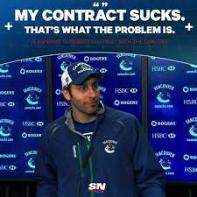
Signing: There are more bad signings in Canucks history than good ones. Among the worst would be Mark Messier’s three-year, $18 million pact in 1997 and Loui Eriksson’s six-year, $36 million deal in 2016. Messier was a cancer in the Canucks locker room, while Eriksson vastly underperformed his contract, both drawing the ire of the fan base. Also, Roberto Luongo’s 12-year, $64 million resigning in 2009, eventually led to a three-year, $3 million cap recapture penalty, upon Luongo’s retirement.
Draft Pick: The Canucks have never selected first overall, but have done fairly well with the number two pick, using their first ever choice in 1970 on Dale Tallon and also getting Trevor Linden (1988) and the Sedin twins (1999) at second and third. Their greatest draft steal was Pavel Bure in the sixth round, 113th overall. The Nucks drafted Bure in 1989, despite confusion over his eligibility.
Holdouts: Once the team’s most popular superstar, Pavel Bure’s exit from the Canucks was ugly. Following the 1997-98 season, Bure gave new GM Brian Burke the first headache of his tenure, stating he would not play the final year of his contract. It took until January 17, 1999, for Bure (along with Bret Hedican, Brad Ference and a third-round draft pick) to be sent to the Florida Panthers in exchange for Ed Jovanovski, Dave Gagner, Mike Brown, Kevin Weekes, and a first-round draft pick.
Buyouts: The Canucks own the largest non-compliance buyout in the NHL salary cap era, used to terminate the contract of defenseman Oliver Ekman-Larsson. Ekman-Larsson had joined Vancouver via trade in 2021, lasting only two seasons before his eight-year, $66 million deal was bought out with four seasons remaining. Ekman-Larsson will be paid by the Canucks $19.33 million over eight years.
Unique Game: The Canucks have taken part in a number of NHL international firsts. The first regular season games played outside North America saw Vancouver and the Mighty Ducks of Anaheim meet for a pair of 1997-98 season-opening contests in Tokyo, Japan. In 2017, the Canucks would play two pre-season games against the Los Angeles Kings in Shanghai and Beijing, China. These were the first NHL matches ever played in the country. Vancouver also hosted the 2014 Heritage Classic, facing the Ottawa Senators.
Goal: Two Alex Burrows goals during the 2011 run to the Stanley Cup Finals are among the greatest in team history. First the ‘Slay the Dragon’ Game 7 overtime winner versus the Chicago Blackhawks finally put the Canucks past their nemesis. Later, Burrows tally mere seconds into overtime of Game 2 of the Stanley Cup Finals versus the Boston Bruins gave Vancouver a 2-0 series lead, causing mass hysteria across the province.
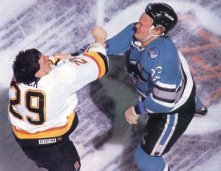
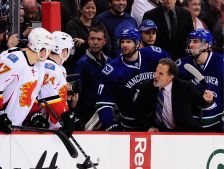
Fight/Brawl: When Canucks coach John Tortorella saw the Calgary Flames starting lineup flush with goons prior to a 2014 game, he knew something was up. Kellen Lain was playing his first NHL game and a receipt was due for an injury he’d caused in an earlier minor league contest. A line brawl ensued to start the game, with Lain and others ejected from the match. At intermission, Tortorella went to the Flames dressing room, trying to confront Calgary coach Bob Hartley. This resulted in a 15-day suspension for Tortorella.
Injury: On February 11, 2000, Canucks enforcer Donald Brashear fought and defeated his Boston Bruins counterpart Marty McSorley. McSorley pursued a rematch, which Brashear turned down. Late in the contest, McSorley hit Brashear in the side of the head with his stick, knocking Brashear unconscious. Brashear suffered a seizure and concussion, while McSorley was suspended indefinitely, ending his career. McSorley was later convicted of assault with a weapon and sentenced to 18 months probation.
Penalty: The Todd Bertuzzi-Steve Moore incident is one of hockey’s biggest black eyes. The Canucks were out for revenge after Moore had previously elbowed Canucks captain Markus Naslund, resulting in a concussion. In the midst of a blowout loss, Bertuzzi punched Moore in the back of the head, knocking him out. The resulting fall fractured three of Moore’s neck vertebrae. Criminal and civil action followed, along with Bertuzzi being suspended for the rest of the 2003-04 season and throughout the 2004-05 lockout.
Wildest Story: Canucks fans have long had a feeling the team is cursed, dating back to one of the team’s first official activities. To decide which of Vancouver and the Buffalo Sabres would get the first overall choice in the 1970 NHL Draft, a roulette wheel was used. NHL president Clarence Campbell declared the Canucks the winners, before it was pointed out the ball didn’t stop on number one, but 11 instead. Thus, the Sabres earned the right to select junior standout Gilbert Perreault.
Blooper: In the first round of the 2002 playoffs, the surprising Canucks were up 2-0 in their series against the Presidents’ Trophy-winning Detroit Red Wings. What happened next changed the entire course of the series, as Red Wings defenseman Nicklas Lidstrom launched a shot from center ice, beating Canucks goalie Dan Cloutier. Detroit won four straight games, eliminating the Canucks, en route to another Stanley Cup.
Miscellaneous: Wayne Gretzky, the greatest player in NHL history, twice almost became a Canuck. In 1988, before he was traded to the Los Angeles Kings, the Canucks could have had ‘The Great One’ for $25 million, Kirk McLean, Greg Adams and three first-round draft picks. A decade later, Gretzky was a free agent and had committed to signing with Vancouver, until he was pressured to put pen to paper and didn’t like the pushy approach. He ended up with the New York Rangers to finish his career.
Vancouver Canucks: Vancouver Canucks Cocktail
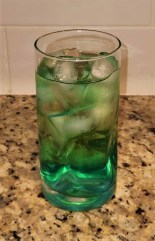
- 1 oz Vodka
- 0.5 oz Melon Liqueur
- 0.5 oz Blue Curacao
- Splash of Lemon Lime Soda
For this cocktail, you mix the Vodka, Melon Liqueur and Lemon Lime Soda, before adding a float of Blue Curacao. The Canucks are looking good this season, renewing the faith of the countless disappointed diehards of this franchise. Go Canucks Go!!!




 Sip Advisor