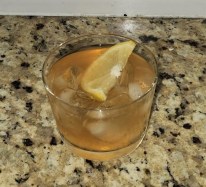
Winnipeg Jets – Jet Stream

Throughout the year, the Sip Advisor will alphabetically travel the National Hockey League (NHL), discovering the best and worst each team has to offer in a variety of subjects. We will also feature a drink based off the franchise. Today, we brave frosty temperatures to fly with the Winnipeg Jets:

Establishment Story: Version 2.0 of the Jets was born when the Atlanta Thrashers were relocated to the Manitoba capital in 2011. The Thrashers had joined the NHL as an expansion team in 1999. After some debate, new Jets owner Mark Chipman/True North Sports & Entertainment decided to return to the Jets nickname, which had been given to the previous World Hockey Association/NHL franchise that had relocated to Phoenix in 1996.

Stanley Cups: The Jets have yet to win a Stanley Cup, coming closest in 2018, when they were eliminated in the Western Conference Final by the Vegas Golden Knights. As for the Thrashers, they only qualified for the playoffs once in their existence, being swept in the first round by the New York Rangers in 2007. The original Jets won the WHA Avco World Trophy three times, but that legacy belongs to the Phoenix/Arizona Coyotes.

Celebrity Fan: Professional wrestler Chris Jericho is such a big Jets fan (original and 2.0) that the Winnipeg native has donned his team gear at opponent rinks, including his current home of Tampa Bay, even when he’s been given free tickets by Lightning employees. When jokingly told “You can’t do that,” Jericho simply replied “Watch me!” Jericho also once appeared on WWE Monday Night Raw in a Jets t-shirt.

Thrashers to Jets

Super Fan: Len ‘Kroppy’ Kropioski was often featured on the Winnipeg scoreboard, as the World War II veteran sang the Canadian national anthem and saluted the country’s flag. Kroppy had been a season ticket holder since the Jets returned in 2011, making a 2.5-hour trek from Kenora, Ontario for each home game. Sadly, Kroppy passed away in 2016, at the age of 98. In 2018, Kroppy was immortalized with an Upper Deck hockey card release.

Mascot: Mick E. Moose was the mascot of the minor league Minnesota Moose, moving with the team to Manitoba in 1996. When the Jets returned to the NHL in 2011, Mick E. was called up to the big leagues. He now represents both the Jets and Moose. Benny, the mascot of the original Jets, was resurrected at the 2016 Heritage Classic, becoming a secondary mascot for the Jets 2.0. While in Atlanta, the team’s mascot was Thrash, a brown thrasher, the state bird of Georgia.

Tradition: The Winnipeg White Out was first used for the opening round of the 1987 playoffs, when fans were encouraged to wear all white, as a counter to their opponents, the Calgary Flames, whose fans created a ‘C of Red’. When the Jets won the series, fans continued the tradition. Fans are also known to emphasize the “true north” portion of the Canadian national anthem, an homage to Winnipeg’s geographic location.

Appearances in Media: On the sitcom How I Met Your Mother, character Robin Scherbatsky was occasionally seen wearing a Vancouver Canucks jersey. That all changed in a later season episode, when she is shown wearing a Thrashers jersey, with the logo removed. All this, despite the team having moved to Winnipeg years earlier. Also, the Jets 2.0 franchise is profiled in a series of documentary shorts called Jets Legends, on the Crave streaming service.
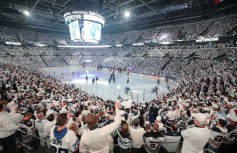
White Out

Events/Scandals: When an entire article is devoted to a timeline of a player’s behavioural incidents with a team, you might call said player a problem. Despite his obvious talent, drafted fourth overall in 2009 by Atlanta, Evander Kane caused many headaches during his time with the Jets, including issues around his social media use, relationships with local businesses, angering his own teammates, allegations of faking injuries, benchings by coaches, and even legal matters.

Rivalry: While the new incarnation of the Jets shares some minor rivals with their original predecessors (Edmonton Oilers, Calgary Flames and Vancouver Canucks), these battles aren’t what they used to be, given they no longer all share the same division. The honour of current top rival would likely go to the geographically close Minnesota Wild, with the Colorado Avalanche and Nashville Predators being other options.

Tragedy: On September 29, 2003, Dany Heatley crashed his Ferrari with his Thrashers teammate Dan Snyder in the vehicle with him. Heatley suffered a number of injuries, but eventually made a full recovery. Sadly, Snyder never awoke from his coma, succumbing to septic shock on October 5, 2003. Despite the team’s relocation, the Jets continue to present the Dan Snyder Memorial Award for perseverance, dedication and hard work, in his memory.

Player Nicknames: Nikolai Ehlers earned the nickname Fly thanks to his speed and finesse. Ehlers has spent his entire career with the Jets, drafted ninth overall in 2014 by the team. Friend and former teammate Patrik Laine also once dropped the moniker ‘Little Buddy Nik’ towards Ehlers in an interview. The 6’5” Laine is definitely big, but Ehlers holds his own at a respectable 6’0”.
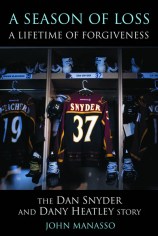
Dan Snyder

Line: One notable line from Jets history was the checking unit of Tanner Glass, Jim Slater and Chris Thorburn, dubbed the GST Line, a reference to the Canadian Goods and Services Tax. Going back to the Thrashers days, Dany Heatley and Ilya Kovalchuk were a dangerous combo, even as freshmen. The duo were both nominated for the 2001-02 Calder Trophy (rookie of the year), playing on a line together.

Captain: Blake Wheeler was named captain of the Jets prior to the 2016-17 season. He remained in the role until September 2022, when he was stripped of his captaincy, with Winnipeg electing to go into the season with no selected captain. New head coach Rick Bowness stated he wanted to go with a committee leadership approach, with a number of assistant captains, rather than one particular captain.

Enforcer: Chris Thorburn holds the Jets/Thrashers franchise record for career penalty minutes with 832, while Jeff Odgers tops the list for most penalty minutes in a single season with 226. Had Dustin Byfuglien not surprisingly retired at the age of 35 (more on that later), he certainly would have surpassed Thorburn, as he sits second on the Jets all-time list with 826 penalty minutes. Big Buff is best remembered for his bone-crunching hits and not shying away from the rough stuff.

Family Values: Father and son, Dave and Adam Lowry, enjoyed a coach/player relationship from November 2020 to April 2022. Adam was drafted by the Jets in 2011, with Dave joining the team as an assistant coach in 2020. Dave was named interim head coach just over a year later, with the departure of Paul Maurice, leaving the team at the end of the season to join the Seattle Kraken as an assistant coach.
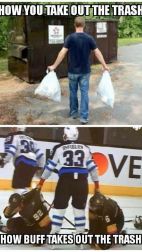
Dustin Byfuglien

Returning Players: Paul Stastny first joined the Jets at the 2018 trade deadline, brought in to be the team’s second line center. Despite being a perfect fit with the club and the team having a successful playoff run, Stastny signed with the Vegas Golden Knights in the off-season. After two season with Vegas, Stastny was again traded to Winnipeg, where he resumed his spot on the team’s second line for two campaigns.

Short Stint: When Hall of Fame member Chris Chelios retired in August 2010, at the age of 48, he held the record for most games played by a defenseman, with 1,651. The last seven NHL contests of his lengthy career were spent with the Atlanta Thrashers. Chelios had signed a 25-game tryout contract with the minor league Chicago Wolves, being recalled by the Thrashers to close out the 2009-10 season.

Undrafted: Brandon Tanev was signed by the Jets out of college in 2016, joining the team for their final three games of that season. Tanev remained with the organization until 2019, when he was lured away by a six-year, $21 million contract offer by the Pittsburgh Penguins. For much of his time with Winnipeg, Tanev was used in a checking line role, often playing with Adam Lowry and Andrew Copp.

Trade: The organization’s final season in Atlanta saw the Thrashers take great advantage of the Chicago Blackhawks, who had serious salary cap issues. In two separate moves, the Thrashers brought in Dustin Byfuglien and Andrew Ladd (among others), who were coming off the Blackhawks 2010 Stanley Cup championship and would be important members of the franchise once moved to Winnipeg.
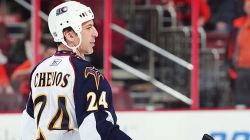
Chris Chelios

Signing: The Jets don’t often dip their toe into the big name free agent market, preferring to draft and develop their players, while acquiring others via trade. In this vein, one of the biggest moves the organization has ever made was re-signing center Mark Scheifele and goalie Connor Hellebuyck to identical seven-year, $59.5 million contracts, when everyone in the hockey world assumed the players were as good as gone from Winnipeg and would be dealt for packages of draft picks, prospects and other pieces.

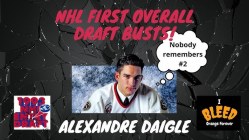
Draft Pick: The Thrashers/Jets franchise has had the first overall pick twice, taking Patrik Stefan in 1999 and Ilya Kovalchuk in 2001. Stefan proved to be one of the biggest draft busts of all-time, while Kovalchuk enjoyed some success with Atlanta, before being traded. Mark Scheifele, taken seventh overall in 2011, was the first-ever pick of the franchise after it relocated to Winnipeg. A definite draft steal was selecting goalie Connor Hellebuyck at 130th overall in 2012.

Holdouts: A number of top Jets players have staged holdouts with the organization. Both Josh Morrissey in 2018 and Patrik Laine in 2019 missed training camp, but put pen to paper before the start of the season. Jacob Trouba was a different story, missing the first month of the 2016-17 season and even requesting a trade out of Winnipeg, before finally coming to terms with the organization.

Buyouts: Blake Wheeler played 12 seasons in Winnipeg, the last remaining player to come over from Atlanta. In 2023, the Jets bought out the last season of Wheeler’s five-year, $41.25 million contract, leading to the player being owed $5.5 million over two years. Wheeler left the organization as its career leader in games played (897), assists (550) and points (812). He signed a one-year deal with the New York Rangers for the 2023-24 campaign.
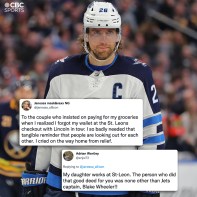
Blake Wheeler

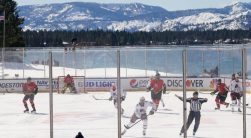
Unique Game: The Jets have been involved in two Heritage Classic games, facing the Edmonton Oilers at Investors Group Field in Winnipeg in 2016, and the Calgary Flames at Mosaic Stadium in Regina, Saskatchewan in 2019. The Jets were shutout 3-0 at home against Edmonton, while they defeated the Flames 2-1 in their neutral site game, although they were listed as the hosting team.

Goal: On November 24, 2018, Patrik Laine scored five goals against the St. Louis Blues. Even more impressive, the Finnish sniper only had five shots in the game. The feat earned a Winnipeg man $1 million, as part of a promotional contest. Another notable tally in team history was Nik Antropov scoring the first goal of Jets 2.0 history, giving fans their first chance to erupt for an NHL marker in 15 years.

Fight/Brawl: While the original Jets had their fair share of melees, version 2.0 hasn’t shied away from scuffles with opposing teams, particularly against divisional rivals such as the Minnesota Wild, Nashville Predators and St. Louis Blues. A memorable one-on-one tilt, saw unlikely fighters Blake Wheeler and Evgeni Malkin of the Pittsburgh Penguins drop the gloves, as Wheeler looked to avenge an elbow to the head by Malkin during the teams’ previous meeting.

Injury: In an injury that would make all men squeamish, former Jets captain Blake Wheeler suffered a ruptured testicle when hit with a friendly fire shot during a December 15, 2022 game against the Nashville Predators. Amazingly, Wheeler finished the contest, quipping afterwards: “There’s a difference between being hurt and being injured. I didn’t know I was injured until the next day.” He missed five weeks of action to heal.
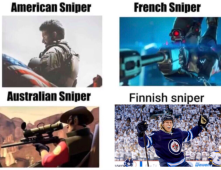
Patrik Laine

Penalty: During the second round of the 2021 playoffs, the underdog Montreal Canadiens were on the verge of winning Game 1, when Jets center Mark Scheifele decided to take his frustrations out on Canadiens forward Jake Evans, who had just scored an empty net goal, with a massive hit. Evans had to be stretchered off the ice and missed multiple games recovering from a concussion. Scheifele was handed a four-game suspension for the infraction.

Wildest Story: Dustin Byfuglien was among the Jets top defensemen coming into the 2019-20 season. As training camp was set to begin, news broke that Byfuglien had been granted a leave of absence from the team for personal reasons. Then, the popular player just never returned, being suspended by the team, so his contract wouldn’t affect Winnipeg’s salary cap. Byfuglien never played again, his contract mutually terminated in April 2020. In retirement, Byfuglien became a professional fisher.

Blooper: During an October 6, 2013 game between Winnipeg and the Anaheim Ducks, Jets defenseman Zach Bogosian retrieved the puck from behind his own goal line. When he attempted to pass the puck up the ice, he fanned on it, sending it straight to Ducks center Corey Perry, who promptly put it past Jets netminder Ondrej Pavelec for an easy goal. Worst of all, the marker was a 3-2 game-winner for Anaheim.

Miscellaneous: Although technically not connected to the original franchise, whose history belongs to the Arizona Coyotes, Jets 2.0 has honoured those jerseys retired by the first club. This includes Bobby Hull, Dale Hawerchuk and Thomas Steen. The team has also built a Hall of Fame, annually recognizing members of the original Jets, such as Randy Carlyle, Teemu Selanne and Teppo Numminen.

Winnipeg Jets: Jet Stream
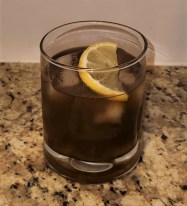
Jet Stream

  • 1.5 oz Crown Royal
  • 0.5 oz Crème de Violette
  • 0.5 oz Sweet Vermouth
  • Splash of Lime Juice
  • Dash of Agave Syrup
  • Dash of Angostura Bitters
  • Garnish with a Lemon Slice

I found this cocktail on a Jets Reddit page. Crown Royal is produced in Gimli, Manitoba, so I appreciate its inclusion in the beverage. This wraps the year-long NHL project. I hope you’ve enjoyed travelling the best sports league in the world with me!
Washington Capitals – All Caps Smash

Throughout the year, the Sip Advisor will alphabetically travel the National Hockey League (NHL), discovering the best and worst each team has to offer in a variety of subjects. We will also feature a drink based off the franchise. Today, we head to the U.S. capital to filibuster the Washington Capitals:

Establishment Story: The Capitals joined the NHL as an expansion team in 1974. Their first season was the worst ever for an NHL expansion team, finishing with a 8-67-5 record. Things didn’t get much better for the Capitals for the next few years and the team was in danger of being relocated in the early 1980s, before a ‘Save the Caps’ campaign kept the franchise in Washington.

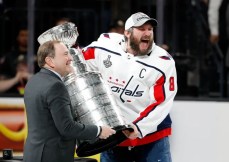
Stanley Cups: The Capitals have won one Stanley Cup, defeating the Vegas Golden Knights in 2018. Washington has played in one other Stanley Cup Final, being swept by the Detroit Red Wings in 1998. Even making the playoffs was once very difficult for the Capitals, as after joining the NHL in 1974, they didn’t reach the post-season for the first time until 1983. That was followed by 14 straight playoff appearances, though.

Celebrity Fan: Some of the Capitals celebrity supporters include Wheel of Fortune host Pat Sajak, who has been a season ticket holder for many years, and Wonder Woman actress Lynda Carter, who became a Washington fan early into the team’s existence, when she moved to the area. Both were present for and participated during the Capitals 2018 Stanley Cup championship run.

Ovechkin Cup

Super Fan: For many years, Capitals season ticket holder Sam Wolk was best known by other supporters as Horn Guy. During games, Wolk would blow his horn three times, leading the rest of the crowd to chant “Let’s go, Caps!” His fandom led to being cast in a Capitals advertising campaign and being included as part of the Caps Road Crew. Wolk crafted each of his horns himself, spending hours on them prior to the season.

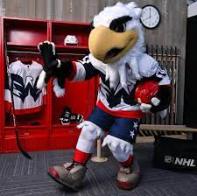
Mascot: Slapshot is a bald eagle, donning jersey number 00. He debuted with the team on November 18, 1995, and is sometimes flanked by secondary mascots, Air Slapshot and Hat Trick. The Capitals first mascot was Winger, who still makes rare appearances at games. Aside from the usual mascot work, riling up crowds and handing out merchandise, Slapshot even appeared on a 2009 episode of The Price is Right.

Tradition: The Capitals fight song, released in 2008, is called Rock the Red, by Washington, D.C. heavy metal band Darkest Hour. Fans of the team are also encourage to Rock the Red, by wearing red gear to home games. Another notable team slogan is Unleash the Fury, which is often used when the Capitals need to rally back from a deficit. Unleash the Fury was originally created by Scott Brooks, when he was a member of the Atlanta Thrashers organization.

Appearances in Media: The HBO sports documentary series 24/7: Road to the NHL Winter Classic series debuted in 2010, detailing the Capitals and Pittsburgh Penguins seasons, as they were set to meet in the 2011 Winter Classic. The four-part series highlighted the rivalry between superstars Alex Ovechkin and Sidney Crosby. Speaking of Ovechkin and Crosby, the two helped promote the 2011 Winter Classic with an appearance on The Price is Right, presenting a VIP prize package for the marquee game.

Slapshot

Events/Scandals: Following the 1989-90 campaign, four Capitals players – Dino Ciccarelli, Geoff Courtnall, Neil Sheehy and Scott Stevens – were accused of raping a 17-year-old girl, following a team season wrap-up event. While the case never made it to court, police believed there was enough evidence that a crime had occurred. In the aftermath, all but Ciccarelli never played for Washington again.

Rivalry: The Capitals have feuded with both Pennsylvania-based teams (Pittsburgh Penguins and Philadelphia Flyers), along with both New York City-located clubs (the Rangers and Islanders). All five franchises comprised the Patrick Division for much of its existence and remained together for the early years of the Atlantic Division and later Metropolitan Division. Washington was moved to the Southeast Division from 1997 to 2013.

Tragedy: For an almost 50-year-old franchise, the Capitals have managed to avoid player misfortunes. There has been deaths of notable fathers close to the organization, including T.J. Oshie’s dad, Tim, and Alex Ovechkin’s dad, Mikhail. Tim Oshie was suffering with Alzheimer’s during Washington’s 2018 Stanley Cup run, with the son and father embracing during the championship celebration becoming one of its most memorable moments. Mikhail Ovechkin also spent a lot of time around the team, before health issues.

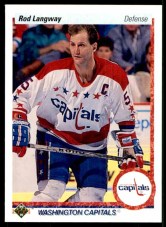
Player Nicknames: There’s been some clever nicknames in Capitals history. First, rearguard Rod Langway was dubbed the Secretary of Defense, based on the team playing in the American capital. Next, goalie Jim Carey was given the moniker Net Detective, a play on actor Jim Carey’s Ace Ventura: Pet Detective film. And you can’t forget superstar Alex Ovechkin earning the nickname The Great Eight, based on his play and number.

Rod Langway

Line: Alex Ovechkin has been a constant on the Capitals best line for close to two decades. Over that time, he has been combined with Alex Semin and Nicklas Backstrom as the SOB Line, as well as with Evgeny Kuznetsov and Tom Wilson. At times, Backstrom has taken the place of Kuznetsov, to complete the unit. Ovechkin holds the NHL record for career power play goals, so those five-man groupings deserve great credit.

Captain: Alex Ovechkin has served as the Capitals captain since January 2010, following the trade of Chris Clark to the Columbus Blue Jackets. Ovechkin would lead the team to their only Stanley Cup championship, winning the Conn Smythe Trophy as playoffs MVP, in the process. Ovechkin continues to wow crowds to this day, as he chases down Wayne Gretzky’s NHL record for most career goals.

Enforcer: Dale Hunter has the second most penalty minutes in NHL history and ranks first in playoff penalty minutes. Much of that time spent in the penalty box was accrued as a member of the Capitals, with Hunter holding the franchise penalty minute record with 2,003. Shockingly, he does not hold the single-season record, however. His 12-year stint with the team was honoured with the Capitals retiring Hunter’s jersey in 2000.

Family Values: Brothers Dale and Mark Hunter were both members of the Capitals in 1992-93, although Mark only played seven games for the squad and retired at the end of that season. Also in 1992-93, brothers Kelly and Kevin Miller played for Washington together, with Kevin suiting up for 10 games. A third Miller brother, Kip, played two seasons with the Capitals a decade later.

Dale Hunter

Returning Players: A number of players have spent two stints with the Capitals, including former third overall (1981) draft pick Bobby Carpenter, defenseman Sylvain Cote, enforcer Craig Berube, checking center and published author Eric Fehr, all-time Ukrainian scoring leader Dmitri Khristich, and winger Todd Krygier. Additionally, goalie Vitek Vanecek was a Seattle Kraken expansion draft selection from Washington, only to be returned to the Capitals via trade a week later.

Short Stint: While not the most glamorous name that could have been included here, John Kordic’s seven-game tenure with the Capitals in 1990-91 was productive, with nine fights and 101 penalty minutes, as well as two suspensions (one from the team and another from the league). Tragically, Kordic died in August 1992, never able to overcome the demons he was battling when he joined Washington. Kordic’s death came after a drug-fuelled police incident in L’Ancienne-Lorette, Quebec.

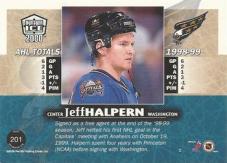
Undrafted: Jeff Halpern was signed by the Capitals out of college in 1999, becoming the first player born and raised in the Washington, D.C. region to play for the team. He even played on the Little Caps minor hockey team as a youngster. Halpern remained with the organization until 2006, serving as captain for the 2005-06 campaign, and also joined the club for the 2011-12 season. In 2023, Halpern was an unsuccessful candidate for the Capitals vacant head coach position.

Trade: With the Capitals having never made the playoffs in their eight years of existence, in the 1982 off-season, they acquired defenseman Rod Langway (along with Doug Jarvis, Craig Laughlin and Brian Engblom) from the Montreal Canadiens for Ryan Walter and Rick Green. Langway replaced Walter as team captain and Washington made the post-season in each of the next 11 seasons, with Langway winning two Norris trophies along the way, until he retired during the 1992-93 campaign.

Jeff Halpern

Signing: On July 1, 2014, newly-minted Capitals GM Brian MacLellan made two contract offers that would pay great dividends down the road. On the opening of free agency, MacLellan signed defensemen Brooks Orpik and Matt Niskanen (both taken from the Pittsburgh Penguins) to five-year, $27.5 million and seven-year, $40.25 million contracts, respectively. Both would be members of the 2018 Stanley Cup championship squad, with Orpik scoring the Finals Game 2 winner.

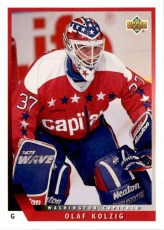
Draft Pick: The Capitals have selected first overall three times in franchise history, highlighted by taking Alex Ovechkin in 2004. Some other top picks for the team, include fourth overall choices Mike Gartner (1979) and Nicklas Backstrom (2006), Scott Stevens (5th overall in 1982) and Olaf Kolzig (19th overall in 1989). One of Washington’s greatest draft steals was selecting Peter Bondra at 156th overall in 1990.

Holdouts: The Capitals have experienced a number of holdouts over the years, sometimes with two players or more sitting out much of training camp. This includes Peter Bondra and Michal Pivonka in 1995, as well as the trio of Jan Bulis, Sergei Gonchar and Chris Simon in 2000. Others to go through a contract dispute at different lengths with the team are Kevin Hatcher (1990), Don Beaupre (1991) and Adam Oates (1997).

Buyouts: The Capitals have only used three buyouts over the course of the salary cap era, with the most expensive being defenseman Jeff Schultz, who was owed $2 million, when a compliance buyout was used on the final year of his deal in 2013. Other buyout recipients were Ben Clymer in 2008 and Tyler Sloan in 2011, each with one year remaining and $616,667 and $466,667 due, respectively.

Olaf Kolzig

Unique Game: Washington played the 2011 Winter Classic versus the Pittsburgh Penguins, 2015 Winter Classic against the Chicago Blackhawks, a 2018 Stadium Series contest opposed by the Toronto Maple Leafs, and a 2023 Stadium Series match opposite the Carolina Hurricanes. Internationally, the Capitals played a four-game exhibition series versus the Kansas City Scouts in Japan, winning the Coca-Cola Bottlers’ Cup. They also participated in the 1980 and 1981 DN-Cup, which were round robin tournaments in Sweden.

Goal: Despite the importance of Lars Eller’s Stanley Cup-clinching goal in 2018, one of the greatest tallies in NHL history belongs to the future league goal scoring king, Alex Ovechkin. With so many goals to his name (currently at 827), what made this one against the Arizona Coyotes so special was Ovechkin scored from his back, while hooking the puck into the net. This occurred during Ovechkin’s rookie season, setting a high bar for future goals to be compared to.

Fight/Brawl: For whatever reason, nothing brings NHL fans to their feet quicker than a goalie fight. In 2013, they got one, when Braden Holtby battled Ray Emery of the Philadelphia Flyers. Holtby was somewhat of an unwilling combatant, given Emery’s reputation as a fighter (not to mention he had no reason to drop the gloves, given the Capitals were winning handedly), but the two tussled anyway.

Injury: On December 23, 2022, defenseman John Carlson took a slapshot to the side of the head, resulting in a small skull fracture and severed temporal artery. On the plus side, Carlson never lost consciousness and was not concussed on the play. The injury also necessitated Carlson’s ear having to be partially reattached. Carlson was able to return to the team before the end of the season.

Ovechkin Scores

Penalty: During the 1993 playoffs, Pierre Turgeon scored for the New York Islanders, putting his team up 5-1 and confirming the Capitals would be eliminated. While celebrating, Turgeon was slammed into the boards by a frustrated Dale Hunter, who had lost the puck, leading to the goal. Turgeon suffered a separated shoulder from the hit, while Hunter was handed a 21-game suspension, then an NHL record.

Wildest Story: The 1974-75 inaugural season for the Capitals is viewed as one of the worst campaigns for a team in NHL history, with their .131 winning percentage (8-67-5 record) remaining a league record. When the club finally won their first road game towards the end of the year, they celebrated like winning the Stanley Cup, using a garbage can as a trophy.

Blooper: One of the funniest moments in NHL history took place in January 2009, when Alex Semin dropped the gloves with Marc Staal of the New York Rangers. What followed resembled a percussion musician playing the bongos, as Semin slapped at the head of Staal. Semin would never be confused as an enforcer, but young kids can throw better punches than he displayed in this tilt.

Miscellaneous: The Capitals (along with the Washington Wizards of the National Basketball Association (NBA) – both teams owned by Ted Leonsis) are potentially set to move south to Alexandria, Virginia. The franchises would play out of a new sports and entertainment complex, set to open in 2028. Speaking of Capitals owners, it should also be noted NBA megastar Michael Jordan once had a minority stake in the club.

Washington Capitals: All Caps Smash

All Caps Smash

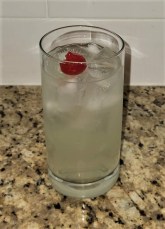
  • 2 oz Vodka
  • Top with Grapefruit Juice
  • Garnish with a Maraschino Cherry

This drink is based off a ready-to-drink canned cocktail served at Capitals games. It is produced by Devils Backbone Distilling Co. I threw in the Maraschino Cherry so even the beverage was rocking the red!

Vegas Golden Knights – Knight Time

Throughout the year, the Sip Advisor will alphabetically travel the National Hockey League (NHL), discovering the best and worst each team has to offer in a variety of subjects. We will also feature a drink based off the franchise. Today, we travel to Sin City to take a gamble on the Vegas Golden Knights:

Establishment Story: The Golden Knights joined the NHL as an expansion team in 2017. Vegas played their expansion draft to perfection, putting together a lineup of “misfits/castoffs” that ended up working very well together. This changed the trajectory of the franchise and instead of struggling for many years, as most expansion clubs do, the Golden Knights have chased the Stanley Cup instead.

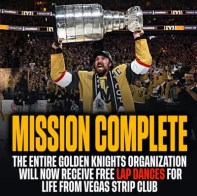
Stanley Cups: The Golden Knights captured their first Stanley Cup (2023) in only their sixth season of existence, just as owner Bill Foley forecast, defeating the Florida Panthers. They also came incredibly close in their first year of operation, losing in the 2018 Finals to the Washington Capitals. Vegas has been a contender nearly every season, missing the playoffs only once.

Celebrity Fan: Being based in the entertainment capital of Las Vegas has allowed for many celebrity supporters to adopt the team. This includes long-time performers in the city, such as Wayne Newton, Criss Angel and Carrot Top. Other inhabitants of Vegas, including poker player Daniel Negreanu, chef Gordon Ramsay and boxing ring announcer Michael Buffer have also had associations with the team.

Golden Knights

Super Fan: John ‘Hulk’ Baratta was an original Golden Knights season ticket member, who attended games sporting a Hulk Hogan-style mustache and dressed in a shirt he would rip off when Vegas scored. Sadly, Baratta passed away in March 2020, prompting the Golden Knights to honour him with a video tribute at their next home game. Fans in Baratta’s usual section were given tear-away shirts, which they ripped off when Vegas scored.

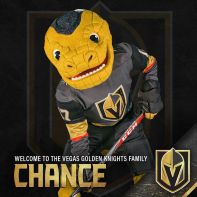
Mascot: Chance is a gila monster who came to the team from Red Rock Canyon, located outside Las Vegas. The lizard, coloured the same as the hockey team, debuted at the Golden Knights second ever home game on October 13, 2017. Vegas purposely stayed away from using a knight as their mascot, as they felt examples from other teams weren’t very child-friendly.

Tradition: The Golden Knights home rink, T-Mobile Arena, has quickly become one of the most raucous barns in the NHL. This is thanks to in-game entertainment, highlighted by a battle between knights, themed around that game’s combatants. Given T-Mobile Arena’s location along the Vegas strip, the fun begins well before game time, including a parade that winds its way from the Brooklyn Bridge outside New York New York up to the building.

Appearances in Media: The Golden Knights inaugural season is documented in the film Valiant, released in 2019. The movie received its premiere screening at T-Mobile Arena. Many also believe that first Cinderella season could eventually be turned into a Hollywood film, with casting choices including Anthony Hopkins as coach Gerard Gallant, Jon Hamm as GM George McPhee and Adrien Brody as goalie Marc-Andre Fleury.

Chance

Events/Scandals: As the Golden Knights chased the Stanley Cup, under the mandate of owner Bill Foley, some have accused the team of being disloyal to players who helped the team become successful. Original misfits, such as Erik Haula, Nate Schmidt and Marc-Andre Fleury (the first face of the franchise), were callously jettisoned to make room for replacements/in salary cap dumps. With a Stanley Cup won in just year six of existence, some would argue the ends justify the means.

Rivalry: A top rival to the Golden Knights, thanks to a nasty playoff history, is the San Jose Sharks. Facing each other in back-to-back post-seasons, both clubs have won one series. The hatred between the teams has diminished lately, though, as San Jose is going through a long-term rebuild. Another adversary of Vegas is any fan who believes their success came to soon and more suffering should have been endured in the team’s earliest years.

Tragedy: On October 1, 2017, days before the Golden Knights played their first-ever game, 64-year-old Stephen Paddock shot and killed 58 people from his 32nd-floor suite in the Mandalay Bay hotel. The victims were attending the Route 91 Harvest music festival nearby. For Vegas’ home opener on October 10, the team paid tribute to those slain, retiring jersey #58, as a remembrance of the incident.

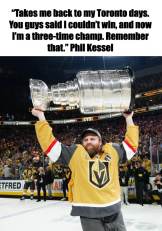
Player Nicknames: Phil Kessel, holder of the NHL’s Iron Man record at 1,064 consecutive games played, joined the Golden Knights for the 2022-23 season. Known for his prolific scoring, rather than his defensive acumen, Kessel was nicknamed Selke by teammates, a reference to the NHL trophy given to the best defensive forward each season. Another good moniker was given to goaltender Marc-Andre Fleury, who was dubbed The Dude, during his time with Vegas, comparing him to the protagonist of The Big Lebowski.

Phil Kessel

Line: The Misfit Line, comprised of William Karlsson, Jonathan Marchessault and Reilly Smith, played together since the Golden Knights began play in 2017, up until Smith was dealt to the Pittsburgh Penguins in the 2023 off-season. Each joined the team as part of the Expansion Draft, with Karlsson and Marchessault being selections and Smith being traded so Vegas selected Marchessault. In year one, Karlsson scored 43 goals, a single-season NHL expansion team record.

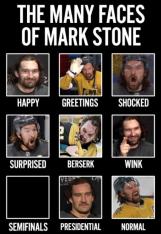
Captain: Mark Stone is the only captain in Golden Knights history, given the distinction on January 13, 2021. Prior to Stone’s appointment, the team had gone with groups of alternate captains, with Deryk Engelland and Reilly Smith being part of the leadership group for each season, along with others. In 2017-18, six different players wore an ‘A’ at some point for the club.

Enforcer: Ryan Reaves holds the Golden Knights single-season penalty minutes record with 74. The record was set in 2018-19, Reaves first full season with the team after coming over from the Pittsburgh Penguins in February 2018. In the 2021 off-season, Reaves was traded to the New York Rangers, in exchange for a third-round draft pick in 2022. Brayden McNabb holds the team’s all-time penalty minute record, while Keegan Kolesar has the most fighting majors in Vegas history.

Family Values: Vegas has yet to have any family members play together or even at different times in their brief history. The best I can fill this section is to highlight second generation/brotherly players who have suited up for the Golden Knights, such as Jake Leschyshyn, whose father Curtis Leschyshyn played 1,033 NHL games; Brett Howden whose older brother is Quinton Howden; and Reilly Smith whose older brother is Brendan Smith.

Mark Stone

Returning Players: While his tenure with the team technically never ended, the Golden Knights did attempt to trade forward Evgenii Dadonov to the Anahemi Ducks at the 2022 NHL trade deadline, with the transaction voided, due to Dadonov having Anaheim on his no trade list. The Ottawa Senators, who had previously traded Dadonov to Vegas, had neglected to inform the Golden Knights of his no-trade contract clause, leading to later punishment of the Senators organization.

Short Stint: A number of the players that were integral to the Golden Knights successful inaugural season left the team that campaign. This included early stars David Perron and James Neal. Also, goaltender Jonathan Quick joined Vegas for 10 regular season games and zero playoff appearances, winning his third Stanley Cup as the Golden Knights took home the 2023 championship.

Undrafted: Defenseman Zach Whitecloud was signed out of college by the Golden Knights in 2018. He remains with the team to this day, having signed a six-year, $16.5 million contract extension in 2021. Whitecloud is the first player to reach the NHL from the Sioux Valley Dakota Nation and was a member of the team’s 2023 Stanley Cup championship squad. During that playoff run, Whitecloud contributed two goals and six assists.

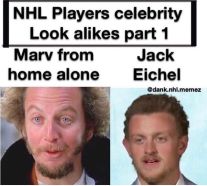
Trade: With the early success of the franchise, the Golden Knights have often gone big game hunting, in on every NHL star that becomes available. This has led to the team acquiring the likes of Mark Stone, Max Pacioretty and Jack Eichel via trade. While giving up notable assets to add these players to the roster, both Stone and Eichel were key cogs of the 2023 Stanley Cup-winning crew.

Jack Eichel

Signing: Much like going after big fish in trades, Vegas has also pursued many of the top free agents in their early years. The organization’s best signing was luring Alex Pietrangelo from the St. Louis Blues in 2020, inking the former Blues captain to a seven-year, $61.6 million pact. Pietrangelo brought with him to Vegas the experience of winning the 2019 Stanley Cup, hoisting a second championship with the Golden Knights.

Draft Pick: Vegas entered their first ever draft in 2017 with three first round picks. They selected Cody Glass (6th overall), Nick Suzuki (13th overall) and Erik Brannstrom (15th overall), all of which have been traded away in an attempt to sustain the unprecedented success of the team’s first season. Later, Peyton Krebs (17th overall in 2019) would also be sent packing as part of another trade package.

Holdouts: Following his breakout rookie season, defenseman Shea Theodore was due a new contract. With each side looking for a different length to his next deal, Theodore missed the first two weeks of training camp, before finally putting pen to paper. With a seven-year, $36.4 million pact finalized, Theodore continued his upward trajectory, even while being treated for testicular cancer.

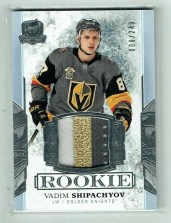
Buyouts: Vadim Shipachyov’s time in the NHL was brief, but interesting. The Golden Knights signed him out of the Kontinental Hockey League in May 2017, before they had even formed the bulk of their team via the expansion draft. After three games to begin Vegas’ inaugural season, Shipachyov was demoted to their minor league affiliate. After failing to report to the team, Shipachyov’s contract was terminated and he returned to Russia.

Vadim Shipachyov

Unique Game: Despite their short history, the Golden Knights have already been summoned to participate in a number of marquee NHL events. First, Vegas faced the Colorado Avalanche as part of the 2021 Outdoors at Lake Tahoe. They are also set to oppose the Seattle Kraken for the 2024 Winter Classic. Lastly, the Golden Knights played a pre-season game in both 2021 and 2022 against the Los Angeles Kings in Salt Lake City, with the contests dubbed Frozen Fury.

Goal: James Neal scored the first two goals in franchise history, earning the Golden Knights their first ever victory. Years later, Jonathan Marchessault tallied three game-winning goals in the 2023 playoffs, earning the Conn Smythe Trophy for his efforts, becoming the first undrafted player to win the playoff MVP award since Wayne Gretzky in 1988. Vegas’ cup-clinching game was won with a score of 9-3, the game-winning goal coming off the stick of Reilly Smith.

Fight/Brawl: As the Golden Knights took a commanding 3-1 lead at the end of Game 4 of the 2023 Stanley Cup Finals versus the Florida Panthers, a typical scrum between the two teams began. The gathering quickly turned into more than just players grabbing jerseys, as some combatants started fighting with one another. Adding to the chaos was frustrated Florida fans littering the ice with debris. The Panthers were assessed 26 penalty minutes in the melee, while Vegas walked away with just two penalty minutes.

Injury: The Golden Knights have always seemed to struggle with injuries to their goaltenders. In their first month of NHL play, they were forced to use four different backstops and five goalies appeared for the team in that inaugural campaign. The trend has continued with starting netminder Robin Lehner missing two full seasons with chronic hip issues and the team using a triage of goalies en route to their Stanley Cup championship.

Lake Tahoe

Penalty: In the first round of the 2019 playoffs, the Golden Knights were up 3-0 in Game 7 of their series against the San Jose Sharks. Off a faceoff, Vegas center Cody Eakin cross-checked Sharks center Joe Pavelski, who fell awkwardly, hitting his head and becoming injured. The referees gave Eakin a five-minute major for a hit to the head. San Jose scored four goals on that power play, eventually winning the game 5-4 in overtime. Golden Knights GM George McPhee said the NHL later called to apologize for the penalty call error.

Wildest Story: For their inaugural season, the Golden Knights were given 500-1 odds of winning the Stanley Cup. When the team exceeded expectations and made the Finals, sportsbooks must have grown a little nervous about potential payouts. All tolled, only 13 bets were placed on Vegas at 500-1, all $20 or less. That said, a $20 wager would earn $10,000 in winnings, while $1 gambles would translate to a $500 payout. It was all moot, though, as Vegas failed to win the championship.

Blooper: During an April 2022 game against the Vancouver Canucks, the Golden Knights handed their opponents an easy power play goal. William Karlsson won a faceoff in his own zone, drawing the puck back to defenseman Alec Martinez, who while trying to play the puck, redirected it past goaltender Robin Lehner. The tally was credited to Bo Horvat, who took the faceoff for Vancouver. In the end, Vegas still managed to win the game 3-2 in overtime.

Miscellaneous: Lil Jon, who has been attached to the Golden Knights on occasion, is actually listed as the team’s Offensive Coordinator on their website, thanks to a funny viral video, featuring the rapper. The video sees head coach Bruce Cassidy bring in Jon to help his club’s offensive woes, with the rapper advising all will be well if the team just takes “shots, shots, shots… YEAH!”

Vegas Golden Knights: Knight Time

Knight Time

  • 1.5 oz Whiskey
  • 0.5 oz Orange Liqueur
  • Top with Sweet & Sour Mix
  • Garnish with Lemon and Lime Slices

A number of bars around Vegas have got in on the act of supporting the Golden Knights with themed cocktails. This particular offering can be found at Station Casinos around the infamous vacation destination.

Vancouver Canucks – Vancouver Canucks Cocktail

Throughout the year, the Sip Advisor will alphabetically travel the National Hockey League (NHL), discovering the best and worst each team has to offer in a variety of subjects. We will also feature a drink based off the franchise. Today, we look at the Vancouver Canucks, the Sip Advisor’s hometown and favourite squad. I’ll try my best to not show any bias!:

Establishment Story: The Canucks joined the NHL as an expansion team in 1970. Previously, minor league versions of the Canucks played in the Pacific Coast Hockey League and Western Hockey League from 1945-70. Canucks owners had bid to join the NHL for its 1967 expansion, but were denied. They also tried to have the Oakland Seals moved to Vancouver, but that was vetoed by the NHL.

Stanley Cups: The Canucks have not won the big one, despite appearing in three Stanley Cup Finals (1982 vs. New York Islanders, 1994 vs. New York Rangers and 2011 vs. Boston Bruins). In two of those championship series, they played to a seventh and deciding game, coming up short both times. Vancouver did win back-to-back President’s Trophies in 2011 and 2012, but the ultimate prize has always eluded the franchise.

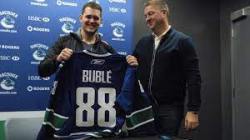
Celebrity Fan: Singer Michael Bublé is a passionate supporter of the Canucks, as the Burnaby native has been for most of his life. Bublé even has an ownership stake in the Western Hockey League Vancouver Giants junior team. Bublé is such a hockey fan, part of his concert contract rider asks each promoter to include the puck of a local team in his dressing room.

Buble

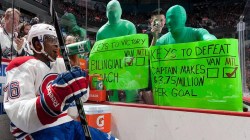
Super Fan: First appearing on December 22, 2009, the infamous Green Men – wearing full-body spandex outfits – quickly became recognizable fixtures at Canucks games. Taking their seats next to the visitor’s penalty box, the Green Men (Adam ‘Force’ Forsyth and Ryan ‘Sully’ Sullivan) would mercilessly mock those sent to the sin bin with signs and other antics. The duo was inducted into ESPN’s Hall of Fans, before retiring after the 2014-15 season.

Mascot: Fin the Whale was introduced on June 4, 2001. Among the orca/killer whale’s favourite things are B.C. salmon, the book Moby Dick and the movie Free Willy… not to mention arena popcorn! His least favourite team, of course, would be the defunct Hartford Whalers. While Fin is perhaps best known for his charity appearances, he also has a habit of chomping unsuspecting fan’s heads.

Tradition: Towel Power was born during the 1982 Campbell Conference Finals. When coach Roger Nielson grew frustrated over what he viewed to be lopsided officiating, he waived a white towel attached to a raised stick as his sign of surrender. Upon the team’s return to home ice, fans began waving towels in support of the coach and team. The Canucks won three straight, advancing to their first Stanley Cup Finals.

Appearances in Media: Thanks to actress Cobie Smulders hailing from Vancouver, like her How I Met Your Mother character Robin Scherbatsky, a number of references to the Canucks occurred over the course of the sitcom’s nine seasons. These included multiple occasions where Scherbatsky is clad in a Canucks jersey, mentions players from the team and attends a Canucks-New York Rangers game.

Green Men

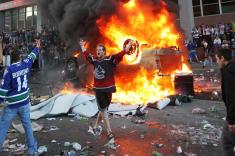
Events/Scandal: Following their defeats in both the 1994 and 2011 Stanley Cup Finals, Downtown Vancouver became engulfed in riots that destroyed property and caused numerous injuries. Thankfully, in both incidents, no deaths were reported. In the aftermath of the 2011 riot, 887 criminal charges were laid against 301 suspects, hopefully deterring future similar behaviour.

Rivalry: The Canucks lacked a true geographic rival until the Seattle Kraken entered the NHL in 2021. Up to that point, rivalries with fellow western Canada clubs the Calgary Flames and Edmonton Oilers have always existed, as well as incident- and playoff-born rivalries with teams such as the New York Rangers, Colorado Avalanche, Chicago Blackhawks and Boston Bruins.

Tragedy: The Canucks franchise has been struck with tragedy on a few occasions. One of the team’s first stars, Wayne Maki, was diagnosed with brain cancer in 1972, succumbing to the disease in 1974, aged 29. Then, in 2008, defenseman Luc Bourdon was killed in a motorcycle accident at the young age of 21. Finally, forward Rick Rypien committed suicide in the 2011 off-season, after his tenure with Vancouver, but before debuting with the Winnipeg Jets.

Player Nicknames: Canucks history is loaded with great nicknames. Among them: Russian Rocket (Pavel Bure), Steamer (Stan Smyl), Captain Kirk (Kirk McLean), Brockstar (Brock Boeser), King Richard (Richard Brodeur), and JovoCop (Ed Jovanovski). An underrated entry would be Cowan the Brabarian, given to Jeff Cowan after a bra was thrown on the ice following a goal from the enforcer.

Riot

Line: Two Canucks lines had very successful runs as a unit. First, the West Coast Express (Markus Naslund, Todd Bertuzzi and Brendan Morrison) terrorized opponents from 2002-06. The line was named after Vancouver’s commuter train line. Second, the Lotto Line (Brock Boeser, Elias Petterson and J.T. Miller) had a shorter but memorable stint together. The trio received its moniker when a Twitter user realized their numbers 6, 40 and 9, matched the local 649 lottery.

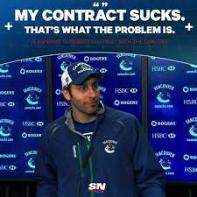
Captain: While the Canucks have had a number of memorable leaders, including Stan Smyl, Trevor Linden and Henrik Sedin, in 2008, the organization abandoned all convention, naming goalie Roberto Luongo as the team’s captain. He was the first netminder to hold such an honour since 1947-48. Luongo’s reign as team leader lasted only two seasons, before it was mutually agreed he should relinquish the role.

Enforcer: Canucks history is littered with teams that couldn’t beat opponents on the scoreboard, so they just tried to beat them up. Among the franchise’s many fighters, perhaps the most beloved was – and still is – the ‘Algonquin Assassin’ Gino Odjick. Odjick holds the team record for total penalty minutes at 2,127, over eight seasons with the club. Odjick also holds five of the top 10 slots for penalty minutes in a season.

Family Values: The Canucks have a long history of family relations within the organization. This is best highlighted with the Sedin twins, who were able to come to Vancouver together thanks to the incredible draft day dealings of GM Brian Burke. The Canucks also united the Courtnall brothers – Geoff and Russ, from nearby Vancouver Island – for 13 games in the 1994-95 season.

Gino Odjick

Returning Players: The trading of Trevor Linden during the 1998 Olympic break never seemed right for both the player and the organization. That was all remedied in 2001, when Linden was reacquired by the Canucks. Linden played out the rest of his career with the team, reaching 1,000 games played and points scored with the club it was meant to happen with.

Short Stint: A free agent in 2008, Toronto Maple Leafs icon Mats Sundin weighed contract offers from a number of teams, while also considering retirement. The Canucks two-year, $20 million offer would have made Sundin the highest paid player in the NHL. After sitting out the start of the season, Sundin finally put pen to paper with Vancouver on December 18, 2008, being paid a prorated $5 million for the season. Sundin played 49 games combined (regular season and playoffs) with the Canucks, before retiring.

Undrafted: Alex Burrows story of perseverance from undrafted to star player is inspiring. He quickly rose through the ranks of the minor leagues, joining the big league squad in January 2006 and never looked back. Originally a checker, Burrows eventually found himself on the top line, where he and the Sedins became a popular trio. Burrows was added to the Canucks Ring of Honour in 2019.

Trade: Among the best moves the Canucks have made are acquiring Roberto Luongo from the Florida Panthers and stealing Markus Naslund from the Pittsburgh Penguins. Both trades are among the most lopsided in NHL history. On the flip side, dealing a young, homegrown Cam Neely to the Boston Bruins has always been lamented by Canucks fans. While the return was decent, Neely blossomed into a superstar, plus they also gave up a first-round draft pick in the transaction.

Trevor Linden

Signing: There are more bad signings in Canucks history than good ones. Among the worst would be Mark Messier’s three-year, $18 million pact in 1997 and Loui Eriksson’s six-year, $36 million deal in 2016. Messier was a cancer in the Canucks locker room, while Eriksson vastly underperformed his contract, both drawing the ire of the fan base. Also, Roberto Luongo’s 12-year, $64 million resigning in 2009, eventually led to a three-year, $3 million cap recapture penalty, upon Luongo’s retirement.

Draft Pick: The Canucks have never selected first overall, but have done fairly well with the number two pick, using their first ever choice in 1970 on Dale Tallon and also getting Trevor Linden (1988) and the Sedin twins (1999) at second and third. Their greatest draft steal was Pavel Bure in the sixth round, 113th overall. The Nucks drafted Bure in 1989, despite confusion over his eligibility.

Holdouts: Once the team’s most popular superstar, Pavel Bure’s exit from the Canucks was ugly. Following the 1997-98 season, Bure gave new GM Brian Burke the first headache of his tenure, stating he would not play the final year of his contract. It took until January 17, 1999, for Bure (along with Bret Hedican, Brad Ference and a third-round draft pick) to be sent to the Florida Panthers in exchange for Ed Jovanovski, Dave Gagner, Mike Brown, Kevin Weekes, and a first-round draft pick.

Buyouts: The Canucks own the largest non-compliance buyout in the NHL salary cap era, used to terminate the contract of defenseman Oliver Ekman-Larsson. Ekman-Larsson had joined Vancouver via trade in 2021, lasting only two seasons before his eight-year, $66 million deal was bought out with four seasons remaining. Ekman-Larsson will be paid by the Canucks $19.33 million over eight years.

Roberto Luongo

Unique Game: The Canucks have taken part in a number of NHL international firsts. The first regular season games played outside North America saw Vancouver and the Mighty Ducks of Anaheim meet for a pair of 1997-98 season-opening contests in Tokyo, Japan. In 2017, the Canucks would play two pre-season games against the Los Angeles Kings in Shanghai and Beijing, China. These were the first NHL matches ever played in the country. Vancouver also hosted the 2014 Heritage Classic, facing the Ottawa Senators.

Goal: Two Alex Burrows goals during the 2011 run to the Stanley Cup Finals are among the greatest in team history. First the ‘Slay the Dragon’ Game 7 overtime winner versus the Chicago Blackhawks finally put the Canucks past their nemesis. Later, Burrows tally mere seconds into overtime of Game 2 of the Stanley Cup Finals versus the Boston Bruins gave Vancouver a 2-0 series lead, causing mass hysteria across the province.

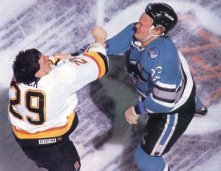
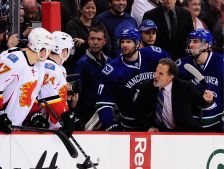
Fight/Brawl: When Canucks coach John Tortorella saw the Calgary Flames starting lineup flush with goons prior to a 2014 game, he knew something was up. Kellen Lain was playing his first NHL game and a receipt was due for an injury he’d caused in an earlier minor league contest. A line brawl ensued to start the game, with Lain and others ejected from the match. At intermission, Tortorella went to the Flames dressing room, trying to confront Calgary coach Bob Hartley. This resulted in a 15-day suspension for Tortorella.

Injury: On February 11, 2000, Canucks enforcer Donald Brashear fought and defeated his Boston Bruins counterpart Marty McSorley. McSorley pursued a rematch, which Brashear turned down. Late in the contest, McSorley hit Brashear in the side of the head with his stick, knocking Brashear unconscious. Brashear suffered a seizure and concussion, while McSorley was suspended indefinitely, ending his career. McSorley was later convicted of assault with a weapon and sentenced to 18 months probation.

John Tortorella

Penalty: The Todd Bertuzzi-Steve Moore incident is one of hockey’s biggest black eyes. The Canucks were out for revenge after Moore had previously elbowed Canucks captain Markus Naslund, resulting in a concussion. In the midst of a blowout loss, Bertuzzi punched Moore in the back of the head, knocking him out. The resulting fall fractured three of Moore’s neck vertebrae. Criminal and civil action followed, along with Bertuzzi being suspended for the rest of the 2003-04 season and throughout the 2004-05 lockout.

Wildest Story: Canucks fans have long had a feeling the team is cursed, dating back to one of the team’s first official activities. To decide which of Vancouver and the Buffalo Sabres would get the first overall choice in the 1970 NHL Draft, a roulette wheel was used. NHL president Clarence Campbell declared the Canucks the winners, before it was pointed out the ball didn’t stop on number one, but 11 instead. Thus, the Sabres earned the right to select junior standout Gilbert Perreault.

Blooper: In the first round of the 2002 playoffs, the surprising Canucks were up 2-0 in their series against the Presidents’ Trophy-winning Detroit Red Wings. What happened next changed the entire course of the series, as Red Wings defenseman Nicklas Lidstrom launched a shot from center ice, beating Canucks goalie Dan Cloutier. Detroit won four straight games, eliminating the Canucks, en route to another Stanley Cup.

Miscellaneous: Wayne Gretzky, the greatest player in NHL history, twice almost became a Canuck. In 1988, before he was traded to the Los Angeles Kings, the Canucks could have had ‘The Great One’ for $25 million, Kirk McLean, Greg Adams and three first-round draft picks. A decade later, Gretzky was a free agent and had committed to signing with Vancouver, until he was pressured to put pen to paper and didn’t like the pushy approach. He ended up with the New York Rangers to finish his career.

Vancouver Canucks: Vancouver Canucks Cocktail

Vancouver Canucks Cocktail

  • 1 oz Vodka
  • 0.5 oz Melon Liqueur
  • 0.5 oz Blue Curacao
  • Splash of Lemon Lime Soda

For this cocktail, you mix the Vodka, Melon Liqueur and Lemon Lime Soda, before adding a float of Blue Curacao. The Canucks are looking good this season, renewing the faith of the countless disappointed diehards of this franchise. Go Canucks Go!!!

Toronto Maple Leafs – Toronto Maple Leafs

Throughout the year, the Sip Advisor will alphabetically travel the National Hockey League (NHL), discovering the best and worst each team has to offer in a variety of subjects. We will also feature a drink based off the franchise. Today, we *looks at calendar*… ugh, travel to Toronto to investigate why the Maple Leafs have often been named the “Most Hated Team in Hockey”:

Establishment Story: The Toronto hockey team was founded in 1917. The club was known as the Arenas and later St. Patricks, before finally receiving the Maple Leafs moniker in 1927, when the team was bought by Conn Smythe. An Original Six franchise, the Leafs were rebranded by Smythe to match the national symbol of Canada. They were also to wear red and white jerseys, but briefly wore white and green, before settling on their iconic blue and white.

Stanley Cups: None since 1967 and that’s all that really matters. Seriously, though, the Leafs have won 13 championships, all of which occurred when the league consisted of only six teams. The Leafs have two recognized dynasties, from 1946-51 and 1961-67. Not only has the team not won a Stanley Cup since 1967, they have no Finals appearances since then, as well, with five Conference Finals losses during that time.

Celebrity Fan: Somehow, the Leafs have quite the collection of celebrity supporters. Actors Mike Myers, Jim Carrey, Will Arnett and Keanu Reeves support the team, along with musicians Justin Bieber and Drake. Professional wrestler Edge is a fan, as is astronaut Chris Hadfield. As for female celebs, tennis star Bianca Andreescu can often be seen rocking the blue and white. Personally, I think they’re all nuts!

Leafs Blue

Super Fan: Steven Glynn, better known by the moniker Steve Dangle, turned his Leafs fandom into a career. Dangle went from posting YouTube videos to becoming an analyst for Sportsnet. His book This Team Is Ruining My Life (But I Love Them): How I Became A Professional Hockey Fan, was released in 2019 to critical acclaim. Today, Dangle co-hosts a podcast and the blooper web series Steve’s Dang-Its.

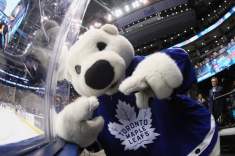
Mascot: Carlton the Bear is a polar bear, named for the street Maple Leaf Gardens was located. Carlton wears jersey number 60, in homage to the address of the iconic arena. Carlton debuted for the 1995-96 season. At the 2000 NHL All-Star Game in Toronto, Carlton hosted the inaugural Mascot Summit. Carlton is on track to surpass long-time Leafs player George Armstrong for most appearances with the franchise during the 2023-24 season.

Tradition: The Leafs greatest ritual is losing, particularly in the first round of the playoffs, if they even get there. Just kidding! When the team has made the post-season in more recent years, fans have gathered in Maple Leaf Square, located outside Scotiabank Arena. This has provided the Sip Advisor with many moments of schadenfreude, as Toronto supporters have been visibly crushed by losses. I must admit, their tears sustain me!

Appearances in Media: The Leafs most prominent appearance in popular culture is in the Mike Myers’ movie The Love Guru, where Myers plays a guru tasked with fixing the team’s players, particularly star Darren Roanoke. The Leafs were also heavily featured in the 1971 Canadian film Face-Off. Another notable appearance in media is Toronto’s inclusion in the children’s book The Hockey Sweater.

Carlton the Bear

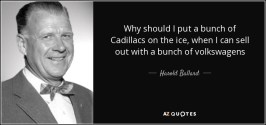
Events/Scandals: The Harold Ballard years as owner of the Leafs were filled with controversies, with perhaps the most notable blemish on the franchise being the Maple Leaf Gardens child sex abuse scandal. Ballard owned the arena during the time a trio of employees abused at least two dozen children. Ballard was also convicted of 47 counts of fraud, theft and tax evasion, during his ownership tenure, serving one-third of a nine-year prison sentence.

Rivalry: Everyone hates the Leafs, right? Okay, they do have a substantial fan base, much of whom probably don’t like me very much, but I’m not wrong that many revile Toronto. Enemy teams include the Ottawa Senators (Battle of Ontario), Montreal Canadiens (only two Canadian clubs, divided by language and other cultural differences, until 1967), Boston Bruins, Detroit Red Wings, and Buffalo Sabres (Battle of the QEW).

Tragedy: Bill Barilko spent his entire NHL career with the Leafs. He was the overtime hero of the 1951 Stanley Cup Finals, but disappeared that off-season while on a fishing trip. In 1962, the wreckage of the plane Barilko had been travelling in was discovered. Barilko is the subject of The Tragically Hip song Fifty Mission Cap, which has become an anthem of sorts for Leafs fans. Also, Leafs prospect Rodion Amirov succumbed to a brain tumour in August 2023.

Player Nicknames: As much as I hate the Leafs, their fans have come up with some creative monikers for players. Tops among them, would be Optimus Reim for goaltender James Reimer. The name was based on Optimus Prime from the Transformers franchise. Other popular culture nicknames for players include The Cat (Felix Potvin), from the character Felix the Cat, Captain Crunch (Wendel Clark), based off the children’s cereal, and Uncle Leo (Leo Komarov), borrowed from Seinfeld.

Harold Ballard

Line: Many trios in hockey history have been dubbed ‘The Kid Line’, but the original played for the Leafs during the 1930s. Joe Primeau was 23 years old, while his linemates, Charlie Conacher and Harvey Jackson were only 18 when they were put together in late 1929. The unit only won one Stanley Cup together, despite five Finals appearances. The line has remained popular over the years, with a children’s book published in 2001.

Captain: George Armstrong was captain of the Leafs for a club record 12 seasons. He played his entire 21-campaign career with the team, winning four Stanley Cups. Armstrong’s jersey number 10 was retired by the Leafs in 2016. Another notable captain for Toronto was Mats Sundin, who in 1997, became the first non-Canadian to wear the ‘C’ in franchise history. Sundin served in the role for 11 seasons, becoming the longest serving non-North American born captain in NHL history.

Enforcer: Tie Domi is the Leafs single-season and all-time penalty minute king, with 365 and 2,265 minutes in the sin bin. Domi also has the most fighting majors in NHL history with 333, a majority of those recorded during his time with Toronto. Domi was originally drafted by the Leafs in 1988, but didn’t play for them until 1995, after stops with the New York Rangers and Winnipeg Jets.

Family Values: Perhaps the most notable family members to play together with the Leafs were brothers-in-law Shayne Corson and Darcy Tucker, from 2000 to 2003. Tucker is married to Corson’s sister, with the two also previously playing for the Montreal Canadiens together. Father and son combos to play for the Leafs, include Mike and Nick Foligno, Bryan and Mason Marchment and Tie and Max Domi.

Tie Domi

Returning Players: Wendel Clark spent three stints with the Leafs. He was drafted first overall by the team in 1985, playing nine seasons (three as captain) in his first tenure. Clark then spent two campaigns with other teams, before returning to Toronto for another go around. Clark retired after the 1999-2000 season, following a final 20 games with the Leafs. Fellow franchise icon Doug Gilmour also ended his career with the Leafs in 2003, injured in his first game back after a trade deadline deal.

Short Stint: For a time, each season seemed to feature the Leafs bringing in an aged star – or two – hoping they would add something to their upcoming playoff chances. This included Tom Barrasso (four games in 2002), Phil Housley (four games in 2003), Glen Wesley (12 games in 2003), Brian Leetch (28 games in 2004), and Ron Francis (24 games in 2004). Another brief tenure with the club, belongs to Joe Thornton, who suited up with Toronto for 51 games in 2020-21.

Undrafted: Borje Salming was brought to the NHL from Sweden as a free agent in 1973. By the end of his long tenure with the Leafs, he changed the perception of European players being seen as soft. This was perhaps best exemplified when Salming had his face accidentally stepped on by a skate in 1986, requiring over 200 stitches and cosmetic surgery to repair. Salming holds a number of Leafs records for a defenseman.

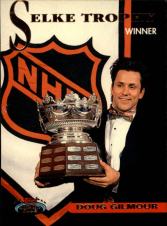
Trade: One of the largest transactions in NHL history was the 1992 10-player deal between the Leafs and Calgary Flames that brought cult hero Doug Gilmour to Toronto. During his first full season with the Leafs, Gilmour recorded 127 points and earned the Frank J. Selke Trophy as the best defensive forward in the league. Gilmour’s tenure would also see the team make back-to-back appearances in the Conference Finals.

Doug Gilmour

Signing: The Leafs struggled mightily from the late 2000s to the mid 2010s, exacerbated by a number of misguided free agent deals. This included contracts for Jeff Finger (four-year, $14 million in 2008), Mike Komisarek (five-year, $21.5 million in 2009) and David Clarkson (seven-year, $36.75 in 2013). Finger played half his contract with Toronto’s minor league affiliate, Komisarek had his contract bought out in the final season and Clarkson was traded after two campaigns.

Draft Pick: The Leafs have picked first overall twice in their history, taking Wendel Clark in 1985 and Auston Matthews in 2016. Some of their other top picks include Darryl Sittler (8th overall in 1970), Lanny McDonald (4th overall in 1973), Morgan Rielly (5th overall in 2012), and Mitch Marner (4th overall in 2015). Perhaps their greatest diamond in the rough selection was taking Tomas Kaberle 204th overall in 1996. He would go on to play 12 seasons in Toronto.

Holdouts: During the 1981-82 season, Darryl Sittler requested a trade due to the deterioration of his relationship with Leafs management and ownership. When no deal was reached after months of waiting, Sittler left the team, at the advice of his doctor, on the basis he was “mentally depressed”. Sittler was eventually dealt to the Philadelphia Flyers, ending his 12-season tumultuous stint with the franchise.

Buyouts: Mikhail Grabovski had completed the first season of his five-year, $27.5 million contract, when the Leafs surprisingly used one of their compliance buyouts from the 2012-13 lockout on him. This meant Grabovski was due $14.33 million over the next eight seasons. Two days earlier, the Leafs used their other compliance buyout on defenseman Mike Komisarek, owing him $2.33 million over two years.

Darryl Sittler

Unique Game: Given the Leafs profile, the team has been used for many marquee NHL events. This included the 2014 Winter Classic and 2017 NHL Centennial Classic, both against the Detroit Red Wings, a 2018 Stadium Series contest versus the Washington Capitals, and the 2022 Heritage Classic opposite the Buffalo Sabres. Toronto also played two 1993 pre-season games against the New York Rangers in London, United Kingdom.

Goal: Each game of the 1951 Stanley Cup Finals went to overtime, with the Leafs pulling off a 4-1 series victory over the Montreal Canadiens. Bill Barilko scored the Stanley Cup-clinching goal at 2:53 of Game 5’s extra period. Another famous tally in Leafs lore is the one Bobby Baun scored in overtime of Game 6 of the 1964 Stanley Cup Finals, while playing with a broken ankle. The Leafs would win Game 7 4-0, earning their third consecutive championship.

Fight/Brawl: Things got out of hand during a 2013 pre-season game versus the Buffalo Sabres, leading to a brawl. When Buffalo enforcer John Scott went after Toronto star Phil Kessel, newly-signed Leaf David Clarkson left the bench to protect Kessel. This resulted in an automatic 10-game suspension for Clarkson, who never got going in Toronto, and was traded to the Columbus Blue Jackets after 118 games and only 15 goals and 26 points, despite an annual salary of $5.25 million.

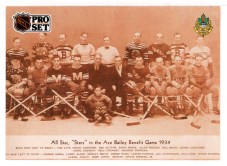
Injury: When Leafs forward Ace Bailey suffered a severe head injury, following a hard check by Eddie Shore of the Boston Bruins, two major developments came from the incident. First, the inaugural NHL all-star game was played months later to raise money for Bailey and his family. Second, at that all-star benefit game, Bailey’s number 6 jersey was retired, becoming the first player in professional sports history to receive such an honour.

Ace Bailey

Penalty: Leafs enforcers have a history of getting into trouble. Tiger Williams was charged with assault (later acquitted) for a 1977 stick hit on Dennis Owchar, which required 46 stitches to seal. A decade later, John Kordic high sticked Keith Acton, resulting in a 10-game suspension. Tie Domi had two infractions earn him lengthy bans, one for sucker punching Ulf Samuelsson in 1995 (eight games) and another for elbowing Scott Niedermayer in the 2001 playoffs (rest of series and eight games the following season).

Wildest Story: When Brian Spencer was to make his debut with the Leafs on December 12, 1970, he informed his father, Roy, of the good news. Later, Roy tried to watch the game on TV, but was greeted with a Vancouver Canucks-California Golden Seals contest instead. Upset, Roy drove 135 km to the closest TV station, where he threatened employees at gunpoint to air the Leafs game. A standoff with police and shootout ensued, resulting in Roy’s death. Brian would later also die by gunshot during a drug robbery.

Blooper: In one of the most viewed NHL videos of all-time, enforcer Tie Domi was banished to the penalty box during a game in Philadelphia. A Flyers fan was heckling Domi, so the enforcer squirted his water bottle into the crowd. Another angered fan ended up falling into the penalty box when the pane of glass separating players from the audience gave way. Domi punched the fan multiple times before being pulled away. Domi was fined $1,000 for the incident.

Miscellaneous: In an event that would make international headlines, the Leafs lost a 2020 game with Emergency Back-up Goalie David Ayres in net for the opposing Carolina Hurricanes. Worst of all, Ayres was employed by the Leafs, as a building operator/Zamboni driver. Ayres became a legend following the 6-3 victory, receiving his own day in Raleigh, North Carolina, and the story is set to become a Disney feature film.

Toronto Maple Leafs: Toronto Maple Leafs

Toronto Maple Leafs

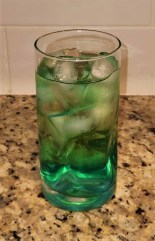
  • 0.75 oz Blue Curacao
  • 0.75 oz Irish Cream

I still find it hard to believe, as a youngster, I was a fan of the Leafs. Today, everything about Toronto and their sports landscape irks me. This is because the sports networks are all based there and we who live elsewhere in the country are treated to an unwanted deluge of coverage on Toronto teams.

St. Louis Blues – Monday Night Miracle

Throughout the year, the Sip Advisor will alphabetically travel the National Hockey League (NHL), discovering the best and worst each team has to offer in a variety of subjects. We will also feature a drink based off the franchise. Today, we journey through the Gateway to the West, checking in with the St. Louis Blues:

Establishment Story: The Blues entered the NHL during the 1967 expansion from the Original Six to 12 teams. The league had previously dabbled with the city by relocating the original Ottawa Senators there, becoming the St. Louis Eagles. The Eagles played one season (1934-35) before folding. The Blues are named for the W.C. Handy song Saint Louis Blues, released in 1914.

Stanley Cups: The Blues lone Stanley Cup victory occurred in 2019. The team also made the Stanley Cup Finals three times in their first three seasons, when the league’s divisions were split into the Original Six and the 1967 expansion teams (Next Six). St. Louis lost each time, twice to the Montreal Canadiens and once to the Boston Bruins. Revenge against Boston finally came with that 2019 championship.

Celebrity Fan: There are a number of famous supporters of the Blues, including actors Jon Hamm and Jenna Fischer, who both call St. Louis home. Hamm and Fischer were honourary coaches during the 2020 NHL All-Star Game in St. Louis and were prominent in the Blues Stanley Cup run in 2019. Because of his lifelong love of the Blues, Hamm has also done a fair bit of work for the NHL, including hosting the NHL100 event.

Jon Hamm

Super Fan: Laila Anderson is often credited with inspiring the Blues to turn around their 2018-19 season, which climaxed with their Stanley Cup championship. Anderson, who battled a rare auto-immune disease during that season, became a mascot of sorts for the club, as she celebrated the Stanley Cup win with them on the ice and at their rally. Anderson was also presented with a Stanley Cup ring, which is etched with her name on the inside.

Mascot: Louie is a blue polar bear, who debuted during the 2007-08 season. Louie’s backstory says he travelled to St. Louis from the Arctic Circle, inspired to search out his favourite hockey team. A 2021 poll conducted by Play Canada ranked Louie as the fourth most popular mascot in the NHL, but given the winner of the poll was Carlton the Bear of the Toronto Maple Leafs, the poll loses all credibility.

Tradition: The Blues and their fans have a couple rituals of note. First, following a goal, a bell tone is played for each tally scored that night, as the crowd counts along. Also, during the team’s 2018-19 season turnaround and Stanley Cup run, the song Gloria by Laura Branigan became the Blues theme track, played after each win. The tune was retired after St. Louis celebrated raising their Stanley Cup banner.

Appearances in Media: The Tom Hanks post-apocalyptic movie Finch is set in St. Louis and features his characters wearing a classic Blues jersey. Also, musician Nelly, a proud St. Louis native, can be seen alternating between St. Louis Cardinals and Blues gear throughout the music video for his hit song Country Grammar. Nelly can often be seen in Blues paraphernalia and is a big fan of the team.

Nelly

Events/Scandals: Just days after the Blues were eliminated from the 2004 playoffs, player Mike Danton was arrested on a conspiracy to commit murder charge. Danton had attempted to hire a hitman to murder his agent David Frost. Danton was sentenced to 90 months in prison, serving 63 before he was released. Danton later claimed his estranged father was the intended target of the murder-for-hire plot.

Rivalry: The Blues have had a long-standing feud with the Chicago Blackhawks, as the two teams have shared a division since 1970. While brawls between the clubs were common, one particular melee in 1991 is known as the St. Patrick’s Day Massacre. The result of the fights was 12 players ejected and three players suspended. Interestingly, all six Sutter brothers were members of each team in 1991-92.

Tragedy: Bob Gassoff played for the Blues from 1973 to 1977. At a party following the 1976-77 season, hosted by teammate Garry Unger, Gassoff was involved in a motorcycle accident, killing him at only 24 years old. Following his death, Gassoff’s number 3 jersey was retired by the Blues and the Bob Gassoff Trophy was created, rewarded to the most improved defenseman of the Central Hockey League. Gassoff holds the Blues record for penalty minutes in a season at 306.

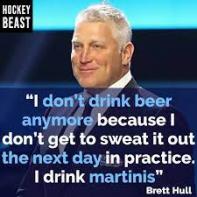
Player Nicknames: Brett Hull’s father, Bobby Hull, was nicknamed the Golden Jet during his illustrious hockey career. Therefore, the moniker the Golden Brett was bestowed upon Brett, who shared his father’s scoring touch. Once Brett joined the Blues in 1988, he became one of the league’s most dangerous scorers, holding the franchise records for single-season and career goals. Hull’s jersey number 16 was retired by the Blues in 2006.

Brett Hull

Line: Sometimes, it doesn’t matter who the third member of a line is, so long as the first two pieces have tremendous chemistry. Such was the case when Brett Hull and Adam Oates were paired together, comprising the duo of Hull & Oates, a play on the musical tandem Hall & Oates. Together, Hull and Oates played together from 1989 to 1992, with Hull scoring 212 goals during that span, while his frequent playmaker Oates recorded 228 assists.

Captain: Brian Sutter was the longest-serving captain in Blues history, holding the mantle from 1979 up until his retirement in 1988. Sutter played his entire career with St. Louis, drafted by the team 20th overall in 1976. After hanging up his skates, Sutter became head coach of the Blues, leading them behind the bench from 1988 to 1992. Sutter’s number 11 jersey was retired by the organization on December 30, 1988.

Enforcer: Kelly Chase and Tony Twist were known as the Bruise Brothers while they played together for the Blues in 1989-90 and later from 1997 to 1999. The two had been together in junior hockey with the Saskatoon Blades and the minor leagues with the Peoria Rivermen. Despite being good friends and Twist living in Chase’s house while he was with the Hartford Whalers, the two even fought each other during a March 9, 1996 game.

Family Values: The Plager brothers (Bobby, Barclay and Bill) played together for the Blues from 1968 to 1972. The trio helped lead St. Louis to their three straight Stanley Cup Finals appearances after the Blues joined the NHL. Another brother set to suit up together with St. Louis was Gino and Paul Cavallini. They were both members of the franchise from 1987 to 1992.

Plager Brothers

Returning Players: David Perron has had three stints with the Blues. He was drafted by the team in 2007, playing six seasons, before being traded to the Edmonton Oilers in 2013. Perron returned to St. Louis as a free agent in 2016, but after one season, was the Vegas Golden Knights Expansion Draft choice from the Blues. He was back in St. Louis in 2018, playing four seasons, before signing as a free agent with the Detroit Red Wings in 2022.

Short Stint: Some of the greatest players of all-time have had such short stints with St. Louis, that seeing them in a Blues jersey looks odd. This includes goalies Martin Brodeur (seven games after two decades with the New Jersey Devils), and Tom Barrasso (six games), along with Peter Stastny (27 games, regular season and playoffs combined), and even Wayne Gretzky (31 games, regular season and playoffs combined).

Undrafted: Curtis Joseph, nicknamed Cujo, from the Stephen King novel of the same name, was signed out of the NCAA University of Wisconsin in 1989. He would remain in St. Louis until 1995, gaining a reputation as one of the best goalies in the league, including being a Vezina Trophy finalist for the 1992-93 season. In 2015, Joseph was inducted into the St. Louis Sports Hall of Fame.

Trade: Among the Blues better acquisitions were bringing in Brett Hull from the Calgary Flames in March 1988 (along with Steve Bozek for Rob Ramage and Rick Wamsley), followed by Adam Oates from the Detroit Red Wings in June 1989 (along with Paul MacLean for Bernie Federko and Tony Mckegney). The two combined to make one of the most lethal offensive duos in NHL history, as noted above.

Curtis Joseph

Signing: In the early 90s, the Blues made a number of offer sheet signings to restricted free agents. They threw out contracts to the likes of Scott Stevens (twice!), Dave Christian, Brendan Shanahan, Michel Goulet, Marty McSorely, Petr Nedved, and Shayne Corson. Only Goulet, McSorely and Stevens (the second time) didn’t end up with the club, but the cost of the acquisitions was a number of draft picks and key players lost in compensation.

Draft Pick: The Blues have had an interesting draft history. The team passed on their opportunity to make any picks in their very first draft in 1967, didn’t participate in the 1983 draft, and had five straight first rounders (1991-95) transfer to the Washington Capitals, as compensation for the successful Scott Stevens offer sheet. They have selected first overall just once, taking defenseman Erik Johnson in 2006.

Holdouts: Alex Pietrangelo only missed one training camp practice before signing a seven-year, $45.5 million contract with the Blues in 2013. The hope was that Pietrangelo would spend his entire career with the team, but the defenseman, who was selected fourth overall in 2008, joined the Vegas Golden Knights in free agency in 2020 (seven years, $61.6 million), upon the expiry of the aforementioned pact.

Buyouts: The Blues have only used two buyouts in their history and none since 2009. In 2007, the team parted ways with captain Dallas Drake, following six seasons in St. Louis. Drake would move onto the Detroit Red Wings for a season, retiring as a Stanley Cup champion. Two years later, defenseman Jay McKee was bought out of the final year of his four-year, $16 million contract signed in 2006. His final campaign came with the Pittsburgh Penguins.

Pietrangelo

Unique Game: The Blues have participated in two Winter Classic games. First, they hosted the rival Chicago Blackhawks in 2017, followed by facing the Minnesota Wild in 2022. St. Louis and the Edmonton Oilers also participated in the 1990 Epson Cup in Dusseldorf, West Germany, which included a game against each other as part of the tournament. Finally, the Blues opened their 2009-10 season with a pair of games against the Detroit Red Wings in Stockholm, Sweden, for the 2009 NHL Premiere.

Goal: Blues fans waited 52 years for the club’s first Stanley Cup and it took a 4-1 win in Game 7 of the finals against the Boston Bruins to get that title. The St. Louis faithful were put at ease when Ryan O’Reilly tallied the opening goal of that game at 16:47 of the first period and the Blues never looked back. O’Reilly was later named the Conn Smythe Trophy recipient as playoff MVP.

Fight/Brawl: Blues history is littered with infamous brawls. These include melees against the Philadelphia Flyers (1972), Pittsburgh Penguins (1973), New York Rangers (1974), Chicago Blackhawks (1991 St. Patrick’s Day Massacre), and Detroit Red Wings (1993). The fracas with the Penguins occurred during a pre-season contest and lasted 20 minutes, with fighting occurring in the penalty boxes and the hallway leading from them to St. Louis’ dressing room.

Injury: Two Blues defensemen have suffered serious heart issues during games with the team. First, during the 1998 playoffs, Chris Pronger was hit with a slapshot to the chest in a contest against the Detroit Red Wings. This caused Pronger to go into cardiac arrest due to his heart rhythm being disrupted. Next, in 2020, Jay Bouwmeester collapsed on the bench due to cardiac arrest. Thankfully, both players survived their ordeals, but Bouwmeester never played in the NHL again.

Ryan O'Reilly

Penalty: During a 1969 pre-season game, Wayne Maki got into a stick swinging fight against Ted Green of the Boston Bruins. Maki clubbed Green over the head, resulting in a fractured skull and brain injury. Both players were charged with assault, becoming the first NHL players to face criminal prosecution for an on-ice incident, but were acquitted. Maki was suspended 30 days, while Green missed the entire season recovering.

Wildest Story: The Blues were almost moved to Saskatoon, Saskatchewan in 1983, but the NHL’s Board of Governors voted to reject the proposed $12 million sale. This led to lawsuits between then owner Ralston Purina (of the Purina animal food empire) and the NHL, with control of the franchise taken over by the league. The result was the Blues stayed in St. Louis, when a new ownership group, led by businessman Harry Ornest, was put together.

Blooper: In February 2006, Blues defenseman Dennis Wideman made one of the most memorable shootout attempts of all-time… memorable for all the wrong reasons. As Wideman swiftly skated towards Chicago Blackhawks goalie Corey Crawford, he made a nice deke move, but lost a skate edge and went flying up in the air, landing flat on his back, with the puck sliding into the corner of the rink.

Miscellaneous: Bernie Federko deserves some mentioning, as he’s the Blues career leader in games, assists and points, while sitting second all-time in goals. Federko was drafted by St. Louis seventh overall in 1976, remaining with the team until a 1989 trade to the Detroit Red Wings. Federko would have his number 24 jersey retired by the Blues in 1991 and for an extended period was the color commentator on the team’s TV broadcasts.

St. Louis Blues: Monday Night Miracle

Monday Night Miracle

  • 1.5 oz Gin or Vodka
  • 1 oz Blue Curacao
  • Splash of Lime Juice
  • Garnish with a Lime Slice

This cocktail is named after the greatest comeback in Blues history, Game 6 of the Campbell Conference Finals, which occurred on Monday, May 12, 1986. The Blues were down 5-2 with 12 minutes left in the contest, when they rallied to force overtime and won 6-5. Despite the momentum change, they would still lose the series to the Calgary Flames.

San Jose Sharks – Shark Bite

Throughout the year, the Sip Advisor will alphabetically travel the National Hockey League (NHL), discovering the best and worst each team has to offer in a variety of subjects. We will also feature a drink based off the franchise. Today, we visit the Bay Area and go swimming with the San Jose Sharks:

Establishment Story: The Sharks joined the NHL as an expansion team in 1991. The Gund family wished to return a team to the San Francisco Bay Area, having previously operated the California Golden Seals there. The Seals were relocated to Cleveland and later merged with the Minnesota North Stars, which the Gunds wanted to sell their share of. A Dispersal Draft was held to divvy up players between the Sharks and North Stars.

Stanley Cups: The Sharks have never won the Stanley Cup and have only made one Finals appearance, losing to the Pittsburgh Penguins in six games in 2016. This, despite long stretches of time being considered among the best teams in the league, reaching the Western Conference Finals on four other occasions. San Jose have qualified for the playoffs in 21 of the 31 seasons they have been an NHL franchise.

Celebrity Fan: The Sharks have a number of famous followers, including musician Neil Young, tech guru Steve Wozniak and members of the band Metallica. Young and Wozniak have been season ticket members for years, while Metallica – who have been based in San Francisco for much of their careers – have provided the team with their entrance song, Seek & Destroy, since 2013 and were honoured with Metallica Night in January 2015.

Sharks

Super Fan: Sam Tageson grew up a fan of the Sharks. On March 18, 2014, the then 18-year-old, who suffers from hypoplastic left heart syndrome, was signed to a one-day contract by the team. Tageson participated in the teams pre-game practice and hit the ice with them for their contest that night against the Florida Panthers. The night was immortalized with an Upper Deck rookie trading card of Tageson posing by the team’s shark entrance prop.

Mascot: S.J. Sharkie debuted a few months after the rest of the Sharks, in January 1992. He has been called ‘The Hardest Working Fish in Sports’, making 450 public appearances each year, including fundraisers, birthday parties, corporate events and even weddings. S.J. Sharkie was named the 2012 Most Awesome Mascot for the Cartoon Network’s Hall of Game Awards, becoming the first hockey mascot to win the honour.

Tradition: For home games, Sharks players enter through a menacing looking shark mouth, while Seek & Destroy by Metallica blasts throughout the arena. A former entrance song, Get Ready for This by 2 Unlimited, is the team’s current goal song. Another long-standing ritual for fans is to do a chomping gesture with their hands, particularly while the team is about to go on a power play, as the memorable theme track from the movie Jaws plays.

Appearances in Media: Due to his unique look and personality, during his time with the Sharks, defenseman Brent Burns appeared in two episodes of the TV series Vikings and was featured in commercials for Kit Kat Chunky chocolate bars and CCM Hockey equipment. Also, the character of Lester Averman wears a Sharks hoodie in The Mighty Ducks, years before San Jose and the Mighty Ducks of Anaheim would be rivals.

Tageson

Events/Scandals: Evander Kane was no stranger to controversy by the time he joined the Sharks in 2018, but things seemed to get worse during his San Jose tenure. Incidents included Kane being sued for unpaid gambling debts, Kane filing for bankruptcy, accusations from Kane’s estranged wife that the player bet on his own games, as well as assaulted her, and Kane using a fake COVID-19 vaccine card. In the end, the organization had enough and terminated his contract in January 2022.

Rivalry: The Sharks chief rival is the Los Angeles Kings, who they met in the playoffs four times between 2011 to 2016, with each club taking two series. The feud is not surprising, given rivalries between San Francisco Bay Area and Greater Los Angeles teams in other leagues (Giants-Dodgers [MLB], 49ers-Rams [NFL] and Earthquakes-Galaxy [MLS]) and the general Northern California vs. Southern California opposition.

Tragedy: Bryan Marchment, who had played parts of six seasons with the Sharks from 1998 to 2003, had moved into coaching and scouting roles with the team after retiring in 2006. On July 6, 2022, while attending the 2022 NHL Draft in Montreal in his scouting capacity, Marchment died suddenly. No cause of death was released. Sharks GM, Mike Grier, paid tribute to Marchment prior to the team’s first-round draft selection.

Player Nicknames: Long-time Sharks star Joe Thornton was given the nickname Jumbo, thanks both to his large stature and also because there is a statue of the famous circus elephant of the same name in Thornton’s hometown of St. Thomas, Ontario, where the elephant died after being hit by a train. Thornton gained another nickname, Big Joe, in contrast to teammate Joe Pavelski, who was dubbed Little Joe. Pavelski was also known for a time as The Big Pavelski, a reference to the film The Big Lebowski.

Evander Kane

Line: The Jumbo Heated Patty Line (also known as the Burger Line), consisted of Joe Thornton (Jumbo), Dany Heatley (Heated) and Patrick Marleau (Patty). When defensemen Dan Boyle (Boiled) and Marc-Edouard Vlasic (Pickles) were added to the mix, you had the Boiled Jumbo Heated Patty with Pickles Line. These players comprised the core of the Sharks roster for many seasons.

Captain: Doug Wilson was the first captain in Sharks franchise history, leading the team for two seasons (1991 to 1993), prior to retiring. Wilson would return to the organization as GM in 2003, serving in the role until stepping down in April 2022, due to health issues. The team’s current captain, Logan Couture, has held the position since the 2019-20 season. Couture was drafted by San Jose ninth overall in 2007.

Enforcer: Although Link Gaetz only played 48 games with the Sharks, his NHL career ended by a car accident, he’s fondly remembered, in part because of his wild reputation and willingness to take on all combatants. Gaetz was nicknamed ‘The Missing Link’ and legend has it, he showed up to the 1988 draft with two black eyes from a bar fight the night before. In his brief Sharks tenure, Gaetz recorded 326 penalty minutes, a franchise single-season record.

Family Values: Cousins Scott and Joe Thornton played together with the Sharks for the 2005-06 season. Also, father and son, Ulf and Jonathan Dahlen, both enjoyed tenures with San Jose. Ulf played parts of four seasons (1994 to 1997) with the club, while Jonathan suited up for a single season (2021-22). Lastly, brothers Jamie and Tye McGinn had separate stints with the organization.

Link Gaetz

Returning Players: Patrick Marleau had three separate stints with the Sharks. The first began with him being drafted second overall in 1997 and lasted two decades. Following two seasons with the Toronto Maple Leafs, Marleau had his contract bought out and he returned to San Jose. Following a trade deadline deal to the Pittsburgh Penguins, Marleau returned again, allowing him to surpass Gordie Howe’s NHL games played record where it all began.

Short Stint: Hall of Fame goalie, Ed Belfour, was shockingly traded to the Sharks on January 25, 1997, when he refused to sign a contract extension with the Chicago Blackhawks. Belfour’s time with San Jose did not go well, winning only three games in 13 appearances. While with the Sharks, Belfour changed his number from 30 to 20, as a tribute to legendary netminder, Vladislav Tretiak, who was his coach with the Blackhawks.

Undrafted: Jeff Odgers was signed by the Sharks in 1990, joining the team for their inaugural 1991-92 season. Over his five years in San Jose, Odgers set the franchise record for all-time penalty minutes with 1,001, and holds the runner-up spot for penalty minutes in a season with 253. Odgers also served as Sharks captain for a season and a half. He finished his career with 821 games played, 75 goals, 70 assists and 2,364 penalty minutes.

Trade: The Sharks acquisition of Joe Thornton from the Boston Bruins early in the 2005-06 season is regarded as one of the most lopsided deals in NHL history. Thornton, a former first overall draft pick in 1997, was dealt for forwards Marco Sturm and Keith Primeau, as well as defenseman Brad Stuart. Thornton would go on to win the Art Ross (NHL regular season points leader) and Hart Memorial (NHL MVP) Trophies in his first season in teal and become a league superstar.

Patrick Marleau

Signing: In 2010, the Chicago Blackhawks loss, was the Sharks gain, as San Jose picked up the most recent Stanley Cup winning goalie (the first Finnish backstop to do so) on a relatively team-friendly deal. Antti Niemi had been rewarded $2.75 million by an arbiter, but Chicago was forced to walk away from the decision, due to their salary cap constraints. The Sharks swooped in and signed Niemi to a one-year, $2 million pact. He would go on to become San Jose’s netminder for the next five seasons.

Draft Pick: The Sharks have never drafted first overall, but have done well with the second choice, highlighted by selecting Patrick Marleau in 1997. The team also has a couple diamond in the rough picks that looked like steals later in Evgeni Nabokov (219th overall in 1994) and Joe Pavelski (205th overall in 2003). Time will tell how recent high draft picks, such as William Eklund (seventh overall in 2021) and Will Smith (fourth overall in 2023) turn out.

Holdouts: Goalie Evgeni Nabokov was one of the NHL’s best goalies going into the 2002-03 season and he wanted to be compensated as such. Five games into the season, after the Sharks managed to win only one contest, the team and Nabokov finally agreed on a new deal. One year prior, defenseman Mike Rathje sat out 24 games, before a four-year, $8.25 million contract brought him back into the fold.

Buyouts: In July 2017, the Sharks signed Martin Jones to a six-year, $34.5 million contract extension. Just three seasons into that deal, following a drop in performance (three straight .896 save percentages), Jones was bought out, owed $10 million over the next six years. Jones has bounced around the NHL since departing San Jose, playing for a different team in each subsequent season.

Joe Pavelski

Unique Game: The Sharks opened their 1998 season with a pair of games against the Calgary Flames in Tokyo, Japan. They also took part in the 2010 NHL Premiere with two contests against the Columbus Blue Jackets in Stockholm, Sweden, as well as back-to-back matches against the Nashville Predators in Prague, Czechia, for the 2022 NHL Global Series. A 2015 Stadium Series event featured San Jose against the Los Angeles Kings.

Goal: The Sharks have a history of upsetting favoured teams in playoff Game 7s, based on memorable goals. Underdog Sharks teams defeated both the Detroit Red Wings and Calgary Flames back-to-back in 1994 and 1995, with goals from Jamie Baker and Ray Whitney in double overtime, respectively. In 2000, Owen Nolan’s center ice slap shot tally helped to eliminate the St. Louis Blues. Also, goaltender Evgeni Nabokov became the first European backstop to score a goal, when he did so on March 10, 2002.

Fight/Brawl: The playoffs brings a whole new level of intensity to NHL hockey. A great example of that occurred during the first round of the 2009 post-season, when the Sharks battled their California rivals, the Anaheim Ducks. In Game 6 of the series, Joe Thornton fought Ryan Getzlaf, while later Joe Pavelski scrapped with Ryan Whitney. All four players were not known for their fisticuffs, but rose to the occasion at the most important time of the year. The Ducks would go on the win the series.

Injury: It’s not often that an injury leads to good. That was the case in the 2019 playoffs, when Joe Pavelski fell to the ice after being hit by Cody Eakin of the Vegas Golden Knights and suffered a head injury. Eakin received a five-minute major, during which San Jose scored four goals, to erase a 3-0 deficit. While Pavelski did not return to the contest, the Sharks would go on to win the deciding Game 7 in overtime.

Joe Thornton

Penalty: Raffi Torres had a long history of NHL discipline before his hit to the head of Anaheim Ducks forward Jakob Silfverberg during a 2015 pre-season contest. Torres was suspended for 41-games (half the season, which is the longest ban in NHL history for a hit and longest non-lifetime suspension in league history). Torres never played again in the NHL, being assigned to the Sharks minor league affiliate after serving his punishment.

Wildest Story: The Sharks once invested in a Chinese hockey team, agreeing to send five players and three coaches to China. Thus, the China Sharks briefly existed, lasting two seasons from 2007 to 2009 in Asia League Ice Hockey, before the NHL Sharks were done with the international experiment and pulled their funding. Perhaps the most notable occurrence of the team’s existence, was Claude Lemieux beginning his comeback attempt there with two contests, before suiting up for San Jose for 18 games.

Blooper: Blunders happen, but it’s not often they result in playoff elimination. Game 5 of the 2011 Western Conference Finals went to double overtime, with the Vancouver Canucks one win away from a Stanley Cup Finals berth. Suddenly, Canucks defenseman Kevin Bieksa was celebrating, while few others had any idea he had just scored the winning goal. Replays showed the puck had bounced off a glass stanchion, allowing Bieksa to shoot the puck on net, while others on the ice had lost sight of the biscuit.

Miscellaneous: A little more on how the Sharks team name was chosen, the moniker could have been Blades, based on the name winning a fan vote, but concerns about the term’s association with violence, led to Sharks being selected, as it was the runner-up amongst 5,000 submissions. It should be noted, the Sharks minor league affiliate from 1990 to 1996 was the Kansas City Blades.

San Jose Sharks: Shark Bite

Shark Bite

  • 0.75 oz Spiced Rum
  • 0.75 oz Light Rum
  • 0.5 oz Blue Curacao
  • Top with Lemon-Lime Soda
  • Drops of Grenadine
  • Garnish with Shark Gummies

I amalgamated a couple different Shark Bite recipes here. This was a fun drink that took a little more prep than your typical cocktail, but was totally worth it!
Pittsburgh Penguins – The Pittsburgh Penguin

Throughout the year, the Sip Advisor will alphabetically travel the National Hockey League (NHL), discovering the best and worst each team has to offer in a variety of subjects. We will also feature a drink based off the franchise. Today, we travel to the Steel City to get constructive with the Pittsburgh Penguins:

Establishment Story: The Penguins joined the NHL as it expanded from six to 12 teams in 1967. The original ownership group included some heavy hitters, including H.J. Heinz III, heir to the Heinz Company, and Pittsburgh Steelers owner Art Rooney. The name Penguins was chosen from a contest, where 700 of the 26,000 entries suggested the nickname. Previously, the Pittsburgh Pirates had played in the NHL from 1925 to 1930.

Stanley Cups: The Penguins have won five Stanley Cups, including two back-to-back sets in 1991/1992 and 2016/2017. They also brought home the league championship in 2009. Their only Stanley Cup Final loss came the year before, at the hands of the Detroit Red Wings, who they beat in the 2009 rematch. The Penguins five Stanley Cup victories ties them with the Edmonton Oilers for most among non-Original Six clubs.

Celebrity Fan: Michael Keaton, star of movies such as Batman, Beetlejuice and The Founder, resides in Pittsburgh and is an avid supporter of the city’s teams. Keaton has appeared as a presenter at some of the NHL Awards ceremonies. Another unlikely Penguins fan was Fred Rogers, aka Mr. Rogers. Rogers appeared on a 1992 Pro Set hockey card as a Celebrity Captain of the club, donning his trademark sweater and sneakers.

Mr. Rogers

Super Fan: Cy Clark, nicknamed The Hulk for his Hulk Hogan-inspired look, was an avid Penguins fan, first gaining media attention during Pittsburgh’s 2009 Stanley Cup run. In October 2011, Clark was invited to Penguins practice by coach Dan Bylsma, an honour the fan truly cherished. Sadly, Clark passed away in June 2014, following a battle with cancer. Both the Penguins organization and former Philadelphia Flyers player Scott Hartnell, who had a good-natured feud with Clark, sent condolences.

Mascot: The Penguins have had two mascots in their history. First, there was Penguin Pete, who was a real-life Humboldt penguin that was taught to skate on custom made skates. Pete only made seven appearances from February to November 1968, prior to dying. A second Penguin Pete, used in 1971-72, was nicknamed Re-Pete. In 1992, Iceburgh, a king penguin, debuted as mascot for the team, wearing jersey number 00.

Tradition: A pair of long-time Penguins employees became fixtures of Pittsburgh games for fans. First, Vince Lascheid was the Penguins organist from 1970-2003. He was inducted into the Penguins’ Hall of Fame in 2005, passing away in 2009 at the age of 85. Next, Jeff Jimerson has been the team’s national anthem singer for three decades, most notably being credited as ‘Anthem Singer’ in the movie Sudden Death.

Appearances in Media: The Penguins feature heavily in the Jean-Claude Van Damme action movie Sudden Death, as the film takes place during a fictional 1995 Stanley Cup Finals between Pittsburgh and the Chicago Blackhawks. When a group of terrorists invade a VIP suite with the U.S. Vice-President in it, Van Damme’s character has to come to the rescue, including some on-ice and around the arena fight scenes.

Sudden Death

Events/Scandals: Coming out of the 2004-05 NHL lockout, a formula had to be decided upon to see who would get to draft teenage phenom Sidney Crosby. The Penguins, who were battling financial issues and relocation rumours at the time, won the weighted lottery (dubbed the ‘Sidney Crosby Sweepstakes’) and the right to select the generational talent. Many view the event as having saved the franchise, as three Stanley Cups and a new arena have transpired during Crosby’s tenure.

Rivalry: The Penguins top rival is the Philadelphia Flyers, with their feud known as the Battle of Pennsylvania. Both teams joined the NHL as part of the ‘Next Six’ 1967 expansion and have met seven times in the playoffs. Pittsburgh has also had a long-running rivalry with the Washington Capitals, reignited by superstars Sidney Crosby and Alex Ovechkin, who entered the league at the same time, following the 2004-05 NHL lockout.

Tragedy: After a solid rookie season with the Penguins in 1969-70, Michel Briere returned home to Quebec, where he was to marry his long-time girlfriend and mother of his son. Sadly, Briere would be involved in a single-vehicle car accident, where he was thrown from the vehicle. Briere was placed in a coma, but passed away 11 months later at the age of 21. Even worse, the ambulance carrying Briere struck and killed a cyclist who was a friend of Briere.

Player Nicknames: The Penguins two franchise players have memorable nicknames. First, Mario Lemieux was dubbed Super Mario, a play on the Nintendo video game character, as both are able to achieve unbelievable acts. Next, Sidney Crosby has been known as Sid the Kid since he was, well, a kid, but the moniker has stuck even as Crosby plays the latter stages of his career.

Crosby and Ovechkin

Line: The combo of Mario Lemieux and Jaromir Jagr figured into two of the Penguins most dominant trios, with Kevin Stevens as the towering Sky Line and with Ron Francis as the unstoppable Great Line. Other notable units include the Century Line (Syl Apps Jr., Lowell MacDonald and Jean Pronovost), the HBK Line (Carl Hagelin, Nick Bonino and Phil Kessel) and the Option Line (John Cullen, Mark Recchi and Kevin Stevens).

Captain: It’s hard to give this category to one player, given how much Mario Lemieux and Sidney Crosby have each meant to the Penguins organization. Lemieux served three separate stints (1987-94, 1995-97 and 2001-06) as the team’s captain. The Lemieux era gave way to the Crosby era, as Crosby took over the captaincy in 2007, becoming the youngest captain in NHL history and, in 2009, the youngest captain to win a Stanley Cup. All five of the Penguins Stanley Cups have been won with one of these two at the helm.

Enforcer: Defenseman Paul Baxter holds the Penguins franchise record for penalty minutes in a season at 409. This mark is the runner up for the NHL single-season record. Baxter sits sixth on the team’s all-time penalty minute list, despite only playing three seasons with the club. Other notable brawlers for Pittsburgh include Georges Laraque, Eric Godard, Bob ‘Battleship’ Kelly, Dave Schultz, and Jay Caufield.

Family Values: Few know that Mario Lemieux’s brother Alain also played for the Penguins, with the two dressing for a single game together during the 1986-87 season. This would be Alain’s final NHL contest of 119 career games. Other brother combos had longer stints together in Pittsburgh, including Doug and Greg Brown in 1993-94 and twins Chris and Peter Ferraro in 1997-98.

Lemieux and Crosby

Returning Players: Mark Recchi had three stints with the Penguins. He began his NHL career with the team, drafted 67th overall in 1988. After winning the Stanley Cup with Pittsburgh in 1991, Recchi was used as a trade chip to bring Rick Tocchet and Kjell Samuelsson to the Penguins. He returned in 2005, only to be traded to the Carolina Hurricanes, where he would win a second Stanley Cup. Recchi’s final Pittsburgh run, in 2007, resulted in being a waiver claim by the Atlanta Thrashers.

Short Stint: As the Penguins have perennially pursued Stanley Cups, hoping to cash in on the Sidney Crosby era, a number of top players have joined the team for playoff runs, only to leave for other clubs following post-season elimination. This includes Jarome Iginla and Patrick Marleau, who suited up for Pittsburgh for 28 and 12 games (regular season and playoffs combined), respectively.

Undrafted: Although his career ended in great controversy, Marty McSorely enjoyed quite a professional run for an undrafted player. He was signed by the Penguins in 1982, debuting for the team in the 1983-84 season. McSorely was traded to the Edmonton Oilers in September 1985, becoming the bodyguard of Wayne Gretzky for most of the next decade. During his brief time with Pittsburgh, he recorded 239 penalty minutes in only 87 games. McSorely also played 47 contests for the Penguins in 1993-94.

Trade: The best and worst transactions in Penguins history were both trade deadline day deals. The best was bringing in Ron Francis, Ulf Samuelsson and Grant Jennings from the Hartford Whalers in 1991, which resulted in back-to-back Stanley Cups. The worst was sending Markus Naslund to the Vancouver Canucks in 1996 for Alex Stojanov. Stojanov played a mere 45 games for Pittsburgh, while Naslund became one of the NHL’s best player for a few seasons.

Penguins Trade

Signing: Among the best signings the Penguins ever made, were for depth players who were veteran leaders, helping the team finally get over the hump and win back-to-back Stanley Cups. For the 1991 and 1992 championships, this role was played by Bryan Trottier, who came to Pittsburgh after his contract was bought out by the New York Islanders. For the Penguins 2016 and 2017 titles, Matt Cullen provided a solid two-way game, while in the twilight of his career.

Draft Pick: The Penguins have done very well with the first overall pick, selecting generational talents Mario Lemieux (1984) and Sidney Crosby (2005). Pittsburgh has also done well with the number two choice, taking Evgeni Malkin (2004) and Jordan Staal (2006). Lastly, nabbing Jaromir Jagr at fifth overall in 1990 was a huge steal, perhaps based on Jagr telling teams drafting earlier than the Penguins that he would not leave Czechia immediately to play for them.

Holdouts: Petr Nedved is the only Penguins player to stage a contract holdout, when he sat out the entire 1997-98 season and the start of the following year. The holdout was ended when Nedved was traded to the New York Rangers. The move colossally backfired for Nedved, who earned less than he would have had he accepted Pittsburgh’s original offer in 1997.

Buyouts: The Penguins have only bought out one contract in their history. That distinction belongs to defenseman Jack Johnson, who had his five-year $16.25 million deal bought out with three seasons remaining. Johnson’s contract will count against the Penguins salary cap through the 2025-26 season. The buyout may have worked in Johnson’s favour, as two years after his Penguins dismissal, he won the Stanley Cup with the Colorado Avalanche.

Jaromir Jagr

Unique Game: The Penguins have participated in numerous Winter Classics (2008 vs. Buffalo Sabres, 2011 vs. Washington Capitals, 2023 vs. Boston Bruins) and Stadium Series (2014 vs. Chicago Blackhawks, 2017 and 2019 vs. Philadelphia Flyers) contests. Internationally, they opened their 2000-01 season with a pair of games against the Nashville Predators in Saitama, Japan, as well as taking part in the 2008 NHL Premiere, with two matches against the Ottawa Senators in Stockholm, Sweden.

Goal: One of the greatest feats in NHL history was Mario Lemieux scoring five goals in a game, in five different ways. On December 31, 1988, against the New Jersey Devils, he scored even-strength, power-play, short-handed, penalty shot, and empty net goals. Lemieux also recorded three assists that night, being involved in every goal of an 8-6 victory. In 2017, the achievement was voted the greatest moment in the NHL’s first 100 years.

Fight/Brawl: Things got real nasty on February 11, 2011, when the Penguins faced the New York Islanders. Their previous match saw two Islanders concussed and retribution was expected. As the game got out of hand (the final score was 9-3 for the Islanders), melees broke out everywhere, totalling 15 fighting majors and 21 game misconducts. The aftermath saw three players suspended and the Islanders fined $100,000.

Injury: On May 14, 1993, Penguins power forward Kevin Stevens went to hit New York Islanders defenseman Rich Pilon. The collision resulted in Stevens being knocked unconscious and falling face first onto the ice. Many of the bones in Stevens face were shattered and required metal plates to be reconstructed. Worst of all, the injury led Stevens to battle an addiction with prescription drugs that ended his marriage and affected the rest of his career.

Penguins Islanders Brawl

Penalty: Matt Cooke gained a reputation for delivering dangerous hits to the head of opponents during his Penguins tenure. Cooke was suspended four times for infractions, starting with a pair of two-game bans, followed by sitting out four games and 10 games plus the first round of the 2011 playoffs. His worst hit, practically ending the career of Marc Savard, wasn’t punished at all, but led to changes in NHL rules regarding blindside hits to the head.

Wildest Story: The Stanley Cup is the holy grail of hockey. After a summer of celebrating their 1991 championship victory, Penguins forward Phil Bourque noticed a rattling sound coming from within the trophy. When Bourque opened the Stanley Cup up to make repairs, he noticed others who had worked on it prior had inscribed their names inside. Bourque joined them, his message reading: “Enjoy it, Phil Bubba Bourque, ’91 Penguins.”

Blooper: As the Penguins pursued a wild card playoff spot for the 2023 post-season, they were coming up against the lowly Chicago Blackhawks with two important points in the standings up for grabs. Despite being heavy favourites, Pittsburgh lost the contest 5-2. This ended the Penguins 16-year playoff qualification streak (at the time the longest in major North American sports leagues) and opened the door for the Florida Panthers to go on their Cinderella run to the Stanley Cup Finals.

Miscellaneous: In 1993, Penguins owner Howard Baldwin invested in the HC CSKA Moscow team, hoping to gain better access to Russian players. The Russian Penguins played each of the 13 International Hockey League teams once during the 1993-94 season, only winning two games. Alumni from the club included goaltender Nikolai Khabibulin and forward Sergei Brylin. A 2019 documentary, titled Red Penguins, detailed the short history of the club.

Pittsburgh Penguins: The Pittsburgh Penguin

The Pittsburgh Penguin

  • 1.5 oz Kahlua
  • 1 oz Goldschlager
  • Splash of Cream of Coconut
  • Garnish with Coconut Shavings

The Cocktails with the Penguins blog had a number of options for me to use, but I went with this one, an adaptation of the Panda Bear drink. There’s also a Pittsburgh Penguins Martini out there, using white chocolate liqueur, Irish cream, vanilla vodka and chocolate syrup.

Philadelphia Flyers – Philly Flyer

Throughout the year, the Sip Advisor will alphabetically travel the National Hockey League (NHL), discovering the best and worst each team has to offer in a variety of subjects. We will also feature a drink based off the franchise. Today, we visit the City of Brotherly Love, home to the infamous Broad Street Bullies, aka Philadelphia Flyers:

Establishment Story: The Flyers joined the NHL as an expansion team in 1967, when the league expanded from six to 12 teams. Previously, Philadelphia had an NHL team for the 1930-31 season, when the Pittsburgh Pirates relocated to become the Philadelphia Quakers. The team’s Flyers nickname was suggested by owner Ed Snider’s sister Phyllis. Other monikers considered, included Liberty Bells, Ramblers and a return to Quakers.

Stanley Cups: The Flyers won back-to-back Stanley Cups in 1974 and 1975, becoming the first of the 1967 expansion teams to accomplish the feat. However, since then, the franchise has been on the losing end of six straight Stanley Cup Finals appearances (1976 to Montreal Canadiens, 1980 to New York Islanders, 1985 and 1987 to Edmonton Oilers, 1997 to Detroit Red Wings, and 2010 to Chicago Blackhawks).

Celebrity Fan: Actor David Boreanaz, who has starred on shows such as Buffy the Vampire Slayer, Angel and Bones, is a massive Flyers fan. So much so, that his character on Bones wears Flyers shirts or jerseys in a number of episodes. Boreanaz even wrote about his fandom for an essay that was included in the program for the 2012 Winter Classic. U.S. President and First Lady, Joe and Jill Biden, are also supporters of the team.

David Boreanaz

Super Fan: Bill Schoeninger has turned the basement of his Pennsylvania home into a shrine dedicated to the Flyers. His collection includes signed sticks and trading cards, as well as a variety of pucks, jerseys, game tickets and other memorabilia. Elsewhere, Larry Mathers calls himself the “biggest Flyers fan in Canada!” Mathers, from Exeter, Ontario, has put together three levels of Flyers souvenirs, highlighted by his Flyers-themed Christmas tree.

Mascot: In Gritty, the Flyers may have not only the greatest mascot in the NHL or even all of sports, but perhaps the greatest mascot EVER. Sure, he had a 2019 brush with the law, where he was accused of punching a 13-year-old in the back of the head (Gritty was later cleared of the accusation), but appearances on talk shows such as The Tonight Show and Last Week Tonight have made the giant orange creature immensely popular.

Tradition: On December 11, 1969, prior to puck drop, God Bless America sung by Kate Smith was played, rather than The Star-Spangled Banner (U.S. national anthem). Fans loved the change and the Flyers won the game, so it was decided to use the song for select important contests. At times, Smith performed the song live, especially during the playoffs, and the Flyers record is overwhelmingly good when it’s used.

Appearances in Media: The Flyers have appeared in a number of TV shows, included characters attending games on The Goldbergs and It’s Always Sunny in Philadelphia. The starting lineup of the 1976 Flyers also appear as animated jury members (Jury of the Damned) on The Simpsons, when Homer is on trial for making a deal with the devil in one of the Treehouse of Horror segments. Lastly, Gritty appears in a Robot Chicken skit, spoofing the Tonya Harding-Nancy Kerrigan scandal.

Gritty

Events/Scandals: The Flyers organization has made some interesting decisions regarding coaches and players diagnosed with cancer. First, coach Roger Neilson was replaced and later dismissed after leaving the team in 2000 to undergo treatment. Years later, in 2019, player Oskar Lindblom was diagnosed with the disease. The team supported him throughout his battle, even resigning him to a three-year, $9 million contract when he was ready to return, but bought him out of that deal in 2022, with one year remaining.

Rivalry: Given their reputation as the Broad Street Bullies, the Flyers have made many enemies over the years. This includes state rival the Pittsburgh Penguins (Battle of Pennsylvania), New Jersey Devils (Battle of the Jersey Turnpike), New York Rangers (Broadway vs. Broad Street), Boston Bruins (Big Bad Bruins vs. Broad Street Bullies), and Washington Capitals – the two teams separated by only 124 miles.

Tragedy: The Flyers have experienced a number of deaths over the franchise’s 50-plus seasons. These include Pelle Lindbergh’s fatal car accident, Dmitri Tertyshny having his throat slashed by a boat propeller, and Yanick Dupre and Barry Ashbee passing away from cancer as members of the organization. Also, in 1990, Kathy Kerr, the wife of former Flyers star Tim Kerr, died 10 days after giving birth to the couple’s first child, due to an infection.

Player Nicknames: Ken Linesman had an interesting career, even before he became a pro player. His lawsuit was responsible for the World Hockey Association and later the NHL to change the minimum age a player could be drafted. Based on his appearance and the way he played (on the dirtier side of the ledger), Flyers teammate Bobby Clarke nicknamed him The Rat. Linesman originally played four seasons with Philadelphia and another 29 games years later.

Ken Linesman

Line: The Legion of Doom, comprised of Eric Lindros, John LeClair and Mikael Renberg, was one of the NHL’s highest scoring lines ever, but they could also hurt opponents with physical play, given each member was at least 6’2” and 230 lbs. Their best season as a trio, the 1995-96 campaign, saw them score 121 goals combined. Lindros (#88) also featured in the popular Crazy 8s Line with Mark Recchi (#8) and Brent Fedyk (#18).

Captain: With Bobby Clarke as captain from 1973 to 1979, the Flyers identity as a tough and unpleasant team to play against was fortified. Clarke led Philadelphia to their back-to-back Stanley Cup championships in the mid 1970s. When Clarke was named a playing assistant coach, NHL rules stated he must relinquish the captaincy. Clarke became captain again from January 1983 to May 1984, when he retired and became GM of the club.

Enforcer: Dave ‘The Hammer’ Schultz not only holds the Flyers record for most penalty minutes in a season at 472 (1974-75), but it’s also an NHL record. He also ranks fifth all-time in career penalty minutes with the team. Schultz’s popularity in Philadelphia led to him recording the local hit song The Penalty Box and appearing as a guest referee for a Broad Street Bully Match (No Holds Barred) at World Championship Wrestling’s Slamboree 1994 event.

Family Values: A few brothers have played together with the Flyers. This includes Joe and Jimmy Watson, who won two Stanley Cups together during their Flyers stint from 1973 to 1978, as well as twins Rich and Ron Sutter (1983 to 1986) and Luke and Brayden Schenn (2013 to 2016). Also of note, Bill Dineen was coach of the team from 1991 to 1993, while his son Kevin was a member of the franchise.

Dave Schultz

Returning Players: Brian Boucher always seemed to find his way back to the Flyers, playing three stints with the team. He was drafted by Philadelphia 22nd overall in 1995, debuting in the 1999-2000 season. He was traded to the Phoenix Coyotes in June 2002, suiting up for four other NHL teams, before returning to the Flyers as a free agent in 2009. After spending time with the Carolina Hurricanes, Boucher played four final games with Philadelphia in 2013, ending his NHL career.

Short Stint: When Keith Yandle signed with the Flyers for the 2021-22 season, he was in pursuit of the NHL’s iron man streak record. Through his 77 games with Philadelphia, Yandle broke Doug Jarvis’ previous mark, finishing with 989 consecutive games, before he was made a healthy scratch. When he was taken out of the lineup, Yandle ranked worst in a number of defensive statistical categories. He retired in September 2022.

Undrafted: Tim Kerr was signed as an undrafted free agent in 1980. From 1983-84 to 1986-87, Kerr recorded four straight 50-plus goal seasons, before injuries hampered much of the rest of his career. He returned to form for the 1988-89 campaign, scoring 48 goals in 69 games, earning the 1989 Bill Masterton Trophy for perseverance and dedication in the process. Kerr never played more than 40 games in a season again, despite suiting up for another four years.

Trade: The biggest trade in Flyers history was landing Eric Lindros at the 1992 NHL draft, one year after he refused to ever play for the Quebec Nordiques, who had drafted him first overall. The price was hefty, with Philadelphia giving up six players (including future Hall of Famer Peter Forsberg), first round draft picks in 1992 and 1993 and $15 million. While Lindros was a dominant force for a handful of years, the Nordiques would become the Colorado Avalanche and win two Stanley Cups during Lindros’ career.

Lindros Trade

Signing: Two top signings by the Flyers were Jeremy Roenick in 2001 and Danny Briere in 2007. Roenick played three seasons for Philadelphia, recording 173 points in 216 regular season games. He was traded to the Los Angeles Kings coming out of the 2004-05 NHL lockout. Briere inked an eight-year, $52 million deal with the Flyers, helping the team turn around from being the worst team in the league in 2006-07 to a Stanley Cup Finals appearance in 2010.

Draft Pick: The 1969 draft was integral to shaping the Flyers identity, as the club selected Bobby Clarke (17th overall) and Dave Schultz (52nd overall). Philadelphia has only selected first overall once, taking Mel Bridgman with the top choice of the 1975 draft. Their two second overall choices could be seen as misfires, as they took James van Riemsdyk in 2007 and Nolan Patrick a decade later in 2017.

Holdouts: Eric Lindros was no stranger to holding out on a team to force a trade. That’s how he ended up in Philadelphia in the first place. After eight seasons with the Flyers, Lindros now wanted to play elsewhere, following poor treatment by medical staff, having his captaincy stripped by GM Bobby Clarke and being offered a two-way contract as a restricted free agent. Lindros wanted to play for the Toronto Maple Leafs, but after sitting out the entire 2000-01 season, was dealt to the New York Rangers.

Buyouts: Ilya Bryzgalov was signed in 2011 to a nine-year, $51 million contract, with the organization hoping they’d finally found a franchise goalie. Instead, inconsistent play and bizarre behaviour lead to Bryzgalov being nicknamed Mr. Universe. With two compliance buyouts granted to each team coming out of the 2013 NHL lockout, Philadelphia used one of these get-out-of-jail-free cards on Bryzgalov. They were on the hook to pay him $23 million, but his contract didn’t count against their salary cap.

Bryzgalov

Unique Game: The Flyers have participated in two Winter Classics contests, first versus the Boston Bruins in 2010 and next against the New York Rangers in 2012. They have also faced the Pittsburgh Penguins in a pair of Stadium Series games in 2017 and 2019. Lastly, Philadelphia took on the Boston Bruins, as part of the NHL Outdoors at Lake Tahoe in 2021. They will next play outdoors as part of the 2024 Stadium Series, opposite the New Jersey Devils.

Goal: On December 8, 1987, Ron Hextall became the first goalie to score a direct goal in NHL history, when he fired a shot from deep in his own zone into the Boston Bruins’ empty net. Speaking to media following the game, Hextall stated: “I knew I could do it. It was a matter of when.” Hextall scored again during the 1989 playoffs, adding first goalie to score a direct goal during the post-season to his resume.

Fight/Brawl: Being known as the Broad Street Bullies comes with the reputation as being a tough team. That was evident in previously documented in this project brawls with the Montreal Canadiens (1987 warm-up scrap) and Ottawa Senators (2004 melee that set a new NHL record for combined penalty minutes at 419). One lesser discussed fracas occurred in 1972 between the St. Louis Blues and Flyers fans and even police patrolling the Spectrum, which saw a number of Blues players and coach Al Arbour arrested.

Injury: During the 2009-10 season, gritty forward Ian Laperriere twice blocked a shot with his face. The first caused him to lose seven teeth and receive 50-100 stitches. The second came in the first round of the playoffs, resulting in a mild concussion and orbital injury. Although he returned to action, symptoms of post-concussion syndrome surfaced during the 2010 training camp and Laperriere was forced to never play again. He was awarded the 2011 Bill Masterton Trophy for his dedication and perseverance.

broad-street-bullies-pub

Penalty: Given the team’s reputation as bullies, it shouldn’t be a surprise that a number of Flyers have served long suspensions for various transgressions. Enforcer Dave Brown was handed a 15-game suspension in 1987 for crosschecking Tomas Sandstrom, causing a broken jaw and concussion. In the 2007 pre-season, Steve Downie received a 20-game ban for an illegal hit on Dean McAmmond. Just weeks later, Jesse Boulerice crosschecked Ryan Kesler in the face, leading to a 25-game suspension.

Wildest Story: During a February 8, 1972 game against the Vancouver Canucks, Flyers goalie Bruce Gamble suffered a heart attack (diagnosed the next day after he travelled with the team and his chest pains continued), but managed to finish the game and earn a 3-1 win. Unfortunately, this incident would end Gamble’s pro career and over a decade later, another heart attack would claim Gamble’s life.

Blooper: One of the most infamous scenes in hockey history saw Flyers fan Chris Falcone fall into the penalty box after the glass divider gave way, following being sprayed with water by Toronto Maple Leafs goon Tie Domi. Once he fell, Falcone was punched a couple times by Domi, who was fined $1,000 for the incident. Falcone later sued Domi and others involved, but settled with the player, burying the hatchet, after Domi offered tickets to a couple Leafs playoff games to Falcone and his family.

Miscellaneous: The NHL record for going undefeated (including ties) was set by the 1979-80 Flyers, who went without a loss for 35 games, from October 14, 1979 to January 6, 1980. The mark not only tops the NHL’s all-time list, but all North American professional sports leagues. Despite the regular season success, the Flyers were defeated by the New York Islanders in that year’s Stanley Cup Finals.

Philadelphia Flyers: Philly Flyer

Philly Flyer

  • 2 oz Gin
  • 0.33 oz Maraschino Liqueur
  • 0.25 Crème de Cassis
  • Splash of Lemon Juice
  • Garnish with a Maraschino Cherry

This cocktail was created by Philadelphia Magazine to be the signature cocktail of Philadelphia. You can also find some other great beverage options compiled by Broad Street Hockey contributor Kelly Hinkle.

Ottawa Senators – The Statesman

Throughout the year, the Sip Advisor will alphabetically travel the National Hockey League (NHL), discovering the best and worst each team has to offer in a variety of subjects. We will also feature a drink based off the franchise. Today, we’re off to Canada’s capital city for some parliamentary meetings with the Ottawa Senators:

Establishment Story: The Senators – not to be confused with the original Ottawa Senators (1883-1934) – entered the NHL as an expansion team for the 1992-93 season. The successful expansion bid began with a ‘Bring Back the Senators’ campaign, launched by real estate developer Bruce Firestone. After 11,000 season ticket pledges were secured, Firestone was granted the new franchise in 1990.

Stanley Cups: The original Senators claimed the Stanley Cup 11 times, with only one championship coming under NHL operation, when they won the first NHL Stanley Cup Finals over the Boston Bruins in 1927. Version 2.0 of the Senators has never won the big prize, coming closest in 2007, where they were defeated by the Anaheim Ducks in the Finals in five games.

Celebrity Fan: While fans’ hopes for movie star Ryan Reynolds to become part of the franchise’s new ownership group didn’t pan out, it should be noted Friends star Matthew Perry has been a supporter of the Senators for the team’s entire existence. Perry was raised in Ottawa and attends occasional games. Another long-time fan is comedian Tom Green, who wore a Senators hat in the video for Check the O.R., by his rap group Organized Rhyme.

Senators Logo

Super Fan: Jonathan Pitre was born with a rare skin disease, which results in painful blisters. Pitre worked hard to spread awareness of his condition, including being named an honourary scout of the Senators on November 21, 2014. He later attended the NHL Awards as an invitee of the team. Sadly, Pitre passed away on April 4, 2018. The hardest working player at Senators developmental camp is presented the Jonathan Pitre Award.

Mascot: Spartacat is a lion, whose ‘paw-sition’ with the Senators is Ambassador of Fun. Spartacat debuted with the rest of the team on October 8, 1992, with his ‘mane’ goal being to make people laugh. One of his preferred hobbies is “raking Leafs”. Spartacat is heavily involved in community programs, such as Read to Succeed and regularly visits the Sens Zone at the Children’s Hospital of Eastern Ontario.

Tradition: During playoff runs, fans of the team (the diehards are known as the Sens Army, with some even dressing in Roman legion gear) tend to congregate along Sens Mile, otherwise known as Elgin Street. These gatherings are called Red Rallies. The Senators also have their own theme song, created by Carmelo Scaffidi, who would often play the trumpet tune from the stands of the arena. When Scaffidi passed away in 2016, the Senators paid tribute to his association with the club.

Appearances in Media: The Game Changers documentary series ran from 2015 to 2019 and profiled the not-for-profit community programs being operated by the Senators organization and the people behind them. With the tagline “Passion has no off-season”, initiatives highlighted by the show included mental health awareness, pediatric palliative care, school programs and summer camps and work being done by the wives and girlfriends of Senators players.

Spartacat

Events/Scandals: For years, the Senators have pursued a new arena closer to downtown Ottawa, as they currently play in the suburb of Kanata. The most likely site for this project is the LeBreton Flats land, which is currently owned by the National Capital Commission. Former Senators owner Eugene Melnyk had a development deal in place for the area in 2016, but issues between Melnyk and his own partners resulted in the deal falling through and multiple lawsuits being filed.

Rivalry: Ottawa has long-time feuds with geographical rivals the Toronto Maple Leafs, known as the Battle of Ontario, and the Montreal Canadiens. All three teams have shared the same division since the 1998-99 season. In the early 2000s, the Senators and Maple Leafs met in the playoffs four out of five years, including three straight from 2000 to 2002. Toronto won all four heated encounters.

Tragedy: Bryan Murray was a hockey lifer, his coaching career beginning in 1976 and taking him through multiple leagues before he finally reached the NHL in 1981. From there, Murray spent time with a number of teams, in various roles. Murray joined the Senators in 2004 and remained with the club until his death on August 12, 2017 from colon cancer, which he had battled for a few years. In December 2016, Murray was the first member inducted into Ottawa’s Ring of Honour.

Player Nicknames: When Andrew Hammond joined the Senators from their minor-league team late in the 2014-15 season, it was unlikely the team would make the playoffs. Hammond, nicknamed Hamburglar, put together a record of 20 wins, one loss and two overtime/shootout losses, to propel the Ottawa into the post-season. Given his nickname, fans began throwing McDonald’s hamburgers on the ice following wins.

Hammond

Line: The unit of Daniel Alfredsson, Jason Spezza and Dany Heatley was so successful they earned at least three nicknames, including Capital Punishment Line (Ottawa being the capital of Canada), CASH Line (Captain Alfredsson/Spezza/Heatley) and Pizza Line (due to a promotion from the Pizza Pizza chain, which saw fans be able to convert a home game ticket into a free slice of pizza, if the Senators scored at least five goals).

Captain: Daniel Alfredsson served as the Senators captain for 13 seasons and holds numerous team records, including goals (426), assists (682), points (1,108), power play goals (131), short-handed goals (25), game-winning goals (69), hat tricks (8), and more. His number was retired by the team in 2016, becoming the first modern day Senator to receive that honour.

Enforcer: Chris Neil played his entire NHL career with the Senators, amassing a team record 2,522 penalty minutes over 1,026 games. He added a further 204 penalty minutes in 95 playoff contests. Along with his physicality, Neil also provided offense, scoring 112 goals and 250 points. Neil’s tenure with Ottawa ended unceremoniously in 2017, as the sides agreed to part ways, with Neil later announcing his retirement.

Family Values: Brothers Gord and Kevin Dineen both played for the Senators, albeit not at the same time. Gord was a member of the team during its expansion years, playing two campaigns with the club from 1992 to 1994 and being named captain for the last 17 games of his Ottawa tenure. Kevin played a single season with the Senators in 1999-2000, before being left unprotected for the 2000 NHL Expansion Draft.

Alfredsson

Returning Players: Chris Kelly was drafted by the Senators 94th overall in 1999. He spent the first 10 seasons of his career with the organization and was part of their 2007 Stanley Cup Finals run. Kelly was traded to the Boston Bruins in February 2011, going on to win the Stanley Cup that year. The checking forward returned to Ottawa for the 2016-17 campaign, appearing in all 82 games, despite breaking his leg the previous season. In 2018, Kelly retired and joined the Senators coaching staff.

Short Stint: Legendary goalie Dominik Hasek signed with Ottawa for the 2005-06 season, stating he hoped to play with a Stanley Cup contender. He played well in his 43 games, but was injured at the 2006 Winter Olympics and lost for the rest of the regular season and playoffs. Given his age (41 years old) and injury history, Ottawa chose not to re-sign Hasek, who returned to the Detroit Red Wings and won a second Stanley Cup before retiring from the NHL.

Undrafted: Defenseman Artem Zub was signed by the Senators on May 1, 2020, based on his play in the Kontinental Hockey League and as part of the gold medal-winning Olympic Athletes from Russia at the 2018 Winter Olympics. Zub has signed two more contracts with Ottawa, his latest taking him through the 2026-27 season. The stay-at-home defenseman doesn’t pile up the points, but has solidified the team’s defensive efforts.

Trade: A great move by the Senators was trading constant headache Alexei Yashin to the New York Islanders, in exchange for defenseman Zdeno Chara, forward Bill Muckalt and the 2001 second overall draft pick, used to select future top center and star Jason Spezza. Another good transaction was trading for Dany Heatley, sending Marian Hossa and Greg de Vries to the Atlanta Thrashers, before Heatley also became a problem for the team.

Yashin

Signing: Among the best signings in club history was bringing in Claude Giroux (three years, $19.5 million) in 2022 to provide veteran leadership for the up and coming Senators. Giroux would record the 300th goal and 1,000th point of his career in his first season with Ottawa, notching a career-high 35 goals. If Giroux can keep up his production, while the team’s young stars develop, the future is looking bright for the Senators.

Draft Pick: In a four-year span, the Senators held the first overall pick three times, selecting Alexandre Daigle (1993), Bryan Berard (1995) and Chris Phillips (1996). The results were mixed, with Daigle being viewed as one of the biggest draft busts ever and Berard being traded within his draft year, never suiting up for the team, while Phillips became a lifetime Senator. A great draft steal was selecting Daniel Alfredsson 133rd overall in 1994, while the 2020 draft netted Tim Stuetzle (3rd overall) and Jake Sanderson (5th overall).

Holdouts: Drafted second overall in 1992, Alexei Yashin was a constant thorn in the side of Senators management, repeatedly trying to renegotiate his contract with the team. Yashin refused to play the final season of his deal and missed the entire 1999-2000 campaign. The two sides went to arbitration afterwards, with the ruling being that Yashin’s rights still belonged to Ottawa and he would have to play the final year of his pact. He was eventually traded to the New York Islanders in 2001.

Buyouts: The largest financial buyout in Senators history went to winger Bobby Ryan, with the final two seasons of his seven-year, $50.75 million deal signed in 2014 wiped out, with $7.33 million paid out over four seasons. Fellow forward Colin White also had an abrupt ending to his tenure in Ottawa, having the final three seasons of his six-year, $28.5 million pact bought out in 2022, resulting in $5.25 million owed to him over six seasons.

Daigle

Unique Game: The Senators have taken part in the 2014 Heritage Classic versus the Vancouver Canucks, as well as the NHL 100 Classic versus the Montreal Canadiens. They have twice travelled to Sweden for games, first for the 2008 NHL Premiere, taking on the Pittsburgh Penguins in a pair of contests and next for the 2017 Global Series, where they played another pair of matches against the Colorado Avalanche.

Goal: With a spot in the 2007 Stanley Cup Finals just a win away, Daniel Alfredsson scored the overtime winner in Game 5 of the 2007 Eastern Conference Final, giving the Senators their first championship round appearance in franchise history. Speaking of firsts, it took a Steve Duchesne goal in the final game of the 1996-97 season to clinch Ottawa’s first playoff berth since their 1992 debut.

Fight/Brawl: On March 5, 2004, the Senators and Philadelphia Flyers combined to set a new NHL record for penalty minutes in a game with 419, most of which occurred in the final two minutes of the contest. The mischief started when respective enforcers Rob Ray and Donald Brashear fought, causing a line brawl including goalies. More fights occurred after each restart. The final score, a 5-3 Philadelphia win, is largely forgotten.

Injury: Two injuries at the hands of Philadelphia Flyers players stand out in the history of the Senators. First, in October 1998, forward Andreas Dackell was driven head-first into the glass by hulking star Eric Lindros. 36 stitches to the face and a concussion was the result for Dackell. Next, in January 2000, winger Magnus Arvedson was hit into an open bench door by checker Marc Bureau, requiring emergency intestinal surgery. Arvedson still suffers from stomach issues to this day.

Brawl

Penalty: More about the Senators-Flyers brawl, following the fight-filled affair, which resulted in only three Flyers and two Senators being left on the bench, it took officials 90 minutes to sort out all the penalties. For the following season, the NHL added a rule that gave one-game suspensions to anyone instigating a fight in the final five minutes of a game, while coaches could be fined $10,000.

Wildest Story: 2018-19 was a difficult year for the Senators, due to off-ice issues. Prior to the season’s start, defenseman Erik Karlsson and his wife Melinda filed a protection order against Monika Caryk, the fiancée of teammate Mike Hoffman, over harassing online messages. Both Karlsson and Hoffman would be traded before the start of the campaign. Months later, a number of Senators players were caught on viral video by their Uber driver criticizing assistant coach Martin Raymond. The players later apologized.

Blooper: During a December 2022 game, defenseman Thomas Chabot was taking his frustrations out on his stick while on the Senators bench when he accidentally hit teammate Travis Hamonic in the head. Luckily for Chabot and the team, Hamonic wasn’t seriously injured and remained in the game. The Senators would eventually go on to win 3-2 over the Nashville Predators.

Miscellaneous: Modern day Senators who have had their numbers retired are joined by Frank Finnigan in the rafters of the Canadian Tire Centre. Finnigan played for the original Senators from 1923 to 1931 and 1932 to 1934, and was the last surviving member of the 1927 Stanley Cup champions team. He participated in the ‘Bring Back the Senators’ campaign, but passed away before the team’s 1992 return. Finnigan was to have dropped the ceremonial face-off for the team’s first ever game.

Ottawa Senators: The Statesman

The Statesman

  • 2 oz Rye Whiskey
  • Splash of Lemon Juice
  • Splash of Maple Syrup
  • Dashes of Angostura Bitters
  • Float of Peated Scotch
  • Garnish with a Lemon Twist

Another team I struggled to find a cocktail for, which is more surprising given it’s a Canadian franchise and we’re all looking to combine our two favourite loves of hockey and drinking together. Do better, Canada!