Love & Hate: Weddings

Mrs. Sip and I have attended a lot of weddings together. There are many things I love about these events and a handful of things I don’t… or maybe it’s the other way around! Let’s start things off with the pros:

Reunions

Whether it’s the wedding of friends or family, you always reconnect with someone at the event. With friends based around much of the world, sometimes Mrs. Sip and I only get together with people anymore when a wedding provides the opportunity.

Free Dinner and Perhaps Drinks

Not to be a mooch or anything, but let’s be honest: the prospect of a delicious meal, joined by a beverage or two, is the highlight of many weddings for guests. Not that the Sip Advisor ever needs an excuse, but weddings typically bring like-minded people together for a night of drunken revelry.

Wedding Open Bar

Can You Feel the Love?

I’ve often taken the time during weddings to think about my own relationship with Mrs. Sip. Seeing other folks tie the knot reminds me of our special day in 2012 and helps me evaluate whether we are still on track. The verdict: of course we are.

I should also mention that Mrs. Sip always looks amazing at weddings. Whether as a guest, a member of the wedding party, or as the bride, she blows my mind every time! Now we move to the downsides of weddings. Here are the elements I hate:

Break Between Ceremony and Reception

If you’re part of the wedding party and are busy with photos and such, this time will fly by. If you’re not, you better find a place nearby for drinks and snacks, or else time will crawl slower than a day at the office. Sometimes, you’re stuck in the middle of nowhere for hours and if it’s one of those dreaded dry weddings, you’re really in a bad situation.

Wedding Too Late.jpg

Costs

Weddings sure are expensive… even for the guests. Between gifts, travel, accommodations, food, drinks, clothing, etc., a wedding can really throw your budget out of whack. No matter how well you plan in advance, unexpected expenses will always arise around a wedding.

Dancing

The Sip Advisor really hates dancing. Doing so at a wedding is somehow even worse. I do try to hit the dance floor with Mrs. Sip for at least one song per nuptials, but if she wants more dances, she will have to pay up. She is never willing to do this and yet I still end up shaking my groove thing more often than I would like.

Narrowly missing the cut was receiving lines, waiting for your table to be called for buffet dinners and the massive amounts of planning and coordination that goes into any wedding weekend, which has only become more complicated with the addition of children.

Love & Hate: Blushing Beauty

Blushing Beauty

  • 1.5 oz Gin
  • 0.75 oz Elderflower Liqueur
  • Top with Grapefruit Juice
  • Garnish with a Grapefruit Slice

What components of weddings do you love or hate? I guess if you’ve been married and divorced before, you may just hate the concept entirely!


Flavour Revolution – Pomegranate

Seed Stories

Have you ever wondered why most of us go through six months of shitty(ier) weather (and I ain’t talking about scientific mumbo jumbo)? Well, it’s all because of the pomegranate… or its seeds to be exact. At least, that’s how the Greek myth goes. In fact, the pomegranate is viewed in a number of different ways by some of the world’s greatest civilizations. Let’s see how the fruit is depicted around the globe:

Ancient Greece

Let’s start with this sordid tale of unrequited love, kidnapping, and confinement. It all began when Hades, lord of the underworld, fell in love with Persephone (daughter of Demeter, the goddess of the harvest). Hades took Persephone against her will to the underworld to be his wife and kept her there by feeding her six pomegranate seeds. As a result, Persephone had to spend six months every year in the underworld (the winter months), thus giving pomegranates the title “fruit of the dead”.

Hades Greek Mythology

Ancient Egypt

Backtracking, the Ancient Egyptians viewed the pomegranate as a symbol of prosperity and ambition and they were required to be readily available to the pharaohs. Pomegranates were drawn on crypt walls, a figure for life after death, with the infamous King Tut being entombed with a pomegranate vase. The pomegranate’s juice was also used to treat various illnesses and infections, such as tapeworm, while the fruit’s flowers were turned into dye for leather products.

Ancient Israel

When Moses sent scouts to the ‘Promised Land,’ they returned with pomegranates to show the area’s fertility. Therefore, it is a common practice on the Jewish holiday of Rosh Hashana to eat the fruit because it is a symbol of prosperity. The pomegranates 613 seeds are said to match the 613 commandments of the Torah. In my typical luck, my last pomegranate only had 612 seeds. I wonder which commandment doesn’t apply to the Sip Advisor?

Western Europe

Here’s where the pomegranate takes on a bit of a morbid identity (I mean, aside from being known as the “fruit of the dead”), as it was often depicted in paintings as breaking open, to symbolize the suffering of Jesus and his later resurrection. Sometime in the distant future, the Sip Advisor’s suffering and resurrection will be portrayed by a bottle of liquor falling to the ground and smashing to pieces… however the liquor will still reach the lips of my many disciples.

Pomegranate Pain

Qur’an

In this ancient text, pomegranates are described as growing in the gardens of paradise and being an example of a positive thing that God creates. Nowadays, you’d have to cite items like the X-Box, Playstation, and Wii to get across to youngsters that God, in fact, creates good things… or at least robots do. And God created those robots, am I right!?

Armenia

Armenians believe that the pomegranate represents fertility, abundance, and marriage. One potentially messy Armenian tradition is to give a bride a pomegranate and let her throw it against the wall. Hopefully nobody gets in the way, or a game of dodge ball may ensue. Anyway, the scattered seeds of the smashed fruit are said to guarantee the bride’s – as well as the groom’s – fertility. Remember, it takes two to tango!

Fertility Drugs

Persia

Love and fertility is the name of the game for Persians. Also, the mythical character of Isfandiyar is said to have become invincible after eating a pomegranate. Clearly, I haven’t been enjoying my pomegranate liqueur enough to absorb such powers. If I consume a fair bit, I feel invincible, but have never disappeared. It would be fun to play ghost every once in a while and scare the bejesus out unsuspecting folk.

China

In China, the pomegranate symbolizes fertility and many children… too bad the Chinese are only allowed, by law, to have one child, thus negating and powerful vibes the pomegranate may send their way. Many homes were even adorned with pictures of ripe pomegranates, their seeds highlighted in the works, which was meant to bless the family with high numbers of offspring.

Flavour Revolution: Burning Duchess

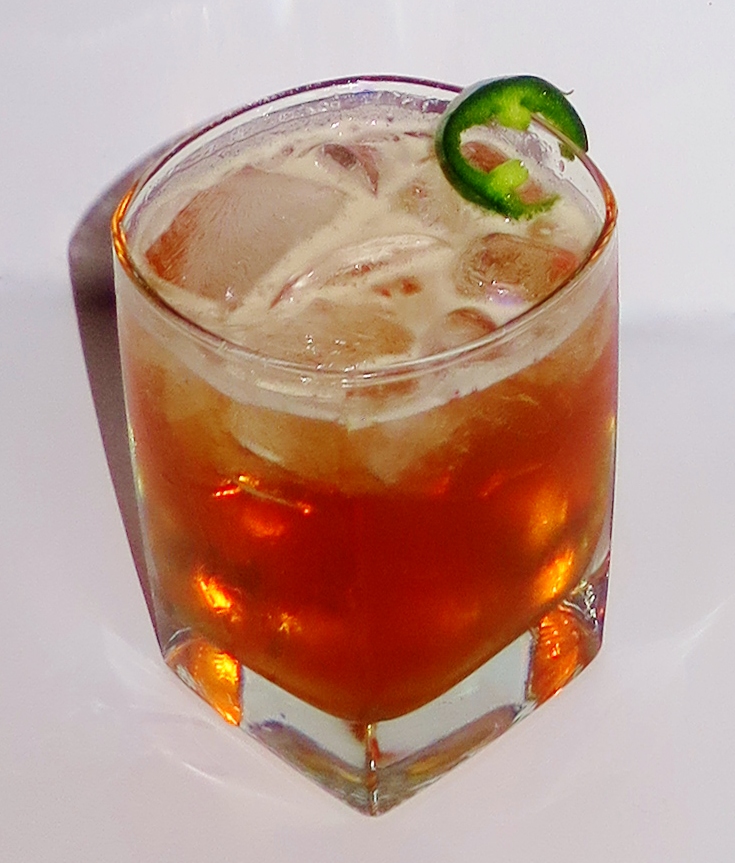
Burning Duchess Cocktail

  • 2 oz Bourbon
  • 1 oz PAMA Pomegranate Liqueur
  • Dash of Agave Syrup
  • 1 Sliced Jalapeno
  • Top with Tonic Water
  • Garnish with a Jalapeno Slice

To sum up, here’s what we’ve learned about the pomegranate: they have a lot to do with how many children you have, how successful your marriage may be, and how much wealth you may acquire, but at the same time, may lead you to be destined to an eternity in the underworld. I guess that’s why the fruit is so expensive in grocery stores!

Sip Advisor Bar Notes (4 Sips out of 5):
Build the drink by combining the Bourbon, Pomegranate Liqueur, and Agave Syrup, stirring to blend ingredients, before adding the sliced Jalapeno and shaking the mix. Pour into a glass and top with Tonic Water, making it ready to serve. I enjoyed this cocktail, which wasn’t a huge surprise, as I like a bite to my drinks. The Tonic Water left a bit of an odd aftertaste, but not enough to diminish from the rest of the recipe.