New Jersey Devils – Dance with the Devil

Throughout the year, the Sip Advisor will alphabetically travel the National Hockey League (NHL), discovering the best and worst each team has to offer in a variety of subjects. We will also feature a drink based off the franchise. Today, we head to the swamplands of New Jersey and make a deal with the Devils:

Establishment Story: The Devils came to exist when the Colorado Rockies were relocated to New Jersey in 1982. The franchise had previously moved from Kansas City – where it had been founded in 1974 as the Scouts – to Colorado in 1976. Even while winning their first Stanley Cup in 1995, rumours were circulating that the team could move yet again, this time to Nashville. In response, the state pledged to fund a new arena for the franchise.

Stanley Cups: The Devils have won three Stanley Cups, from five appearances in the Stanley Cup Finals. They were triumphant in 1995 vs. the Detroit Red Wings, in 2000 vs. the Dallas Stars and in 2003 vs. the Mighty Ducks of Anaheim. Their losses came at the hands of the Colorado Avalanche in 2001 and the Los Angeles Kings in 2012. In a seven year span, from 1995 to 2001, New Jersey appeared in four championship series.

Celebrity Fan: Kevin Smith, creator of the View Askewniverse movies (Clerks, Mallrats, Dogma, etc.), is from New Jersey and has been a lifetime fan of the Devils. He has even blogged about the team for NHL.com. Smith can often been seen in Devils gear and hockey is featured in nearly all of Smith’s movies in some form, including the Devils jersey making appearances in the Clerks film franchise.
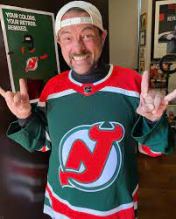
Kevin Smith

Super Fan: Mark Baumann, known simply as Baumann, is a long-time season ticket holder and is credited with creating the D-E-V-I-L-S chant in 1995. He wears a Devils jersey with his last name and the number 00 on it. The Devils also have two well-known supporters’ sections at their home games, the Crazies (Section 233) and the Diablos (Section 122), both recognized for their chants and other conduct.

Mascot: NJ Devil is about what you’d expect as a representative of the team. He’s meant to have a resemblance to the mythical Jersey Devil, which is said to inhabit the state of New Jersey. The franchise’s previous mascot was Slapshot, a large puck, but the man inside the suit was accused of touching three women inappropriately and agreed to counselling to settle the lawsuit. As a result, the mascot was retired in 1993.

Tradition: In the mid-1990s, the Devils became known for their implementation of the neutral zone trap, a defensive system which stifles offensive production and led to what is now called the Dead Puck Era (lack of scoring, also resulting from penalties for clutching and grabbing not being called). The trap’s success led to three Stanley Cups for New Jersey in a nine-year span, so the results were there, even if the exciting on-ice product wasn’t.

Appearances in Media: In the May 1995 episode of Seinfeld, titled The Face Painter, character David Puddy reveals his eccentric support of the Devils while taking Elaine Benes to a New Jersey-New York Rangers game at Madison Square Garden. His face is painted in the team’s colours and he behaves wildly, removing his shirt and clashing with rival Rangers fans. When Benes says he can’t paint his face anymore, he starts painting his chest.

David Puddy

Events/Scandals: After already being moved from Kansas City to Colorado and then onto New Jersey, the Devils organization continued to struggled. Things were so bad, following a 13-4 Edmonton Oilers victory over the Devils in 1983, Wayne Gretzky called the team “a Mickey Mouse operation” that was “ruining the whole league”. Although Gretzky later apologized for his statements, for the next game between the two clubs, fans showed up wearing Mickey Mouse apparel.

Rivalry: The Devils have two main rivals, largely based on geographic location. First, their feud with the New York Rangers is known as the Battle of the Hudson River, the body of water which separates the states. Second, there’s the Philadelphia Flyers, with the grudge known as the Battle of the Jersey Turnpike, with the Flyers even having their practice rink located in New Jersey. All three teams currently play in the Metropolitan Division.

Tragedy: Pat Burns coached the Devils for two seasons (2002-2004), leading the team to their 2003 Stanley Cup championship, before he was forced to resign his position and focus on his health, following colon and liver cancer diagnoses. Sadly, the cancer returned in 2009 and had metastasized to Burns’ lungs. He passed away on November 19, 2010 and was posthumously inducted into the Hockey Hall of Fame in 2014.

Player Nicknames: Ken Daneyko played his entire NHL career with New Jersey, earning the nickname ‘Mr. Devil’. Following his retirement, the three-time Stanley Cup winner has even moved into a colour analyst role for Devils game broadcasts. Daneyko holds the franchise records for games played (1,283) and penalty minutes (2,516), with his jersey being retired by the team in 2006.
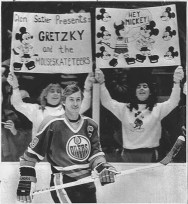
Mickey Mouse Operation

Line: While some lines scored more, the Crash Line, consisting of Bobby Holik, Randy McKay and Mike Peluso, is fondly remembered for their aggressive checking, neutralizing the top stars of opposing teams. The trio played a very important role in the Devils 1995 Stanley Cup championship, providing secondary scoring to go along with their combined intimidation factor.

Captain: Scott Stevens is the longest-serving captain in franchise history, holding the role for 12 seasons from 1992 until his retirement in 2004. Stevens originally refused to report to the team, following his 1991 trade to the Devils, as compensation for the St. Louis Blues signing away restricted free agent Brendan Shanahan. In the end, his decision to finally play for the organization was a good one, resulting in three Stanley Cup wins.

Enforcer: Nicknamed ‘The Polish Hammer’, Krzysztof Oliwa holds the Devils single-season record for penalty minutes with 295. Oliwa patrolled the ice for New Jersey for parts of four seasons, after being drafted by the team 65th overall in 1993. Oliwa is the only player from Poland to win a Stanley Cup, which he did as a member of New Jersey’s 2000 championship squad.

Family Values: Brothers Jack and Luke Hughes were both high draft picks of the Devils, being selected first (2019) and fourth (2021) overall, respectively. Jack is already a superstar with the team, while Luke is among the club’s top prospects, having made his NHL debut late in the 2022-23 season. Twin brothers Patrik and Peter Sundstrom played part of the 1989-90 season together with New Jersey, while Patrik’s son Alexander was drafted by the Devils in 2005, but never played in the NHL.
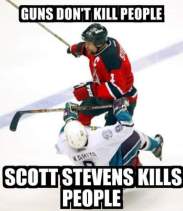
Scott Stevens

Returning Players: Brendan Shanahan was drafted by the Devils second overall in 1987. When he became a restricted free agent in 1991, he signed an offer sheet from the St. Louis Blues, which New Jersey elected to not match. 17 seasons later, after not playing for the first half of the 2008-09 campaign, Shanahan returned to the Devils for what would be the final season of his Hall of Fame career.

Short Stint: High-scoring defenseman Phil Housley bounced around the NHL quite a bit over his 21-season career, including 22 games played with the Devils in 1996. He performed well, recording 16 points in those games, but left for the Washington Capitals as a free agent. Somehow, Housely’s time in New Jersey wasn’t the shortest stint of his eight NHL teams, as he only played a single game for the Toronto Maple Leafs in 2003.

Undrafted: In 1999, the Sporting News named Brian Rafalski the best hockey player outside of the NHL. The 25-year-old defenseman was signed by the Devils and would go on to be a member of their 2000 and 2003 Stanley Cup championship teams, largely playing with Scott Stevens. Rafalski left New Jersey in 2007, joining the Detroit Red Wings for back-to-back Stanley Cup Finals appearances, before retiring in 2011.

Trade: When the Devils traded defenseman Tom Kurvers to the Toronto Maple Leafs one game into the 1989-90 season, they received a 1991 first round draft pick in return. Little did they know that selection would turn into the third overall choice, bringing Scott Niedermayer to New Jersey. Niedermayer would be an integral member of three Stanley Cup championship teams, winning a Norris Trophy in 2004, his final season with the club.
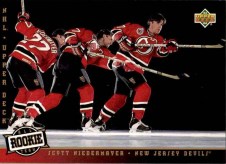
Scott Niedermayer

Signing: Among the Devils worst signings of all-time was their 17-year, $102 million deal to retain the services of Ilya Kovalchuk, who they had traded for a few months earlier. Since the deal was ruled to have violated the NHL’s salary cap, it was nullified and New Jersey was punished with a $3 million fine and the loss of draft picks. A 15-year, $100 million pact was eventually given to Kovalchuk, who bolted for Russia anyway after three seasons.

Draft Pick: The Devils have benefitted from two first overall selections in recent years, taking Nico Hischier in 2017 and Jack Hughes in 2019. Other top picks that have worked out well for New Jersey include John MacLean (6th overall in 1983), Brendan Shanahan (2nd overall in 1987), Scott Niedermayer (3rd overall in 1991). It’s also hard to believe they landed Martin Brodeur at 20th overall in 1990, given his legendary run with New Jersey.

Holdouts: Scott Niedermayer had two significant contract disputes with the Devils during his tenure with the team. First, Niedermayer missed the first month of the 1998-99 season after rejecting an initial offer of $3.25 million. Niedermayer also sat out the first two months of the 2000-01 season, wanting to be paid an average salary comparable to the best defensemen in the NHL. He finally settled for a four-year, $16 million pact.

Buyouts: The Devils biggest buyout came in 2020, when they bought out the remaining two years of goalie Cory Schneider’s seven-year, $42 million contract. Schneider came to New Jersey to be the heir to Martin Brodeur’s goaltending throne and for a time, he was an apt replacement to the legend. Sadly, a string of injuries hampered Schneider’s performance, including a 21-game losing streak, spanning over a year.

Kovalchuk

Unique Game: The Devils took part in a trio of Super Series exhibition matches against teams from the USSR in the late 80s and early 90s. New Jersey took part in the 2018 NHL Global Series, playing a single game against the Edmonton Oilers in Gothenburg, Sweden, to open their 2018-19 season. The Devils also took part in a 2014 Stadium Series contest versus the New York Rangers. A decade later, they will face the Philadelphia Flyers, as part of the 2024 Stadium Series.

Goal: With Game 6 of the 2000 Stanley Cup finals tied, the contest entered double overtime. A win earned the Devils their second Stanley Cup in franchise history. Jason Arnott provided the heroics, putting away the Dallas Stars. Also, Martin Brodeur holds the NHL record for goalie goals, with two scored in the regular season and one in the playoffs. Only one of his tallies was a shot on goal, while the other two, including one game-winner, were own goals by the opposing team.

Fight/Brawl: While the Devils have participated in a number of brawls over the course of their history, a one-on-one fight has become part of hockey folklore, thanks to its spread on social media. During Brendan Shanahan’s early years in the NHL, he once attacked Buffalo Sabres veteran Rick Vaive after a faceoff. Vaive had no clue what he did to deserve being jumped, but it was soon revealed a 14-year-old Shanahan had asked Vaive for an autograph, but was turned down and this was the long-awaited revenge.

Injury: During an October 2014 game, Devils forward Martin Havlat was hit by Jason Chimera of the Washington Capitals. Havlat fell into referee Darcy Burchell, as well as the boards, which caused the visor of his helmet to push into his face. The result was severe lacerations to his nose and upper lip, requiring numerous stitches to close the wounds. Havlat joked about the incident, saying he didn’t need any mask for upcoming Halloween celebrations.
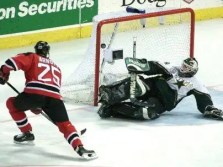
Jason Arnott

Penalty: In one of the most infamous confrontations in hockey history, Devils coach Jim Schoenfeld got into an argument with referee Don Koharski following his team’s loss in the 1988 playoffs. Koharski fell, but accused Schoenfeld of pushing him. Koharski stated he hoped the incident was caught on video, to which Schoenfeld replied: “Good, ’cause you fell, you fat pig! Have another doughnut! Have another doughnut!” Schoenfeld was suspended one game and fined $1,000, while the team was fined $10,000.

Wildest Story: On January 22, 1987, an extreme blizzard in New Jersey resulted in only 334 fans (of an expected 11,247, based on tickets sold) showing up to a Devils game versus the Calgary Flames. Those that did manage to make the dangerous trek and attend the contest, where New Jersey won 7-5, were all made members of the 334 Club. Each fan was later sent a badge commemorating the unique game.

Blooper: During the 2003 Stanley Cup Finals, legendary Devils goalie Martin Brodeur came out of his net to play a dumped in puck. Unfortunately, Brodeur lost the handle on his stick and as it fell to the ice, the puck deflected off it and into the net. It was a rare mistake for one of the best puck playing goalies of all-time. The Devils still managed to win the Stanley Cup, so no harm, no foul, I guess.

Miscellaneous: When New Jersey won the 1995 Stanley Cup, a new tradition was born. For the first time, each player (and some other members of the organization) got to spend a day with the trophy. Since then, children have been baptized in it, dogs have eaten meals out of it, kids have [accidentally] used it as a toilet, and it has travelled the globe, including to some of the most famous sites in the world.

New Jersey Devils: Dance with the Devil

Dance with the Devil

  • 1.5 oz Bourbon
  • 0.75 oz Triple Sec
  • Top with Passionfruit Juice
  • Splash of Lemon Juice
  • Dashes of Tabasco Sauce
  • Garnish with a Maraschino Cherry

It floors me how difficult finding drinks for each NHL team has been throughout this project. Perhaps I’m being too picky, but I thought that aspect would be the easy part of my 2023 mission. Anyway, I was curious about the combo of ingredients in this cocktail, so wanted to see how it all came together.
Nashville Predators – Predator Smash

Throughout the year, the Sip Advisor will alphabetically travel the National Hockey League (NHL), discovering the best and worst each team has to offer in a variety of subjects. We will also feature a drink based off the franchise. Today, we travel to Nashville, or as the local hockey fans know it, Smashville, for an in-depth look at the Predators:

Establishment Story: The Predators joined the NHL as an expansion team in 1998. Previously, Nashville had almost become the home of a relocated New Jersey Devils, but that deal fell through. After the team’s logo was revealed, a naming competition commenced, with options being Ice Tigers, Fury and Attack. One final alternative was submitted by owner Craig Leipold, that being the eventual winner Predators.

Stanley Cups: The Predators have never won the Stanley Cup, but did appear in the 2017 Stanley Cup Finals versus the Pittsburgh Penguins, losing in six games. Aside from 2017, Nashville has only advanced as far as the second round, which they have achieved four times. The Predators have qualified for the playoffs 15 times over their 24 seasons in existence.

Celebrity Fan: Due to Nashville’s music scene, many artists of the area have become supporters of the Predators. This includes Keith Urban and wife Nicole Kidman, Carrie Underwood (who is married to former Predator Mike Fisher), Vince Gill, Dierks Bentley, and Shania Twain. This has made life very easy on whoever has to book musical acts for between periods or national anthem duties.

Smashville

Super Fan: Section 303 of Bridgestone Arena, affectionately known as The Cellblock or Cellblock 303, has been called “the loudest section of the loudest arena in the NHL”. The fan club dates back to the days of the Nashville Knights (1989-96) minor league team. Some popular members included Eudora Hunter, an 82-year-old woman who held up funny signs to the delight of other fans, and Ben ‘Big Ben’ Butzbach, who painted various images on his stomach. Sadly, both fans have passed away.

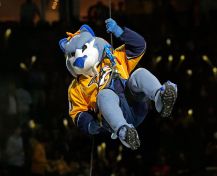
Mascot: Gnash is a sabre-toothed tiger, the animal being selected because the partial skeleton of one was found during excavation of the First American Cave in Nashville in 1971. Based on this story, it’s said that Gnash was discovered frozen in ice, while crews were building the Nashville Arena, today’s Bridgestone Arena. The frozen cat thawed and disappeared, re-emerging to debut with the Predators in 1998.

Tradition: Adapting the Detroit Red Wings tradition of throwing octopi onto the ice, Predators fans have been known to toss catfish from the stands, first occurring on October 30, 2003. Fans are also known to display their Fang Fingers, either foam gloves or curled index and middle fingers, which they use in a biting motion to sounds from the movie Psycho, prior to Predators power plays.

Appearances in Media: The Predators were the 2022 feature team in the NHL Network’s Behind the Glass series, which documents the chosen franchise’s training camp. This was the third installment of the all access series, with other teams followed being the New Jersey Devils in 2018 and Philadelphia Flyers in 2019. No team was highlighted in 2020 or 2021, due to the pandemic. Four episodes aired in fall 2022, with footage including Nashville starting their season with games in Prague, Czechia.

Gnash

Events/Scandals: On June 16, 2018, Predators forward Austin Watson was arrested following a domestic incident. He would plead no contest to a charge of domestic assault and be sentenced to one year probation and attending a batterer intervention course. The NHL suspended Watson for the 2018 pre-season and 27 regular season games (reduced to 18 by an arbiter) for unacceptable off-ice conduct. Watson didn’t rejoin Nashville until March 25, 2019, following time in the league’s substance abuse program.

Rivalry: The Predators greatest feuds have occurred against fellow long-time Central Division opponents, such as the Chicago Blackhawks, Minnesota Wild and St. Louis Blues. Nashville also had decent rivalries with the Detroit Red Wings and Columbus Blue Jackets, but those have dissipated to some degree, as both teams were moved into the Eastern Conference during the 2013 divisional realignment.

Tragedy: Wade Belak played the final three seasons of his NHL career with the Predators. When he retired in 2011, he remained with the franchise in an organizational role. Sadly, on August 31, 2011, Belak was found dead in his Toronto hotel room, where he was to take part in the hockey/figure skating crossover reality TV series Battle of the Blades. Belak’s cause of death was never officially released, but it was treated as a suicide by hanging.

Player Nicknames: Two of Nashville’s top goalies of all-time have memorable handles, including Pekka Rinne being known by teammates as Chief, while his incumbent Juuse Saros has been dubbed Juice. Also, 6’6” fourth-liner Michael McCarron has been the recipient of two wrestling-themed monikers while a member of the Predators organization. First, he was known as Big Show with the minor league Milwaukee Admirals, followed by Big Sexy with the big league club.

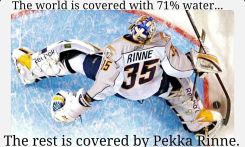
Pekka Rinne

Line: The Vowel Line consisted of Martin Erat, Denis Arkhipov and Vladimir Orszagh, for obvious reasons. Some other former top units include Viktor Arvidsson, Ryan Johansen and Filip Forsberg, as well as J.P. Dumont, Jason Arnott and Alexander Radulov. The franchise has always been known for the quality of its defense, with one of their most dominant pairs being Shea Weber and Ryan Suter.

Captain: Speaking of Shea Weber, he was named captain of the Predators on July 8, 2010. He served in the role for six seasons, before his shocking trade to the Montreal Canadiens in the 2016 off-season. Fellow blueliner Roman Josi is the team’s current leader and going into the next season, will surpass Weber as the franchise’s longest-serving captain. With Josi under contract until 2027-28, he should set a new standard of leadership within the organization.

Enforcer: Jordin Tootoo was a fan favourite for Predators supporters during his eight seasons with the team. The first Inuit person to play a regular season NHL game, Tootoo holds the all-time franchise record for penalty minutes with 725. Nicknamed the Tootoo Train for his devastating hits, Tootoo could also be relied upon to help on the scoresheet, putting up 30 points in his final campaign in Nashville. After retiring in 2018, Tootoo was invited to return to Nashville for Jordin Tootoo Night on February 2, 2019.

Family Values: Brothers Andrei and Sergei Kostitsyn played a portion of one season together with the Predators. They had previously also suited up together with the Montreal Canadiens. Andrei returned to play in Europe in 2012, following a curfew issue during the previous playoffs. Sergei lasted one more season, before his contract was mutually terminated and he too was Europe bound. The brothers were the first Belarussian siblings to play in the NHL.

Shea Weber

Returning Players: Two back-to-back first round Nashville draft picks started and ended their careers there, with gaps in between. Forward Scott Hartnell was drafted 6th overall in 2000, playing six seasons with the Predators. Hartnell closed his career with a final season in Smashville in 2017-18. Defenseman Dan Hamhuis, drafted 12th overall in 2001, played eight seasons with the organization, returning for two campaigns from 2018 to 2020.

Short Stint: Peter Forsberg’s tenure with the Predators lasted all of 22 games. He was brought in prior to the 2007 trade deadline, in exchange for the hefty price of Scottie Upshall, Ryan Parent and first- and third-round draft picks. While he was productive, scoring 19 points in those games, the Predators were eliminated in the first round of the playoffs. Forsberg then contemplated retirement, returning to the Colorado Avalanche for nine games the next season.

Undrafted: Vernon Fiddler was signed by the Predators on May 6, 2002, after playing with their American Hockey League affiliate, the Norfolk Admirals, as a free agent. He would debut with the big club in November 2002 and become a fixture of the roster from 2006 to 2009. Fiddler played the final 20 games of his career with Nashville, finishing with 877 games played, 104 goals and 157 assists.

Trade: One of the most lopsided deals in NHL history saw the Predators trade Martin Erat (along with Michael Latta) to the Washington Capitals for top prospect Filip Forsberg at the 2013 trade deadline. Erat was practically useless for the Capitals, while Forsberg became a star with Nashville. Forsberg is already the Predators all-time leading goal scorer and entered the 2022-23 season with an eight-year contract extension.

Filip Forsberg

Signing: Among the better deals the Predators have signed, include Paul Kariya (two-year, $9 million in 2005) and Jason Arnott (five-year, $22.5 million in 2006). As for one that didn’t turn out so well, was Matt Duchene’s seven-year, $56 million pact in 2019. Duchene, an avid country music fan, was bought out of the last three years of his deal in the 2023 off-season, leaving the Predators with a payout of $9.33 million over six years.

Draft Pick: The highest the Predators have ever picked was second overall, using their first ever selection on David Legwand in 1998. The team has made some amazing second round choices, stealing future captains Shea Weber in 2003 and Roman Josi in 2008. Nashville has also done well drafting goalies in later rounds, taking current netminder Juuse Saros 99th overall in 2013 and all-time backstop stat leader Pekka Rinne 258th overall in 2004.

Holdouts: While the Predators have had no contract impasses over their history, it should be noted that Nashville prospect Jimmy Vesey (drafted 66th overall in 2012) refused to sign with the team. This meant he would become a free agent in the 2016 off-season, as teams have four years to sign a college draft pick. To settle the dispute, the Predators traded Vesey’s rights to the Buffalo Sabres, but he still elected to become a free agent and eventually signed with the New York Rangers.

Buyouts: Center Kyle Turris was a key component of a 2017 three-way trade between the Predators, Colorado Avalanche and Ottawa Senators, signing a contract extension with Nashville immediately following the swap. However, on October 7, 2020, the Predators bought out the remaining four seasons of that six-year, $36 million contract. Nashville would have to pay Turris $16 million over the next eight years, while Turris would play 50 more NHL games over two seasons with the Edmonton Oilers.

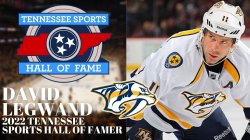
David Legwand

Unique Game: In 2000, the Predators faced the Pittsburgh Penguins for a pair of regular season games in Saitama, Japan. In more recent years, they’ve participated in other high-profile league spectacles, such as the 2020 Winter Classic versus the Dallas Stars, a 2022 Stadium Series game against the Tampa Bay Lightning and were part of the 2022 Global Series, opening their campaign with two matches versus the San Jose Sharks in Prague, Czechia.

Goal: One of the greatest feats in hockey is for a goalie to score a goal. Predators legend Pekka Rinne did just that on January 9, 2020, firing a puck into the empty net of the Chicago Blackhawks, en route to a 5-2 victory. The win was also the first for coach John Hynes behind the Nashville bench. Fellow Predators netminder Chris Mason was also credited with a goalie goal in 2006, but that was the result of an own goal by the Phoenix Coyotes.

Fight/Brawl: Although not a traditional rival, the Predators and Winnipeg Jets have shared the same division since 2013. In the 2017 playoffs, the Predators defeated the Jets in seven games and for the teams first meeting since the elimination, in October 2018, tempers boiled over quickly, resulting in a line brawl. 76 penalty minutes were handed out in the contest, with a lopsided 60 going to Winnipeg. Nashville won the game 3-0.

Injury: In an unfortunate incident of friendly fire, when Jason Arnott scored the winning goal of Game 3 of the first round of 2008 playoffs against the Detroit Red Wings, teammate Alexander Radulov jumped on him in celebration. The resulting fall led to Arnott receiving a concussion and missing much of the rest of the playoffs. Nashville lost the series in six games, playing the final two contests without their captain and regular season scoring leader.

Pekka Rinne Goal

Penalty: Jordin Tootoo was suspended a couple times during his Nashville tenure, including five games in 2007 for a sucker punch to Stephane Robidas (which resulted in a concussion) of the Dallas Stars and two games in 2011 for charging Buffalo Sabres goalie Ryan Miller. It was Miller’s first game back after being hit by Boston Bruins power forward Milan Lucic three weeks earlier, which caused many around the NHL to call for changes to that part of the game, including Predators GM David Poile.

Wildest Story: During the 2012 playoffs, Predators forwards Alexander Radulov and Andrei Kostitsyn were spotted in a Scottsdale, Arizona bar at 5:00 am, the morning of Game 2 of Nashville’s series against the Arizona Coyotes. This violated team curfew and both players were suspended for that night’s contest. Radulov had just returned to the organization after four seasons in Russia. When his contract expired following the team’s elimination by the Coyotes, Radulov returned to Russia for another four years.

Blooper: During a November 2011 game against the Toronto Maple Leafs, winger Craig Smith looked to seal the win for the Predators with an empty net goal. He was alone on a breakaway and nobody had any chance of stopping him. The horn inside Bridgestone Arena went off and everyone assumed Smith had scored… except he had tried to shoot the puck into the top of the net and had completely put it over the net and into the stands instead. Thankfully, Nashville still emerged with a 4-1 victory.

Miscellaneous: When NHL jobs seem to have short shelf lives, it’s amazing that Predators GM David Poile guided the franchise from its earliest days until retiring after the 2023 NHL draft. Poile owns the record for most wins as a GM, finishing his executive career with 1,533 victories. He won the NHL General Manager of the Year award in 2017 and outside of the NHL, Poile also oversaw the 1998 and 1999 USA World Championship teams, as well as the American 2014 Olympics squad.

Nashville Predators: Predator Smash

Predator Smash

  • 2 oz Bourbon
  • Top with Iced Tea
  • Blend with Ice
  • Splash of Lemon-Lime Soda
  • Garnish with a Lime Slice

This frozen drink was served for a time at Bridgestone Arena. While it didn’t come with a name when I found it, I’ve dubbed the beverage myself. I vowed to use my Margaritaville blender more this summer, so this was a good recipe to start with.