
Throughout the year, the Sip Advisor will alphabetically travel the National Hockey League (NHL), discovering the best and worst each team has to offer in a variety of subjects. We will also feature a drink based off the franchise. Today, we visit the City of Brotherly Love, home to the infamous Broad Street Bullies, aka Philadelphia Flyers:
Establishment Story: The Flyers joined the NHL as an expansion team in 1967, when the league expanded from six to 12 teams. Previously, Philadelphia had an NHL team for the 1930-31 season, when the Pittsburgh Pirates relocated to become the Philadelphia Quakers. The team’s Flyers nickname was suggested by owner Ed Snider’s sister Phyllis. Other monikers considered, included Liberty Bells, Ramblers and a return to Quakers.
Stanley Cups: The Flyers won back-to-back Stanley Cups in 1974 and 1975, becoming the first of the 1967 expansion teams to accomplish the feat. However, since then, the franchise has been on the losing end of six straight Stanley Cup Finals appearances (1976 to Montreal Canadiens, 1980 to New York Islanders, 1985 and 1987 to Edmonton Oilers, 1997 to Detroit Red Wings, and 2010 to Chicago Blackhawks).
Celebrity Fan: Actor David Boreanaz, who has starred on shows such as Buffy the Vampire Slayer, Angel and Bones, is a massive Flyers fan. So much so, that his character on Bones wears Flyers shirts or jerseys in a number of episodes. Boreanaz even wrote about his fandom for an essay that was included in the program for the 2012 Winter Classic. U.S. President and First Lady, Joe and Jill Biden, are also supporters of the team.

Super Fan: Bill Schoeninger has turned the basement of his Pennsylvania home into a shrine dedicated to the Flyers. His collection includes signed sticks and trading cards, as well as a variety of pucks, jerseys, game tickets and other memorabilia. Elsewhere, Larry Mathers calls himself the “biggest Flyers fan in Canada!” Mathers, from Exeter, Ontario, has put together three levels of Flyers souvenirs, highlighted by his Flyers-themed Christmas tree.
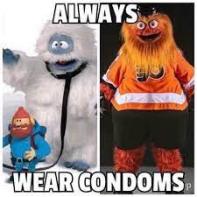
Mascot: In Gritty, the Flyers may have not only the greatest mascot in the NHL or even all of sports, but perhaps the greatest mascot EVER. Sure, he had a 2019 brush with the law, where he was accused of punching a 13-year-old in the back of the head (Gritty was later cleared of the accusation), but appearances on talk shows such as The Tonight Show and Last Week Tonight have made the giant orange creature immensely popular.
Tradition: On December 11, 1969, prior to puck drop, God Bless America sung by Kate Smith was played, rather than The Star-Spangled Banner (U.S. national anthem). Fans loved the change and the Flyers won the game, so it was decided to use the song for select important contests. At times, Smith performed the song live, especially during the playoffs, and the Flyers record is overwhelmingly good when it’s used.
Appearances in Media: The Flyers have appeared in a number of TV shows, included characters attending games on The Goldbergs and It’s Always Sunny in Philadelphia. The starting lineup of the 1976 Flyers also appear as animated jury members (Jury of the Damned) on The Simpsons, when Homer is on trial for making a deal with the devil in one of the Treehouse of Horror segments. Lastly, Gritty appears in a Robot Chicken skit, spoofing the Tonya Harding-Nancy Kerrigan scandal.
Events/Scandals: The Flyers organization has made some interesting decisions regarding coaches and players diagnosed with cancer. First, coach Roger Neilson was replaced and later dismissed after leaving the team in 2000 to undergo treatment. Years later, in 2019, player Oskar Lindblom was diagnosed with the disease. The team supported him throughout his battle, even resigning him to a three-year, $9 million contract when he was ready to return, but bought him out of that deal in 2022, with one year remaining.
Rivalry: Given their reputation as the Broad Street Bullies, the Flyers have made many enemies over the years. This includes state rival the Pittsburgh Penguins (Battle of Pennsylvania), New Jersey Devils (Battle of the Jersey Turnpike), New York Rangers (Broadway vs. Broad Street), Boston Bruins (Big Bad Bruins vs. Broad Street Bullies), and Washington Capitals – the two teams separated by only 124 miles.
Tragedy: The Flyers have experienced a number of deaths over the franchise’s 50-plus seasons. These include Pelle Lindbergh’s fatal car accident, Dmitri Tertyshny having his throat slashed by a boat propeller, and Yanick Dupre and Barry Ashbee passing away from cancer as members of the organization. Also, in 1990, Kathy Kerr, the wife of former Flyers star Tim Kerr, died 10 days after giving birth to the couple’s first child, due to an infection.
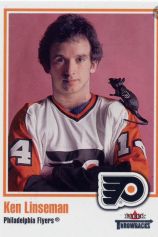
Player Nicknames: Ken Linesman had an interesting career, even before he became a pro player. His lawsuit was responsible for the World Hockey Association and later the NHL to change the minimum age a player could be drafted. Based on his appearance and the way he played (on the dirtier side of the ledger), Flyers teammate Bobby Clarke nicknamed him The Rat. Linesman originally played four seasons with Philadelphia and another 29 games years later.
Line: The Legion of Doom, comprised of Eric Lindros, John LeClair and Mikael Renberg, was one of the NHL’s highest scoring lines ever, but they could also hurt opponents with physical play, given each member was at least 6’2” and 230 lbs. Their best season as a trio, the 1995-96 campaign, saw them score 121 goals combined. Lindros (#88) also featured in the popular Crazy 8s Line with Mark Recchi (#8) and Brent Fedyk (#18).
Captain: With Bobby Clarke as captain from 1973 to 1979, the Flyers identity as a tough and unpleasant team to play against was fortified. Clarke led Philadelphia to their back-to-back Stanley Cup championships in the mid 1970s. When Clarke was named a playing assistant coach, NHL rules stated he must relinquish the captaincy. Clarke became captain again from January 1983 to May 1984, when he retired and became GM of the club.
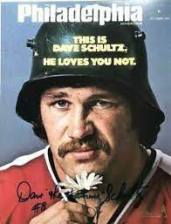
Enforcer: Dave ‘The Hammer’ Schultz not only holds the Flyers record for most penalty minutes in a season at 472 (1974-75), but it’s also an NHL record. He also ranks fifth all-time in career penalty minutes with the team. Schultz’s popularity in Philadelphia led to him recording the local hit song The Penalty Box and appearing as a guest referee for a Broad Street Bully Match (No Holds Barred) at World Championship Wrestling’s Slamboree 1994 event.
Family Values: A few brothers have played together with the Flyers. This includes Joe and Jimmy Watson, who won two Stanley Cups together during their Flyers stint from 1973 to 1978, as well as twins Rich and Ron Sutter (1983 to 1986) and Luke and Brayden Schenn (2013 to 2016). Also of note, Bill Dineen was coach of the team from 1991 to 1993, while his son Kevin was a member of the franchise.
Returning Players: Brian Boucher always seemed to find his way back to the Flyers, playing three stints with the team. He was drafted by Philadelphia 22nd overall in 1995, debuting in the 1999-2000 season. He was traded to the Phoenix Coyotes in June 2002, suiting up for four other NHL teams, before returning to the Flyers as a free agent in 2009. After spending time with the Carolina Hurricanes, Boucher played four final games with Philadelphia in 2013, ending his NHL career.
Short Stint: When Keith Yandle signed with the Flyers for the 2021-22 season, he was in pursuit of the NHL’s iron man streak record. Through his 77 games with Philadelphia, Yandle broke Doug Jarvis’ previous mark, finishing with 989 consecutive games, before he was made a healthy scratch. When he was taken out of the lineup, Yandle ranked worst in a number of defensive statistical categories. He retired in September 2022.
Undrafted: Tim Kerr was signed as an undrafted free agent in 1980. From 1983-84 to 1986-87, Kerr recorded four straight 50-plus goal seasons, before injuries hampered much of the rest of his career. He returned to form for the 1988-89 campaign, scoring 48 goals in 69 games, earning the 1989 Bill Masterton Trophy for perseverance and dedication in the process. Kerr never played more than 40 games in a season again, despite suiting up for another four years.
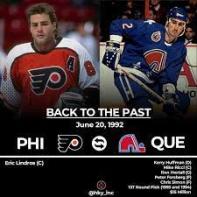
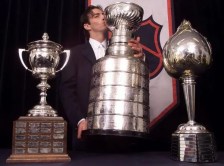
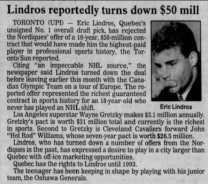
Trade: The biggest trade in Flyers history was landing Eric Lindros at the 1992 NHL draft, one year after he refused to ever play for the Quebec Nordiques, who had drafted him first overall. The price was hefty, with Philadelphia giving up six players (including future Hall of Famer Peter Forsberg), first round draft picks in 1992 and 1993 and $15 million. While Lindros was a dominant force for a handful of years, the Nordiques would become the Colorado Avalanche and win two Stanley Cups during Lindros’ career.
Signing: Two top signings by the Flyers were Jeremy Roenick in 2001 and Danny Briere in 2007. Roenick played three seasons for Philadelphia, recording 173 points in 216 regular season games. He was traded to the Los Angeles Kings coming out of the 2004-05 NHL lockout. Briere inked an eight-year, $52 million deal with the Flyers, helping the team turn around from being the worst team in the league in 2006-07 to a Stanley Cup Finals appearance in 2010.
Draft Pick: The 1969 draft was integral to shaping the Flyers identity, as the club selected Bobby Clarke (17th overall) and Dave Schultz (52nd overall). Philadelphia has only selected first overall once, taking Mel Bridgman with the top choice of the 1975 draft. Their two second overall choices could be seen as misfires, as they took James van Riemsdyk in 2007 and Nolan Patrick a decade later in 2017.
Holdouts: Eric Lindros was no stranger to holding out on a team to force a trade. That’s how he ended up in Philadelphia in the first place. After eight seasons with the Flyers, Lindros now wanted to play elsewhere, following poor treatment by medical staff, having his captaincy stripped by GM Bobby Clarke and being offered a two-way contract as a restricted free agent. Lindros wanted to play for the Toronto Maple Leafs, but after sitting out the entire 2000-01 season, was dealt to the New York Rangers.
Buyouts: Ilya Bryzgalov was signed in 2011 to a nine-year, $51 million contract, with the organization hoping they’d finally found a franchise goalie. Instead, inconsistent play and bizarre behaviour lead to Bryzgalov being nicknamed Mr. Universe. With two compliance buyouts granted to each team coming out of the 2013 NHL lockout, Philadelphia used one of these get-out-of-jail-free cards on Bryzgalov. They were on the hook to pay him $23 million, but his contract didn’t count against their salary cap.

Unique Game: The Flyers have participated in two Winter Classics contests, first versus the Boston Bruins in 2010 and next against the New York Rangers in 2012. They have also faced the Pittsburgh Penguins in a pair of Stadium Series games in 2017 and 2019. Lastly, Philadelphia took on the Boston Bruins, as part of the NHL Outdoors at Lake Tahoe in 2021. They will next play outdoors as part of the 2024 Stadium Series, opposite the New Jersey Devils.
Goal: On December 8, 1987, Ron Hextall became the first goalie to score a direct goal in NHL history, when he fired a shot from deep in his own zone into the Boston Bruins’ empty net. Speaking to media following the game, Hextall stated: “I knew I could do it. It was a matter of when.” Hextall scored again during the 1989 playoffs, adding first goalie to score a direct goal during the post-season to his resume.
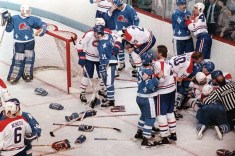
Fight/Brawl: Being known as the Broad Street Bullies comes with the reputation as being a tough team. That was evident in previously documented in this project brawls with the Montreal Canadiens (1987 warm-up scrap) and Ottawa Senators (2004 melee that set a new NHL record for combined penalty minutes at 419). One lesser discussed fracas occurred in 1972 between the St. Louis Blues and Flyers fans and even police patrolling the Spectrum, which saw a number of Blues players and coach Al Arbour arrested.
Injury: During the 2009-10 season, gritty forward Ian Laperriere twice blocked a shot with his face. The first caused him to lose seven teeth and receive 50-100 stitches. The second came in the first round of the playoffs, resulting in a mild concussion and orbital injury. Although he returned to action, symptoms of post-concussion syndrome surfaced during the 2010 training camp and Laperriere was forced to never play again. He was awarded the 2011 Bill Masterton Trophy for his dedication and perseverance.

Penalty: Given the team’s reputation as bullies, it shouldn’t be a surprise that a number of Flyers have served long suspensions for various transgressions. Enforcer Dave Brown was handed a 15-game suspension in 1987 for crosschecking Tomas Sandstrom, causing a broken jaw and concussion. In the 2007 pre-season, Steve Downie received a 20-game ban for an illegal hit on Dean McAmmond. Just weeks later, Jesse Boulerice crosschecked Ryan Kesler in the face, leading to a 25-game suspension.
Wildest Story: During a February 8, 1972 game against the Vancouver Canucks, Flyers goalie Bruce Gamble suffered a heart attack (diagnosed the next day after he travelled with the team and his chest pains continued), but managed to finish the game and earn a 3-1 win. Unfortunately, this incident would end Gamble’s pro career and over a decade later, another heart attack would claim Gamble’s life.
Blooper: One of the most infamous scenes in hockey history saw Flyers fan Chris Falcone fall into the penalty box after the glass divider gave way, following being sprayed with water by Toronto Maple Leafs goon Tie Domi. Once he fell, Falcone was punched a couple times by Domi, who was fined $1,000 for the incident. Falcone later sued Domi and others involved, but settled with the player, burying the hatchet, after Domi offered tickets to a couple Leafs playoff games to Falcone and his family.
Miscellaneous: The NHL record for going undefeated (including ties) was set by the 1979-80 Flyers, who went without a loss for 35 games, from October 14, 1979 to January 6, 1980. The mark not only tops the NHL’s all-time list, but all North American professional sports leagues. Despite the regular season success, the Flyers were defeated by the New York Islanders in that year’s Stanley Cup Finals.
Philadelphia Flyers: Philly Flyer

- 2 oz Gin
- 0.33 oz Maraschino Liqueur
- 0.25 Crème de Cassis
- Splash of Lemon Juice
- Garnish with a Maraschino Cherry
This cocktail was created by Philadelphia Magazine to be the signature cocktail of Philadelphia. You can also find some other great beverage options compiled by Broad Street Hockey contributor Kelly Hinkle.





 Sip Advisor