St. Louis Blues – Monday Night Miracle

Throughout the year, the Sip Advisor will alphabetically travel the National Hockey League (NHL), discovering the best and worst each team has to offer in a variety of subjects. We will also feature a drink based off the franchise. Today, we journey through the Gateway to the West, checking in with the St. Louis Blues:

Establishment Story: The Blues entered the NHL during the 1967 expansion from the Original Six to 12 teams. The league had previously dabbled with the city by relocating the original Ottawa Senators there, becoming the St. Louis Eagles. The Eagles played one season (1934-35) before folding. The Blues are named for the W.C. Handy song Saint Louis Blues, released in 1914.

Stanley Cups: The Blues lone Stanley Cup victory occurred in 2019. The team also made the Stanley Cup Finals three times in their first three seasons, when the league’s divisions were split into the Original Six and the 1967 expansion teams (Next Six). St. Louis lost each time, twice to the Montreal Canadiens and once to the Boston Bruins. Revenge against Boston finally came with that 2019 championship.

Celebrity Fan: There are a number of famous supporters of the Blues, including actors Jon Hamm and Jenna Fischer, who both call St. Louis home. Hamm and Fischer were honourary coaches during the 2020 NHL All-Star Game in St. Louis and were prominent in the Blues Stanley Cup run in 2019. Because of his lifelong love of the Blues, Hamm has also done a fair bit of work for the NHL, including hosting the NHL100 event.

Jon Hamm

Super Fan: Laila Anderson is often credited with inspiring the Blues to turn around their 2018-19 season, which climaxed with their Stanley Cup championship. Anderson, who battled a rare auto-immune disease during that season, became a mascot of sorts for the club, as she celebrated the Stanley Cup win with them on the ice and at their rally. Anderson was also presented with a Stanley Cup ring, which is etched with her name on the inside.

Mascot: Louie is a blue polar bear, who debuted during the 2007-08 season. Louie’s backstory says he travelled to St. Louis from the Arctic Circle, inspired to search out his favourite hockey team. A 2021 poll conducted by Play Canada ranked Louie as the fourth most popular mascot in the NHL, but given the winner of the poll was Carlton the Bear of the Toronto Maple Leafs, the poll loses all credibility.

Tradition: The Blues and their fans have a couple rituals of note. First, following a goal, a bell tone is played for each tally scored that night, as the crowd counts along. Also, during the team’s 2018-19 season turnaround and Stanley Cup run, the song Gloria by Laura Branigan became the Blues theme track, played after each win. The tune was retired after St. Louis celebrated raising their Stanley Cup banner.

Appearances in Media: The Tom Hanks post-apocalyptic movie Finch is set in St. Louis and features his characters wearing a classic Blues jersey. Also, musician Nelly, a proud St. Louis native, can be seen alternating between St. Louis Cardinals and Blues gear throughout the music video for his hit song Country Grammar. Nelly can often be seen in Blues paraphernalia and is a big fan of the team.

Nelly

Events/Scandals: Just days after the Blues were eliminated from the 2004 playoffs, player Mike Danton was arrested on a conspiracy to commit murder charge. Danton had attempted to hire a hitman to murder his agent David Frost. Danton was sentenced to 90 months in prison, serving 63 before he was released. Danton later claimed his estranged father was the intended target of the murder-for-hire plot.

Rivalry: The Blues have had a long-standing feud with the Chicago Blackhawks, as the two teams have shared a division since 1970. While brawls between the clubs were common, one particular melee in 1991 is known as the St. Patrick’s Day Massacre. The result of the fights was 12 players ejected and three players suspended. Interestingly, all six Sutter brothers were members of each team in 1991-92.

Tragedy: Bob Gassoff played for the Blues from 1973 to 1977. At a party following the 1976-77 season, hosted by teammate Garry Unger, Gassoff was involved in a motorcycle accident, killing him at only 24 years old. Following his death, Gassoff’s number 3 jersey was retired by the Blues and the Bob Gassoff Trophy was created, rewarded to the most improved defenseman of the Central Hockey League. Gassoff holds the Blues record for penalty minutes in a season at 306.

Player Nicknames: Brett Hull’s father, Bobby Hull, was nicknamed the Golden Jet during his illustrious hockey career. Therefore, the moniker the Golden Brett was bestowed upon Brett, who shared his father’s scoring touch. Once Brett joined the Blues in 1988, he became one of the league’s most dangerous scorers, holding the franchise records for single-season and career goals. Hull’s jersey number 16 was retired by the Blues in 2006.
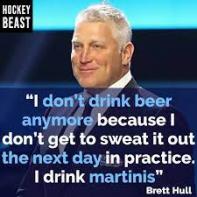
Brett Hull

Line: Sometimes, it doesn’t matter who the third member of a line is, so long as the first two pieces have tremendous chemistry. Such was the case when Brett Hull and Adam Oates were paired together, comprising the duo of Hull & Oates, a play on the musical tandem Hall & Oates. Together, Hull and Oates played together from 1989 to 1992, with Hull scoring 212 goals during that span, while his frequent playmaker Oates recorded 228 assists.

Captain: Brian Sutter was the longest-serving captain in Blues history, holding the mantle from 1979 up until his retirement in 1988. Sutter played his entire career with St. Louis, drafted by the team 20th overall in 1976. After hanging up his skates, Sutter became head coach of the Blues, leading them behind the bench from 1988 to 1992. Sutter’s number 11 jersey was retired by the organization on December 30, 1988.

Enforcer: Kelly Chase and Tony Twist were known as the Bruise Brothers while they played together for the Blues in 1989-90 and later from 1997 to 1999. The two had been together in junior hockey with the Saskatoon Blades and the minor leagues with the Peoria Rivermen. Despite being good friends and Twist living in Chase’s house while he was with the Hartford Whalers, the two even fought each other during a March 9, 1996 game.

Family Values: The Plager brothers (Bobby, Barclay and Bill) played together for the Blues from 1968 to 1972. The trio helped lead St. Louis to their three straight Stanley Cup Finals appearances after the Blues joined the NHL. Another brother set to suit up together with St. Louis was Gino and Paul Cavallini. They were both members of the franchise from 1987 to 1992.

Plager Brothers

Returning Players: David Perron has had three stints with the Blues. He was drafted by the team in 2007, playing six seasons, before being traded to the Edmonton Oilers in 2013. Perron returned to St. Louis as a free agent in 2016, but after one season, was the Vegas Golden Knights Expansion Draft choice from the Blues. He was back in St. Louis in 2018, playing four seasons, before signing as a free agent with the Detroit Red Wings in 2022.

Short Stint: Some of the greatest players of all-time have had such short stints with St. Louis, that seeing them in a Blues jersey looks odd. This includes goalies Martin Brodeur (seven games after two decades with the New Jersey Devils), and Tom Barrasso (six games), along with Peter Stastny (27 games, regular season and playoffs combined), and even Wayne Gretzky (31 games, regular season and playoffs combined).

Undrafted: Curtis Joseph, nicknamed Cujo, from the Stephen King novel of the same name, was signed out of the NCAA University of Wisconsin in 1989. He would remain in St. Louis until 1995, gaining a reputation as one of the best goalies in the league, including being a Vezina Trophy finalist for the 1992-93 season. In 2015, Joseph was inducted into the St. Louis Sports Hall of Fame.

Trade: Among the Blues better acquisitions were bringing in Brett Hull from the Calgary Flames in March 1988 (along with Steve Bozek for Rob Ramage and Rick Wamsley), followed by Adam Oates from the Detroit Red Wings in June 1989 (along with Paul MacLean for Bernie Federko and Tony Mckegney). The two combined to make one of the most lethal offensive duos in NHL history, as noted above.
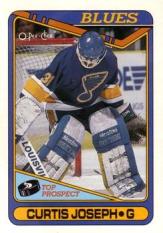
Curtis Joseph

Signing: In the early 90s, the Blues made a number of offer sheet signings to restricted free agents. They threw out contracts to the likes of Scott Stevens (twice!), Dave Christian, Brendan Shanahan, Michel Goulet, Marty McSorely, Petr Nedved, and Shayne Corson. Only Goulet, McSorely and Stevens (the second time) didn’t end up with the club, but the cost of the acquisitions was a number of draft picks and key players lost in compensation.

Draft Pick: The Blues have had an interesting draft history. The team passed on their opportunity to make any picks in their very first draft in 1967, didn’t participate in the 1983 draft, and had five straight first rounders (1991-95) transfer to the Washington Capitals, as compensation for the successful Scott Stevens offer sheet. They have selected first overall just once, taking defenseman Erik Johnson in 2006.

Holdouts: Alex Pietrangelo only missed one training camp practice before signing a seven-year, $45.5 million contract with the Blues in 2013. The hope was that Pietrangelo would spend his entire career with the team, but the defenseman, who was selected fourth overall in 2008, joined the Vegas Golden Knights in free agency in 2020 (seven years, $61.6 million), upon the expiry of the aforementioned pact.

Buyouts: The Blues have only used two buyouts in their history and none since 2009. In 2007, the team parted ways with captain Dallas Drake, following six seasons in St. Louis. Drake would move onto the Detroit Red Wings for a season, retiring as a Stanley Cup champion. Two years later, defenseman Jay McKee was bought out of the final year of his four-year, $16 million contract signed in 2006. His final campaign came with the Pittsburgh Penguins.
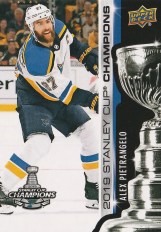
Pietrangelo

Unique Game: The Blues have participated in two Winter Classic games. First, they hosted the rival Chicago Blackhawks in 2017, followed by facing the Minnesota Wild in 2022. St. Louis and the Edmonton Oilers also participated in the 1990 Epson Cup in Dusseldorf, West Germany, which included a game against each other as part of the tournament. Finally, the Blues opened their 2009-10 season with a pair of games against the Detroit Red Wings in Stockholm, Sweden, for the 2009 NHL Premiere.

Goal: Blues fans waited 52 years for the club’s first Stanley Cup and it took a 4-1 win in Game 7 of the finals against the Boston Bruins to get that title. The St. Louis faithful were put at ease when Ryan O’Reilly tallied the opening goal of that game at 16:47 of the first period and the Blues never looked back. O’Reilly was later named the Conn Smythe Trophy recipient as playoff MVP.

Fight/Brawl: Blues history is littered with infamous brawls. These include melees against the Philadelphia Flyers (1972), Pittsburgh Penguins (1973), New York Rangers (1974), Chicago Blackhawks (1991 St. Patrick’s Day Massacre), and Detroit Red Wings (1993). The fracas with the Penguins occurred during a pre-season contest and lasted 20 minutes, with fighting occurring in the penalty boxes and the hallway leading from them to St. Louis’ dressing room.

Injury: Two Blues defensemen have suffered serious heart issues during games with the team. First, during the 1998 playoffs, Chris Pronger was hit with a slapshot to the chest in a contest against the Detroit Red Wings. This caused Pronger to go into cardiac arrest due to his heart rhythm being disrupted. Next, in 2020, Jay Bouwmeester collapsed on the bench due to cardiac arrest. Thankfully, both players survived their ordeals, but Bouwmeester never played in the NHL again.
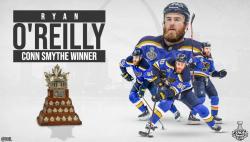
Ryan O'Reilly

Penalty: During a 1969 pre-season game, Wayne Maki got into a stick swinging fight against Ted Green of the Boston Bruins. Maki clubbed Green over the head, resulting in a fractured skull and brain injury. Both players were charged with assault, becoming the first NHL players to face criminal prosecution for an on-ice incident, but were acquitted. Maki was suspended 30 days, while Green missed the entire season recovering.

Wildest Story: The Blues were almost moved to Saskatoon, Saskatchewan in 1983, but the NHL’s Board of Governors voted to reject the proposed $12 million sale. This led to lawsuits between then owner Ralston Purina (of the Purina animal food empire) and the NHL, with control of the franchise taken over by the league. The result was the Blues stayed in St. Louis, when a new ownership group, led by businessman Harry Ornest, was put together.

Blooper: In February 2006, Blues defenseman Dennis Wideman made one of the most memorable shootout attempts of all-time… memorable for all the wrong reasons. As Wideman swiftly skated towards Chicago Blackhawks goalie Corey Crawford, he made a nice deke move, but lost a skate edge and went flying up in the air, landing flat on his back, with the puck sliding into the corner of the rink.

Miscellaneous: Bernie Federko deserves some mentioning, as he’s the Blues career leader in games, assists and points, while sitting second all-time in goals. Federko was drafted by St. Louis seventh overall in 1976, remaining with the team until a 1989 trade to the Detroit Red Wings. Federko would have his number 24 jersey retired by the Blues in 1991 and for an extended period was the color commentator on the team’s TV broadcasts.

St. Louis Blues: Monday Night Miracle
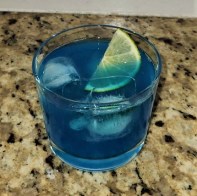
Monday Night Miracle

  • 1.5 oz Gin or Vodka
  • 1 oz Blue Curacao
  • Splash of Lime Juice
  • Garnish with a Lime Slice

This cocktail is named after the greatest comeback in Blues history, Game 6 of the Campbell Conference Finals, which occurred on Monday, May 12, 1986. The Blues were down 5-2 with 12 minutes left in the contest, when they rallied to force overtime and won 6-5. Despite the momentum change, they would still lose the series to the Calgary Flames.
Calgary Flames – Calgary Flames Martini

Throughout the year, the Sip Advisor will alphabetically travel the National Hockey League (NHL), discovering the best and worst each team has to offer in a variety of subjects. We will also feature a drink based off the franchise. Today, we throw on the cowboy boots and leather chaps, en route to Calgary, to investigate how hot them Flames really are:

Establishment Story: The Flames relocated from Atlanta – where they had played from 1972 to 1980 – keeping the Flames nickname from their predecessor. The Flames filled a professional hockey void in the city that had existed since the World Hockey Association’s Calgary Cowboys had folded in 1977. The team has been locally owned by a group of oil tycoons and others since 1981.

Stanley Cups: The Flames have a sole Stanley Cup, winning the championship in 1989. They have appeared in two other Stanley Cup Finals, losing to the Montreal Canadiens in 1986 (the same team they would defeat in 1989) and coming up short against the Tampa Bay Lightning in 2004. The Flames 1989 triumph was the only time the famed Montreal Forum witnessed an opposing team capture the Stanley Cup.

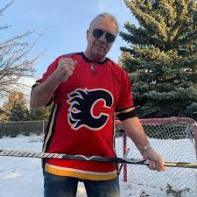
Celebrity Fan: The famous Hart wrestling family is synonymous with Calgary. Therefore, it’s no surprise Bret ‘The Hitman’ Hart is a fan of the Flames. Hart was even a co-founding owner of the Western Hockey League Calgary Hitmen, along with Flames star Theoren Fleury. The Hitmen are now owned and operated by the Flames ownership group. Other notable Flames fans include Letterkenny creator Jared Keeso, country musician George Canyon and golfer Graham Delaet.

Bret Hart

Super Fan: A couple Flames fans have been profiled for the man caves they have created, dedicated to the team. Dean McCord and Chris Payne have each created settings to watch games that are the next best thing to being in attendance at the Saddledome, with large TVs, memorabilia and lighting/sound effects. Both of their homes have become popular places for their friends to enjoy Calgary games.

Mascot: Harvey the Hound was the NHL’s first mascot, debuting in 1983 as the Flames first “pound” draft selection. A memorable moment for Harvey occurred in 2003, when he was taunting Edmonton Oilers coach Craig MacTavish, who proceeded to pulls Harvey’s tongue out and throw it into the stands. Harvey has also served as the secondary mascot of the Canadian Football League’s Calgary Stampeders.

Tradition: Since the 1986 playoffs, when the Flames battled and defeated the Edmonton Oilers, fans have filled the Saddledome, all donning Flames jerseys, t-shirts and other paraphernalia, creating the C of Red. Flames playoff victories feature fans flocking to the Red Mile, a stretch of 17th Avenue SW, in Calgary. Prior to the Red Mile, fans celebrated on 11th Avenue SW, known as Electric Avenue.

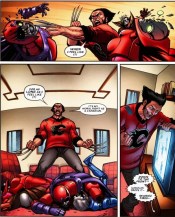
Appearances in Media: Iconic X-Men character, Wolverine, is a Calgary Flames fan. This makes sense, as Wolverine’s fictional backstory has him being from Alberta. His devotion to the Flames goes so far, that in Wolverine: First Class #6, his game watching is interrupted by some robots, causing him to go nuts on the machines, all while clad in a Flames jersey. MacGyver was also a big Flames fan, often wearing various merchandise on the hit 80’s TV show.

Wolverine

Events/Scandals: The Flames organization’s attempts to build a new arena, replacing the 39-year-old Saddledome (one of the oldest rinks in the league) can best be described as a rollercoaster ride. Deals have been made and later reneged on, while team management and Calgary city council continue to clash. The latest is that the two sides have resumed talks over a new home for the Flames, but no one can predict how it all finally plays out.

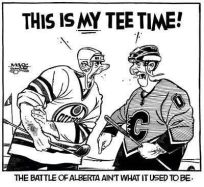
Rivalry: The Battle of Alberta, against provincial nemesis the Edmonton Oilers, is one of hockey’s greatest rivalries. Between 1983 and 1990, the Flames and Oilers dominated the NHL, with one of the teams appearing in the Stanley Cup Finals each year, totalling six Stanley Cup wins. Other top opponents of the Flames include the Vancouver Canucks, with the two teams having met in many playoff clashes.

Tragedy: Two Flames prospects have sadly passed away following being drafted by the team. First, George Pelawa was selected 16th overall in 1986, but was killed in a car accident that summer. More than two decades later, Mickey Renaud was drafted 143rd overall in 2007, but died suddenly, due to hypertrophic cardiomyopathy (thickening of the heart), on February 18, 2008.

Player Nicknames: Nicknames in sports are common, but it’s rare when a player goes out and trademarks their moniker. Johnny Gaudreau spent the first eight seasons of his career with the Flames and became known as Johnny Hockey during that time. Gaudreau took inspiration from Johnny Manziel, who trademarked the nickname Johnny Football in 2014, when he was a big time college football quarterback, before quickly fizzling out as a professional.

Battle of Alberta

Line: Two of the highest scoring lines in Flames history never received the nickname treatment. This includes the units of Gary Roberts, Robert Reichel and Theo Fleury and Johnny Gaudrea, Matthew Tkachuk and Elias Lindholm. One trio that did gain a humourous moniker was the Full Pension Line of Milan Lucic, Trevor Lewis and Brad Richardson, based on each player surpassing the minimum games needed to earn a full NHL pension.

Captain: Jarome Iginla was named captain of the Flames for the 2003-04 season, with Craig Conroy relinquishing the ‘C’ to his teammate. Iginla would serve in the role until he was traded to the Pittsburgh Penguins at the 2013 trade deadline. He had spent 16 seasons in Calgary, setting a number of club records along the way. Iginla’s number 12 was retired by the Flames in 2019.

Enforcer: Tim Hunter holds the Flames records for total penalty minutes (2,405), penalty minutes in a season (375) and penalty minutes in a playoff run (108). Hunter played 545 games for Calgary – his hometown team – being a member of the 1989 Stanley Cup-winning squad. Hunter left the Flames as the final pick of the 1992 Expansion Draft by the Tampa Bay Lightning, although he was quickly traded to the Quebec Nordiques.

Family Values: Two pairs of brothers have played for the Flames at the same time. First, Robyn and Richie Regehr patrolled the Calgary blueline together for 20 games over two seasons. Later, Dougie and Freddie Hamilton spent parts of three seasons playing together with the Flames. It should also be noted, a number of the Sutter brothers have had roles with the team, including Brian, Darryl and Brent each coaching the club.

Jarome Iginla

Returning Players: Theo Fleury is one of the most beloved players to ever suit up for the Flames. His 1999 trade away from Calgary, following 11 seasons with the club, was emotional for all parties. In 2009, after six years away from the NHL, Fleury attempted to make a comeback and there was only one place he wanted it to happen. After recording four points in four pre-season games, Fleury was released from his tryout, but was able to retire as a member of the Flames.

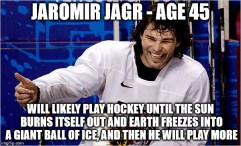
Short Stint: Jaromir Jagr is a legend in the game of hockey, but his time with the Flames is best described as anything but legendary. Jagr signed with Calgary as the 2017-18 season was about to begin. Three months later, the Flames were in talks to terminate Jagr’s contract, following one goal and six assists in 22 games. Jagr returned to HC Kladno, the club he owns, where he still plays to this day.

Undrafted: When Martin St. Louis retired, he was fifth all-time in points by an undrafted player, but his success came after leaving Calgary. As for players who are best recognized as a member of the Flames, defenseman Mark Giordano was signed after attending Calgary’s 2004 summer camp. In 2019, at the age of 35 and serving as the Flames captain, Giordano would win the Norris Trophy, as the NHL’s best defenseman.

Trade: One of the best deals the Flames ever made, as well as one of their worst transactions, both involved Doug Gilmour. Gilmour was acquired by Calgary in 1988, the centerpiece of a seven-player deal with the St. Louis Blues. The Flames would go on to win the Stanley Cup that season. Then, in 1992, a disgruntled Gilmour was dealt to the Toronto Maple Leafs, this time the focal point of a 10-player swap.

Jaromir Jagr

Signing: Two of the Flames worst contracts ever went to forwards Troy Brouwer (four-year, $18 million in 2016) and James Neal (five-year, $28.75 million in 2018). Brouwer was bought out of his deal after two increasingly disappointing seasons, while Neal was traded after one campaign, with the Flames taking back Milan Lucic’s equally bad deal (seven-year, $42 million in 2016) with the Edmonton Oilers, in return.

Draft Pick: The highest the Flames have ever drafted, was fourth overall in 2014. They selected Sam Bennett, who is considered a bust with the team, although he has since gone on to some success with the Florida Panthers. As for good picks, Calgary’s 1984 draft was particularly fruitful, as they added Gary Roberts (12th overall), Paul Ranheim (38th), Brett Hull (117th) and Gary Suter (180th). They joined 1981 draftess Al MacInnis (15th) and Mike Vernon (56th).

Holdouts: Joe Nieuwendyk was the captain of the Flames in 1995, when he endured a contract dispute with the organization. Nieuwendyk sat out until he was traded to the Dallas Stars on December 19, 1995, in exchange for Jarome Iginla and Corey Millen. The deal worked out for both teams, as Nieuwendyk would eventually win a Stanley Cup with Dallas in 1999, while Jarome Iginla became the face of the franchise for more than a decade.

Buyouts: Michael Stone’s 2019 buyout was notable not for how long or how expensive the compensation would take to pay out, but because over a month later, the Flames signed him to another deal. Originally, he was the odd man out on full defense corps, resulting in the final season of his three-year contract being bought out. When an off-season injury to fellow d-man Juuso Valimaki occurred, Calgary circled back to a known commodity and inked Stone to a league minimum deal.

Michael Stone

Unique Game: The Flames have played in two Heritage Classic contests. First, in 2011, they defeated the Montreal Canadiens at McMahon Stadium, in Calgary. Then, in 2019, they lost to the Winnipeg Jets at Mosaic Stadium, in Regina, Saskatchewan. The Flames also opened the 1998-99 season with a pair of games against the San Jose Sharks in Tokyo, Japan, as well as playing two 2018 exhibition matches against the Boston Bruins, in Shenzhen and Beijing, China.

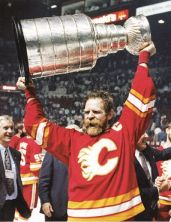
Goal: Flames captain Lanny McDonald had sat out much of the 1989 Stanley Cup Finals, but was reinserted into the lineup for Game 6. With the game tied, McDonald scored to give Calgary the lead, en route to the franchise’s only Stanley Cup. The marker would prove to be McDonald’s final NHL goal, as he would retire after the championship victory. McDonald lifting the cup and parading it around the ice is among the greatest images in Flames history.

Fight/Brawl: Stu Grimson was only a rookie when he defeated one of the NHL’s toughest fighters in Dave Brown of the Edmonton Oilers. The rematch didn’t go as well, with Grimson suffering skull fractures from the one-sided beating. Emergency surgery for Grimson was required, but the enforcer went on to a long career, earning a reputation as a feared pugilist and one of the best nicknames the sports world has ever heard, the Grim Reaper.

Injury: In November 1991, Gary Roberts was hit from behind by Toronto Maple Leafs defenseman Bob Rouse, needing a stretcher to be removed from the ice. This was the start of neck issues for Roberts, who would eventually have to play wearing a brace. After missing much of the 1994-95 and 1995-96 seasons, Roberts decided to retire, at the age of 30. Thankfully, after some training and lifestyle changes, Roberts was able to return to hockey in 1997, playing 12 more seasons.

Lanny McDonald

Penalty: On January 27, 2016, Flames defenseman Dennis Wideman was hit hard into the end boards. On his way back to the bench, Wideman seemed to take his frustrations out on linesman Don Henderson, knocking the official to the ice with a crosscheck. Wideman was suspended for 20 games, later reduced to 10 games by an arbiter. Henderson, who suffered a concussion and never officiated another NHL game, sued Wideman and the Flames for $10.25 million, but the case was stayed by the court.

Wildest Story: Social media can actually be an effective tool, as seen when former NHL player Akim Aliu took to Twitter in 2019, accusing Flames coach Bill Peters of directing racial comments towards him when they were both with the minor league Rockford IceHogs. Days later, Peters resigned from the team, while an investigation was being done by Flames team management. Since then, Peters has only coached briefly in the Kontinental Hockey League.

Blooper: The Flames nearly committed a massive off-ice blunder in February 2013, when they signed Colorado Avalanche holdout Ryan O’Reilly to a two-year, $10 million offer sheet. Had the Avalanche chose to not match the contract, Calgary would have had to compensate Colorado with draft picks AND could have still lost the player through waivers, since O’Reilly had played games in the Kontinental Hockey League, prior to signing a NHL contract.

Miscellaneous: No article about the Flames could be complete without mentioning Bearcat Murray – the most recognizable trainer in NHL history. Murray joined the Flames with their 1980 arrival in Calgary and stayed with the team on the bench until retiring in 1996, when he moved into the role of a community ambassador. Fan clubs for the recognizable trainer popped up in both Boston and Montreal and Murray was even inducted into the Hockey Hall of Fame in 2009. He passed away in June 2022.

Calgary Flames: Calgary Flames Martini

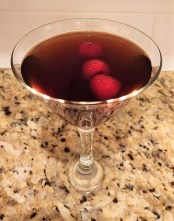
Calgary Flames Martini

  • 2 oz Dry Vermouth
  • 1 oz Gin
  • 1 oz Vodka
  • 1 oz Chambord
  • 1 oz Peach Liqueur
  • Garnish with Raspberries

Four ounces of Dry Vermouth, as the recipe called for, seemed excessive, so I scaled it back to two ounces. Apparently, this beverage can be found in bars along Calgary’s Red Mile and is popular with many patrons.