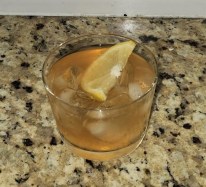
Toronto Maple Leafs – Toronto Maple Leafs

Throughout the year, the Sip Advisor will alphabetically travel the National Hockey League (NHL), discovering the best and worst each team has to offer in a variety of subjects. We will also feature a drink based off the franchise. Today, we *looks at calendar*… ugh, travel to Toronto to investigate why the Maple Leafs have often been named the “Most Hated Team in Hockey”:

Establishment Story: The Toronto hockey team was founded in 1917. The club was known as the Arenas and later St. Patricks, before finally receiving the Maple Leafs moniker in 1927, when the team was bought by Conn Smythe. An Original Six franchise, the Leafs were rebranded by Smythe to match the national symbol of Canada. They were also to wear red and white jerseys, but briefly wore white and green, before settling on their iconic blue and white.

Stanley Cups: None since 1967 and that’s all that really matters. Seriously, though, the Leafs have won 13 championships, all of which occurred when the league consisted of only six teams. The Leafs have two recognized dynasties, from 1946-51 and 1961-67. Not only has the team not won a Stanley Cup since 1967, they have no Finals appearances since then, as well, with five Conference Finals losses during that time.

Celebrity Fan: Somehow, the Leafs have quite the collection of celebrity supporters. Actors Mike Myers, Jim Carrey, Will Arnett and Keanu Reeves support the team, along with musicians Justin Bieber and Drake. Professional wrestler Edge is a fan, as is astronaut Chris Hadfield. As for female celebs, tennis star Bianca Andreescu can often be seen rocking the blue and white. Personally, I think they’re all nuts!

Leafs Blue

Super Fan: Steven Glynn, better known by the moniker Steve Dangle, turned his Leafs fandom into a career. Dangle went from posting YouTube videos to becoming an analyst for Sportsnet. His book This Team Is Ruining My Life (But I Love Them): How I Became A Professional Hockey Fan, was released in 2019 to critical acclaim. Today, Dangle co-hosts a podcast and the blooper web series Steve’s Dang-Its.

Mascot: Carlton the Bear is a polar bear, named for the street Maple Leaf Gardens was located. Carlton wears jersey number 60, in homage to the address of the iconic arena. Carlton debuted for the 1995-96 season. At the 2000 NHL All-Star Game in Toronto, Carlton hosted the inaugural Mascot Summit. Carlton is on track to surpass long-time Leafs player George Armstrong for most appearances with the franchise during the 2023-24 season.

Tradition: The Leafs greatest ritual is losing, particularly in the first round of the playoffs, if they even get there. Just kidding! When the team has made the post-season in more recent years, fans have gathered in Maple Leaf Square, located outside Scotiabank Arena. This has provided the Sip Advisor with many moments of schadenfreude, as Toronto supporters have been visibly crushed by losses. I must admit, their tears sustain me!

Appearances in Media: The Leafs most prominent appearance in popular culture is in the Mike Myers’ movie The Love Guru, where Myers plays a guru tasked with fixing the team’s players, particularly star Darren Roanoke. The Leafs were also heavily featured in the 1971 Canadian film Face-Off. Another notable appearance in media is Toronto’s inclusion in the children’s book The Hockey Sweater.
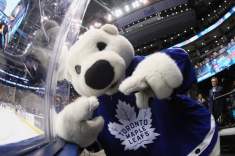
Carlton the Bear

Events/Scandals: The Harold Ballard years as owner of the Leafs were filled with controversies, with perhaps the most notable blemish on the franchise being the Maple Leaf Gardens child sex abuse scandal. Ballard owned the arena during the time a trio of employees abused at least two dozen children. Ballard was also convicted of 47 counts of fraud, theft and tax evasion, during his ownership tenure, serving one-third of a nine-year prison sentence.

Rivalry: Everyone hates the Leafs, right? Okay, they do have a substantial fan base, much of whom probably don’t like me very much, but I’m not wrong that many revile Toronto. Enemy teams include the Ottawa Senators (Battle of Ontario), Montreal Canadiens (only two Canadian clubs, divided by language and other cultural differences, until 1967), Boston Bruins, Detroit Red Wings, and Buffalo Sabres (Battle of the QEW).

Tragedy: Bill Barilko spent his entire NHL career with the Leafs. He was the overtime hero of the 1951 Stanley Cup Finals, but disappeared that off-season while on a fishing trip. In 1962, the wreckage of the plane Barilko had been travelling in was discovered. Barilko is the subject of The Tragically Hip song Fifty Mission Cap, which has become an anthem of sorts for Leafs fans. Also, Leafs prospect Rodion Amirov succumbed to a brain tumour in August 2023.

Player Nicknames: As much as I hate the Leafs, their fans have come up with some creative monikers for players. Tops among them, would be Optimus Reim for goaltender James Reimer. The name was based on Optimus Prime from the Transformers franchise. Other popular culture nicknames for players include The Cat (Felix Potvin), from the character Felix the Cat, Captain Crunch (Wendel Clark), based off the children’s cereal, and Uncle Leo (Leo Komarov), borrowed from Seinfeld.
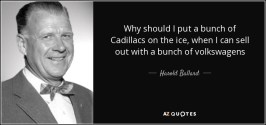
Harold Ballard

Line: Many trios in hockey history have been dubbed ‘The Kid Line’, but the original played for the Leafs during the 1930s. Joe Primeau was 23 years old, while his linemates, Charlie Conacher and Harvey Jackson were only 18 when they were put together in late 1929. The unit only won one Stanley Cup together, despite five Finals appearances. The line has remained popular over the years, with a children’s book published in 2001.

Captain: George Armstrong was captain of the Leafs for a club record 12 seasons. He played his entire 21-campaign career with the team, winning four Stanley Cups. Armstrong’s jersey number 10 was retired by the Leafs in 2016. Another notable captain for Toronto was Mats Sundin, who in 1997, became the first non-Canadian to wear the ‘C’ in franchise history. Sundin served in the role for 11 seasons, becoming the longest serving non-North American born captain in NHL history.

Enforcer: Tie Domi is the Leafs single-season and all-time penalty minute king, with 365 and 2,265 minutes in the sin bin. Domi also has the most fighting majors in NHL history with 333, a majority of those recorded during his time with Toronto. Domi was originally drafted by the Leafs in 1988, but didn’t play for them until 1995, after stops with the New York Rangers and Winnipeg Jets.

Family Values: Perhaps the most notable family members to play together with the Leafs were brothers-in-law Shayne Corson and Darcy Tucker, from 2000 to 2003. Tucker is married to Corson’s sister, with the two also previously playing for the Montreal Canadiens together. Father and son combos to play for the Leafs, include Mike and Nick Foligno, Bryan and Mason Marchment and Tie and Max Domi.

Tie Domi

Returning Players: Wendel Clark spent three stints with the Leafs. He was drafted first overall by the team in 1985, playing nine seasons (three as captain) in his first tenure. Clark then spent two campaigns with other teams, before returning to Toronto for another go around. Clark retired after the 1999-2000 season, following a final 20 games with the Leafs. Fellow franchise icon Doug Gilmour also ended his career with the Leafs in 2003, injured in his first game back after a trade deadline deal.

Short Stint: For a time, each season seemed to feature the Leafs bringing in an aged star – or two – hoping they would add something to their upcoming playoff chances. This included Tom Barrasso (four games in 2002), Phil Housley (four games in 2003), Glen Wesley (12 games in 2003), Brian Leetch (28 games in 2004), and Ron Francis (24 games in 2004). Another brief tenure with the club, belongs to Joe Thornton, who suited up with Toronto for 51 games in 2020-21.

Undrafted: Borje Salming was brought to the NHL from Sweden as a free agent in 1973. By the end of his long tenure with the Leafs, he changed the perception of European players being seen as soft. This was perhaps best exemplified when Salming had his face accidentally stepped on by a skate in 1986, requiring over 200 stitches and cosmetic surgery to repair. Salming holds a number of Leafs records for a defenseman.

Trade: One of the largest transactions in NHL history was the 1992 10-player deal between the Leafs and Calgary Flames that brought cult hero Doug Gilmour to Toronto. During his first full season with the Leafs, Gilmour recorded 127 points and earned the Frank J. Selke Trophy as the best defensive forward in the league. Gilmour’s tenure would also see the team make back-to-back appearances in the Conference Finals.
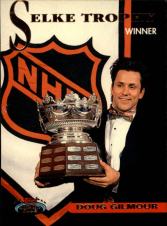
Doug Gilmour

Signing: The Leafs struggled mightily from the late 2000s to the mid 2010s, exacerbated by a number of misguided free agent deals. This included contracts for Jeff Finger (four-year, $14 million in 2008), Mike Komisarek (five-year, $21.5 million in 2009) and David Clarkson (seven-year, $36.75 in 2013). Finger played half his contract with Toronto’s minor league affiliate, Komisarek had his contract bought out in the final season and Clarkson was traded after two campaigns.

Draft Pick: The Leafs have picked first overall twice in their history, taking Wendel Clark in 1985 and Auston Matthews in 2016. Some of their other top picks include Darryl Sittler (8th overall in 1970), Lanny McDonald (4th overall in 1973), Morgan Rielly (5th overall in 2012), and Mitch Marner (4th overall in 2015). Perhaps their greatest diamond in the rough selection was taking Tomas Kaberle 204th overall in 1996. He would go on to play 12 seasons in Toronto.

Holdouts: During the 1981-82 season, Darryl Sittler requested a trade due to the deterioration of his relationship with Leafs management and ownership. When no deal was reached after months of waiting, Sittler left the team, at the advice of his doctor, on the basis he was “mentally depressed”. Sittler was eventually dealt to the Philadelphia Flyers, ending his 12-season tumultuous stint with the franchise.

Buyouts: Mikhail Grabovski had completed the first season of his five-year, $27.5 million contract, when the Leafs surprisingly used one of their compliance buyouts from the 2012-13 lockout on him. This meant Grabovski was due $14.33 million over the next eight seasons. Two days earlier, the Leafs used their other compliance buyout on defenseman Mike Komisarek, owing him $2.33 million over two years.

Darryl Sittler

Unique Game: Given the Leafs profile, the team has been used for many marquee NHL events. This included the 2014 Winter Classic and 2017 NHL Centennial Classic, both against the Detroit Red Wings, a 2018 Stadium Series contest versus the Washington Capitals, and the 2022 Heritage Classic opposite the Buffalo Sabres. Toronto also played two 1993 pre-season games against the New York Rangers in London, United Kingdom.

Goal: Each game of the 1951 Stanley Cup Finals went to overtime, with the Leafs pulling off a 4-1 series victory over the Montreal Canadiens. Bill Barilko scored the Stanley Cup-clinching goal at 2:53 of Game 5’s extra period. Another famous tally in Leafs lore is the one Bobby Baun scored in overtime of Game 6 of the 1964 Stanley Cup Finals, while playing with a broken ankle. The Leafs would win Game 7 4-0, earning their third consecutive championship.

Fight/Brawl: Things got out of hand during a 2013 pre-season game versus the Buffalo Sabres, leading to a brawl. When Buffalo enforcer John Scott went after Toronto star Phil Kessel, newly-signed Leaf David Clarkson left the bench to protect Kessel. This resulted in an automatic 10-game suspension for Clarkson, who never got going in Toronto, and was traded to the Columbus Blue Jackets after 118 games and only 15 goals and 26 points, despite an annual salary of $5.25 million.

Injury: When Leafs forward Ace Bailey suffered a severe head injury, following a hard check by Eddie Shore of the Boston Bruins, two major developments came from the incident. First, the inaugural NHL all-star game was played months later to raise money for Bailey and his family. Second, at that all-star benefit game, Bailey’s number 6 jersey was retired, becoming the first player in professional sports history to receive such an honour.
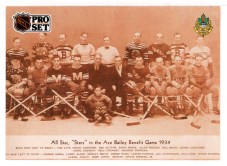
Ace Bailey

Penalty: Leafs enforcers have a history of getting into trouble. Tiger Williams was charged with assault (later acquitted) for a 1977 stick hit on Dennis Owchar, which required 46 stitches to seal. A decade later, John Kordic high sticked Keith Acton, resulting in a 10-game suspension. Tie Domi had two infractions earn him lengthy bans, one for sucker punching Ulf Samuelsson in 1995 (eight games) and another for elbowing Scott Niedermayer in the 2001 playoffs (rest of series and eight games the following season).

Wildest Story: When Brian Spencer was to make his debut with the Leafs on December 12, 1970, he informed his father, Roy, of the good news. Later, Roy tried to watch the game on TV, but was greeted with a Vancouver Canucks-California Golden Seals contest instead. Upset, Roy drove 135 km to the closest TV station, where he threatened employees at gunpoint to air the Leafs game. A standoff with police and shootout ensued, resulting in Roy’s death. Brian would later also die by gunshot during a drug robbery.

Blooper: In one of the most viewed NHL videos of all-time, enforcer Tie Domi was banished to the penalty box during a game in Philadelphia. A Flyers fan was heckling Domi, so the enforcer squirted his water bottle into the crowd. Another angered fan ended up falling into the penalty box when the pane of glass separating players from the audience gave way. Domi punched the fan multiple times before being pulled away. Domi was fined $1,000 for the incident.

Miscellaneous: In an event that would make international headlines, the Leafs lost a 2020 game with Emergency Back-up Goalie David Ayres in net for the opposing Carolina Hurricanes. Worst of all, Ayres was employed by the Leafs, as a building operator/Zamboni driver. Ayres became a legend following the 6-3 victory, receiving his own day in Raleigh, North Carolina, and the story is set to become a Disney feature film.

Toronto Maple Leafs: Toronto Maple Leafs

Toronto Maple Leafs

  • 0.75 oz Blue Curacao
  • 0.75 oz Irish Cream

I still find it hard to believe, as a youngster, I was a fan of the Leafs. Today, everything about Toronto and their sports landscape irks me. This is because the sports networks are all based there and we who live elsewhere in the country are treated to an unwanted deluge of coverage on Toronto teams.
Ottawa Senators – The Statesman

Throughout the year, the Sip Advisor will alphabetically travel the National Hockey League (NHL), discovering the best and worst each team has to offer in a variety of subjects. We will also feature a drink based off the franchise. Today, we’re off to Canada’s capital city for some parliamentary meetings with the Ottawa Senators:

Establishment Story: The Senators – not to be confused with the original Ottawa Senators (1883-1934) – entered the NHL as an expansion team for the 1992-93 season. The successful expansion bid began with a ‘Bring Back the Senators’ campaign, launched by real estate developer Bruce Firestone. After 11,000 season ticket pledges were secured, Firestone was granted the new franchise in 1990.

Stanley Cups: The original Senators claimed the Stanley Cup 11 times, with only one championship coming under NHL operation, when they won the first NHL Stanley Cup Finals over the Boston Bruins in 1927. Version 2.0 of the Senators has never won the big prize, coming closest in 2007, where they were defeated by the Anaheim Ducks in the Finals in five games.

Celebrity Fan: While fans’ hopes for movie star Ryan Reynolds to become part of the franchise’s new ownership group didn’t pan out, it should be noted Friends star Matthew Perry has been a supporter of the Senators for the team’s entire existence. Perry was raised in Ottawa and attends occasional games. Another long-time fan is comedian Tom Green, who wore a Senators hat in the video for Check the O.R., by his rap group Organized Rhyme.

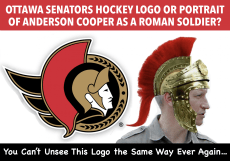
Senators Logo

Super Fan: Jonathan Pitre was born with a rare skin disease, which results in painful blisters. Pitre worked hard to spread awareness of his condition, including being named an honourary scout of the Senators on November 21, 2014. He later attended the NHL Awards as an invitee of the team. Sadly, Pitre passed away on April 4, 2018. The hardest working player at Senators developmental camp is presented the Jonathan Pitre Award.

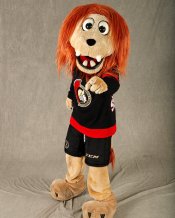
Mascot: Spartacat is a lion, whose ‘paw-sition’ with the Senators is Ambassador of Fun. Spartacat debuted with the rest of the team on October 8, 1992, with his ‘mane’ goal being to make people laugh. One of his preferred hobbies is “raking Leafs”. Spartacat is heavily involved in community programs, such as Read to Succeed and regularly visits the Sens Zone at the Children’s Hospital of Eastern Ontario.

Tradition: During playoff runs, fans of the team (the diehards are known as the Sens Army, with some even dressing in Roman legion gear) tend to congregate along Sens Mile, otherwise known as Elgin Street. These gatherings are called Red Rallies. The Senators also have their own theme song, created by Carmelo Scaffidi, who would often play the trumpet tune from the stands of the arena. When Scaffidi passed away in 2016, the Senators paid tribute to his association with the club.

Appearances in Media: The Game Changers documentary series ran from 2015 to 2019 and profiled the not-for-profit community programs being operated by the Senators organization and the people behind them. With the tagline “Passion has no off-season”, initiatives highlighted by the show included mental health awareness, pediatric palliative care, school programs and summer camps and work being done by the wives and girlfriends of Senators players.

Spartacat

Events/Scandals: For years, the Senators have pursued a new arena closer to downtown Ottawa, as they currently play in the suburb of Kanata. The most likely site for this project is the LeBreton Flats land, which is currently owned by the National Capital Commission. Former Senators owner Eugene Melnyk had a development deal in place for the area in 2016, but issues between Melnyk and his own partners resulted in the deal falling through and multiple lawsuits being filed.

Rivalry: Ottawa has long-time feuds with geographical rivals the Toronto Maple Leafs, known as the Battle of Ontario, and the Montreal Canadiens. All three teams have shared the same division since the 1998-99 season. In the early 2000s, the Senators and Maple Leafs met in the playoffs four out of five years, including three straight from 2000 to 2002. Toronto won all four heated encounters.

Tragedy: Bryan Murray was a hockey lifer, his coaching career beginning in 1976 and taking him through multiple leagues before he finally reached the NHL in 1981. From there, Murray spent time with a number of teams, in various roles. Murray joined the Senators in 2004 and remained with the club until his death on August 12, 2017 from colon cancer, which he had battled for a few years. In December 2016, Murray was the first member inducted into Ottawa’s Ring of Honour.

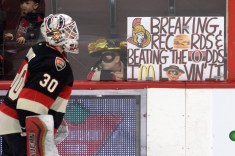
Player Nicknames: When Andrew Hammond joined the Senators from their minor-league team late in the 2014-15 season, it was unlikely the team would make the playoffs. Hammond, nicknamed Hamburglar, put together a record of 20 wins, one loss and two overtime/shootout losses, to propel the Ottawa into the post-season. Given his nickname, fans began throwing McDonald’s hamburgers on the ice following wins.

Hammond

Line: The unit of Daniel Alfredsson, Jason Spezza and Dany Heatley was so successful they earned at least three nicknames, including Capital Punishment Line (Ottawa being the capital of Canada), CASH Line (Captain Alfredsson/Spezza/Heatley) and Pizza Line (due to a promotion from the Pizza Pizza chain, which saw fans be able to convert a home game ticket into a free slice of pizza, if the Senators scored at least five goals).

Captain: Daniel Alfredsson served as the Senators captain for 13 seasons and holds numerous team records, including goals (426), assists (682), points (1,108), power play goals (131), short-handed goals (25), game-winning goals (69), hat tricks (8), and more. His number was retired by the team in 2016, becoming the first modern day Senator to receive that honour.

Enforcer: Chris Neil played his entire NHL career with the Senators, amassing a team record 2,522 penalty minutes over 1,026 games. He added a further 204 penalty minutes in 95 playoff contests. Along with his physicality, Neil also provided offense, scoring 112 goals and 250 points. Neil’s tenure with Ottawa ended unceremoniously in 2017, as the sides agreed to part ways, with Neil later announcing his retirement.

Family Values: Brothers Gord and Kevin Dineen both played for the Senators, albeit not at the same time. Gord was a member of the team during its expansion years, playing two campaigns with the club from 1992 to 1994 and being named captain for the last 17 games of his Ottawa tenure. Kevin played a single season with the Senators in 1999-2000, before being left unprotected for the 2000 NHL Expansion Draft.

Alfredsson

Returning Players: Chris Kelly was drafted by the Senators 94th overall in 1999. He spent the first 10 seasons of his career with the organization and was part of their 2007 Stanley Cup Finals run. Kelly was traded to the Boston Bruins in February 2011, going on to win the Stanley Cup that year. The checking forward returned to Ottawa for the 2016-17 campaign, appearing in all 82 games, despite breaking his leg the previous season. In 2018, Kelly retired and joined the Senators coaching staff.

Short Stint: Legendary goalie Dominik Hasek signed with Ottawa for the 2005-06 season, stating he hoped to play with a Stanley Cup contender. He played well in his 43 games, but was injured at the 2006 Winter Olympics and lost for the rest of the regular season and playoffs. Given his age (41 years old) and injury history, Ottawa chose not to re-sign Hasek, who returned to the Detroit Red Wings and won a second Stanley Cup before retiring from the NHL.

Undrafted: Defenseman Artem Zub was signed by the Senators on May 1, 2020, based on his play in the Kontinental Hockey League and as part of the gold medal-winning Olympic Athletes from Russia at the 2018 Winter Olympics. Zub has signed two more contracts with Ottawa, his latest taking him through the 2026-27 season. The stay-at-home defenseman doesn’t pile up the points, but has solidified the team’s defensive efforts.

Trade: A great move by the Senators was trading constant headache Alexei Yashin to the New York Islanders, in exchange for defenseman Zdeno Chara, forward Bill Muckalt and the 2001 second overall draft pick, used to select future top center and star Jason Spezza. Another good transaction was trading for Dany Heatley, sending Marian Hossa and Greg de Vries to the Atlanta Thrashers, before Heatley also became a problem for the team.

Yashin

Signing: Among the best signings in club history was bringing in Claude Giroux (three years, $19.5 million) in 2022 to provide veteran leadership for the up and coming Senators. Giroux would record the 300th goal and 1,000th point of his career in his first season with Ottawa, notching a career-high 35 goals. If Giroux can keep up his production, while the team’s young stars develop, the future is looking bright for the Senators.

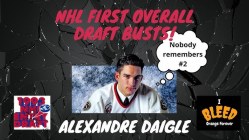
Draft Pick: In a four-year span, the Senators held the first overall pick three times, selecting Alexandre Daigle (1993), Bryan Berard (1995) and Chris Phillips (1996). The results were mixed, with Daigle being viewed as one of the biggest draft busts ever and Berard being traded within his draft year, never suiting up for the team, while Phillips became a lifetime Senator. A great draft steal was selecting Daniel Alfredsson 133rd overall in 1994, while the 2020 draft netted Tim Stuetzle (3rd overall) and Jake Sanderson (5th overall).

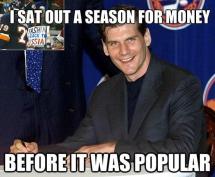
Holdouts: Drafted second overall in 1992, Alexei Yashin was a constant thorn in the side of Senators management, repeatedly trying to renegotiate his contract with the team. Yashin refused to play the final season of his deal and missed the entire 1999-2000 campaign. The two sides went to arbitration afterwards, with the ruling being that Yashin’s rights still belonged to Ottawa and he would have to play the final year of his pact. He was eventually traded to the New York Islanders in 2001.

Buyouts: The largest financial buyout in Senators history went to winger Bobby Ryan, with the final two seasons of his seven-year, $50.75 million deal signed in 2014 wiped out, with $7.33 million paid out over four seasons. Fellow forward Colin White also had an abrupt ending to his tenure in Ottawa, having the final three seasons of his six-year, $28.5 million pact bought out in 2022, resulting in $5.25 million owed to him over six seasons.

Daigle

Unique Game: The Senators have taken part in the 2014 Heritage Classic versus the Vancouver Canucks, as well as the NHL 100 Classic versus the Montreal Canadiens. They have twice travelled to Sweden for games, first for the 2008 NHL Premiere, taking on the Pittsburgh Penguins in a pair of contests and next for the 2017 Global Series, where they played another pair of matches against the Colorado Avalanche.

Goal: With a spot in the 2007 Stanley Cup Finals just a win away, Daniel Alfredsson scored the overtime winner in Game 5 of the 2007 Eastern Conference Final, giving the Senators their first championship round appearance in franchise history. Speaking of firsts, it took a Steve Duchesne goal in the final game of the 1996-97 season to clinch Ottawa’s first playoff berth since their 1992 debut.

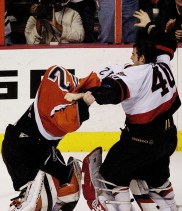
Fight/Brawl: On March 5, 2004, the Senators and Philadelphia Flyers combined to set a new NHL record for penalty minutes in a game with 419, most of which occurred in the final two minutes of the contest. The mischief started when respective enforcers Rob Ray and Donald Brashear fought, causing a line brawl including goalies. More fights occurred after each restart. The final score, a 5-3 Philadelphia win, is largely forgotten.

Injury: Two injuries at the hands of Philadelphia Flyers players stand out in the history of the Senators. First, in October 1998, forward Andreas Dackell was driven head-first into the glass by hulking star Eric Lindros. 36 stitches to the face and a concussion was the result for Dackell. Next, in January 2000, winger Magnus Arvedson was hit into an open bench door by checker Marc Bureau, requiring emergency intestinal surgery. Arvedson still suffers from stomach issues to this day.

Brawl

Penalty: More about the Senators-Flyers brawl, following the fight-filled affair, which resulted in only three Flyers and two Senators being left on the bench, it took officials 90 minutes to sort out all the penalties. For the following season, the NHL added a rule that gave one-game suspensions to anyone instigating a fight in the final five minutes of a game, while coaches could be fined $10,000.

Wildest Story: 2018-19 was a difficult year for the Senators, due to off-ice issues. Prior to the season’s start, defenseman Erik Karlsson and his wife Melinda filed a protection order against Monika Caryk, the fiancée of teammate Mike Hoffman, over harassing online messages. Both Karlsson and Hoffman would be traded before the start of the campaign. Months later, a number of Senators players were caught on viral video by their Uber driver criticizing assistant coach Martin Raymond. The players later apologized.

Blooper: During a December 2022 game, defenseman Thomas Chabot was taking his frustrations out on his stick while on the Senators bench when he accidentally hit teammate Travis Hamonic in the head. Luckily for Chabot and the team, Hamonic wasn’t seriously injured and remained in the game. The Senators would eventually go on to win 3-2 over the Nashville Predators.

Miscellaneous: Modern day Senators who have had their numbers retired are joined by Frank Finnigan in the rafters of the Canadian Tire Centre. Finnigan played for the original Senators from 1923 to 1931 and 1932 to 1934, and was the last surviving member of the 1927 Stanley Cup champions team. He participated in the ‘Bring Back the Senators’ campaign, but passed away before the team’s 1992 return. Finnigan was to have dropped the ceremonial face-off for the team’s first ever game.

Ottawa Senators: The Statesman

The Statesman

  • 2 oz Rye Whiskey
  • Splash of Lemon Juice
  • Splash of Maple Syrup
  • Dashes of Angostura Bitters
  • Float of Peated Scotch
  • Garnish with a Lemon Twist

Another team I struggled to find a cocktail for, which is more surprising given it’s a Canadian franchise and we’re all looking to combine our two favourite loves of hockey and drinking together. Do better, Canada!